


ASTM E1311: Thermal Imaging MDTD Testing Services
ASTM E1311 aims to determine the minimum detectable temperature difference capability of a compound that observes a thermal imaging system as a function of the angle subtended by the target.
TRUSTED BY


Get ASTM E1311 compliant results — request your thermal imaging MDTD testing quote
- Overview
- Scope, Applications, and Benefits
- Test Process
- Specifications
- Instrumentation
- Results and Deliverables
What Is ASTM E1311 Thermal Imaging MDTD?
ASTM E1311 establishes a standardized method to determine the minimum detectable temperature difference (MDTD) of thermal imaging systems. It evaluates the smallest temperature variation that a thermal camera can reliably distinguish under specified conditions, reflecting system sensitivity and performance.
The test uses controlled thermal targets with known temperature differences to assess the imaging system’s ability to resolve contrast. It is widely applied in infrared thermography to quantify detection capability, ensuring consistent performance evaluation across different thermal imaging devices and operating environments.

Applications and Benefits of ASTM E1311 Thermal Imaging MDTD Testing
Scope
ASTM E1311 defines procedures for measuring the sensitivity of thermal imaging systems by determining their ability to detect small temperature differences. It applies to infrared imaging devices used in scientific, industrial, and surveillance applications.
- Determination of minimum detectable temperature difference (MDTD)
- Applicable to infrared and thermal imaging systems
- Use of controlled thermal targets with known temperatures
- Assessment under specified environmental conditions
- Evaluation of system sensitivity and image contrast capability
Applications
- Performance evaluation of thermal cameras
- Infrared thermography in industrial inspections
- Defense and surveillance imaging systems
- Predictive maintenance and fault detection
- Building energy efficiency assessments
- Research in thermal imaging and infrared detection
Benefits
- Quantifies sensitivity of thermal imaging systems
- Provides standardized performance comparison
- Enhances reliability of thermal detection systems
- Supports calibration and system validation
- Improves accuracy in thermal diagnostics
- Enables objective evaluation of imaging capability
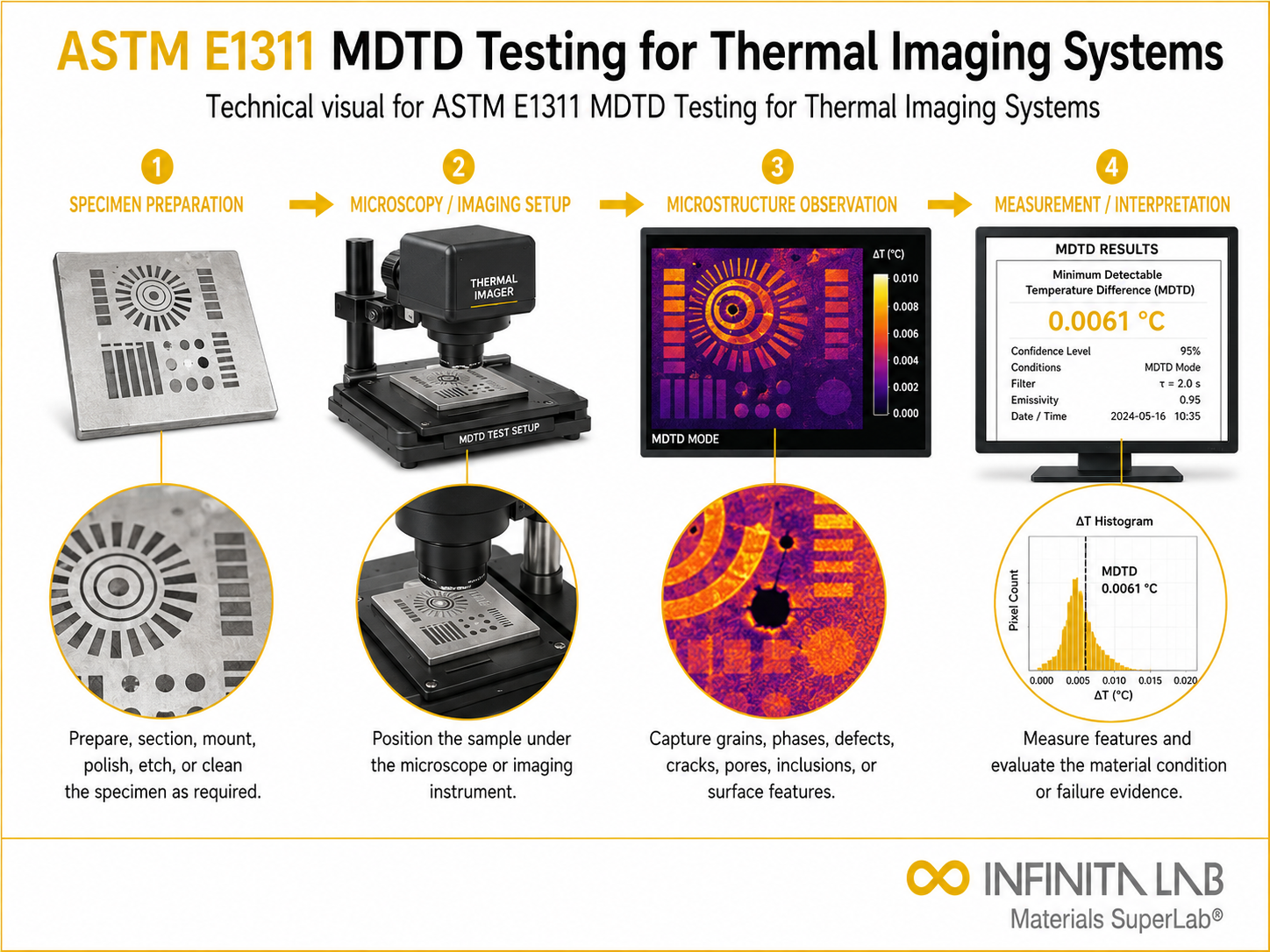
Our ASTM E1311 Testing Procedure
System Setup
Position the thermal imaging system and configure it under controlled environmental conditions.
1Target Preparation
Use a thermal target with known and adjustable temperature differences.
2Image Acquisition
Capture thermal images at varying temperature differences to assess detectability.
3Data Analysis
Determine the smallest temperature difference that produces a detectable image contrast.
4ASTM E1311 Test Parameters and Requirements
| Parameter | Details |
|---|---|
| Parameter Measured | Minimum detectable temperature difference (MDTD) |
| Temperature Range | Typically 0.1°C to several degrees depending on system sensitivity |
| Detection Principle | Contrast detection in thermal images |
| Detector Type | Infrared sensors |
| Environmental Conditions | Controlled temperature and background conditions |
| Spatial Resolution | Influences detectability of small differences |
| Thermal Contrast | Key factor in measurement determination |
| Signal Processing | Digital image analysis and contrast evaluation |


- Thermal imaging camera
- Controlled thermal target (blackbody or calibrated source)
- Temperature control system
- Environmental chamber
- Data acquisition and image processing software
- Infrared calibration equipment
Equipment and Instrumentation Used for ASTM E1311 Testing
What You Receive: Test Report, Data, and Certification
- Minimum detectable temperature difference (MDTD) value
- Thermal image data and contrast analysis
- Calibration and performance evaluation report
- Sensitivity characterization of imaging system
- Environmental and test condition records
- Compliance verification documentation
ASTM E1311 Thermal Imaging MDTD FAQs
MDTD represents the smallest temperature difference that a thermal imaging system can reliably detect. It is a key indicator of system sensitivity, showing how effectively the device can distinguish between objects with very close thermal signatures.
MDTD determines the detection capability of a thermal camera. Lower values indicate higher sensitivity, enabling the system to detect subtle temperature variations, which is critical in applications such as fault detection, surveillance, and precision diagnostics.
Factors include detector sensitivity, noise levels, environmental stability, optical alignment, and calibration accuracy. Any variation in these parameters can affect the system’s ability to reliably detect small temperature differences.
Yes, MDTD provides a standardized metric for comparing the sensitivity of different thermal imaging systems, enabling objective performance evaluation across manufacturers and models.
A lower MDTD allows detection of subtle thermal anomalies, improving effectiveness in applications like electrical inspection, medical diagnostics, and surveillance where small temperature differences are critical.
Why Choose Infinita Lab for Thermal Imaging MDTD Testing
At the core of this breadth is our network of 2,000+ accredited laboratories across the USA, offering access to over 10,000 testing methods and analytical services. From advanced materials characterization (SEM, TEM, RBS, XPS) to mechanical, chemical, environmental, biological, and standardized ASTM/ISO-compliant testing, we deliver unmatched flexibility, specialization, and scale. You are never limited by geography, facility, or methodology — Infinita Lab connects you to the right expertise and testing solution, every time.

Looking for an Accredited Partner for ASTM E1311 Thermal Imaging MDTD Testing?
Send query us at hello@infinitalab.com or call us at (888) 878-3090 to learn more about our services and how we can support you.



Request a Quote
Submit your material details and receive testing procedures, pricing, and turnaround time within 24 hours.
 Quick Turnaround and Hasslefree process
 Confidentiality Guarantee
 Free, No-obligation Consultation
 100% Customer Satisfaction
