


X-Ray Diffraction (XRD) Testing for Phase ID & Crystal Structure Analysis
X-Ray Diffraction analysis (XRD) is a characterization technique used for crystalline materials. In order to measure the intensities and angle of scattering of the X-rays that leave a material, XRD bombards it with incident X-rays. The patterns formed during X-ray diffraction are unique to the periodic atomic arrangements in a specimen and are widely used for phase identification.
TRUSTED BY


Precision Testing Solutions for Accurate, Reliable, and Standards-Compliant Results
- Overview
- Scope, Applications, and Benefits
- Test Process
- Specifications
- Instrumentation
- Results and Deliverables
X-ray Diffraction (XRD) Testing Overview
X-ray Diffraction (XRD) is a non-destructive analytical technique used to identify crystalline phases and determine structural properties of materials. It works by measuring the diffraction of X-rays from atomic planes within a crystal lattice.
XRD provides detailed insights into phase composition, crystallinity, and structural parameters, making it essential for material characterization in metals, ceramics, polymers, pharmaceuticals, and nanomaterials.

Scope, Applications, and Benefits
Scope
XRD testing evaluates:
- Phase identification and composition
- Degree of crystallinity (%)
- Lattice parameters and crystal structure
- Residual stress and phase transformations
Applications
- Metallurgy and alloy development
- Ceramics and minerals
- Pharmaceuticals (polymorph analysis)
- Polymers and composites
- Nanomaterials and coatings
Benefits
- Non-destructive structural analysis
- Accurate identification of crystalline phases
- Detects impurities and phase changes
- Supports research and material development
- Enables process and material optimization
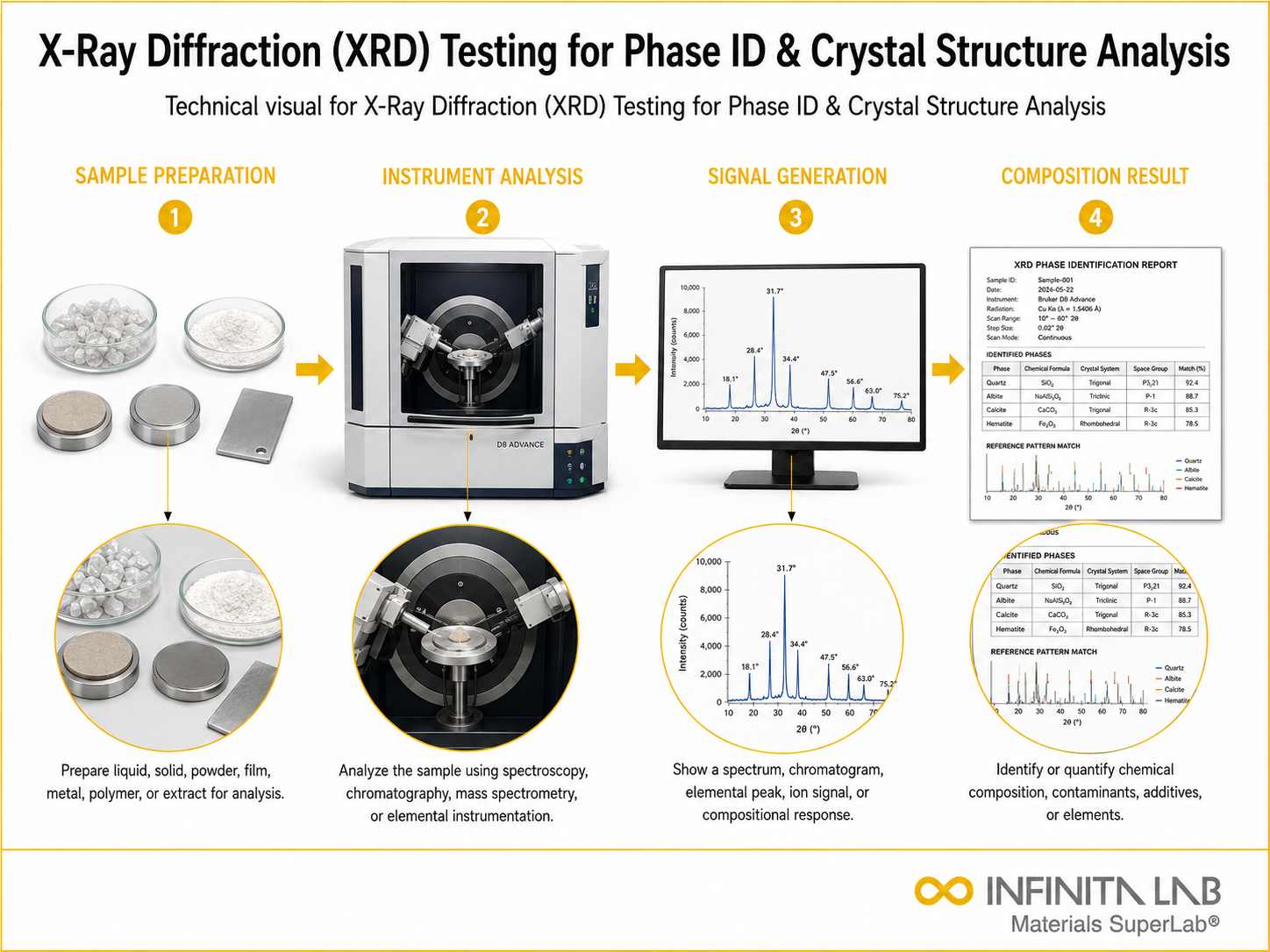
X-ray Diffraction (XRD) Test Process
Sample Preparation
Samples are powdered or prepared with a flat surface to ensure uniform diffraction.
1X-ray Exposure
Monochromatic X-rays (typically Cu Kα, λ ≈ 1.5406 Å) are directed at the sample.
2Diffraction Measurement
Diffracted X-rays are detected over a 2θ range (typically 5°–90°).
3Data Analysis
Diffraction patterns are matched with databases (ICDD PDF) to identify phases.
4X-ray Diffraction (XRD) Technical Specifications
| Parameter | Details |
|---|---|
| Standard | ASTM E975, ISO 13779 |
| Test Principle | Bragg’s Law diffraction (nλ = 2d sinθ) |
| Applicable Materials | Crystalline solids (metals, ceramics, polymers) |
| Minimum Sample Size | Few mg (powder) or flat solid |
| Measured Outputs | Phase composition, crystallinity (%), lattice parameters |
| Detection Limit | ~1–2% phase content |
| Accuracy | ±0.02° (2θ resolution) |


Instrumentation Used for Testing
- X-ray diffractometer
- X-ray source (Cu/Co radiation)
- Goniometer
- Detector (scintillation or solid-state)
- Sample holders
- Data analysis software (ICDD database)
Results and Deliverables
- Phase identification report
- XRD diffraction patterns
- Crystallinity percentage
- Lattice parameter data
- Residual stress and structural analysis
Frequently Asked Questions
Bragg’s Law explains how X-rays are diffracted by crystal planes, defined as nλ = 2d sinθ. It is fundamental for determining interplanar spacing and identifying crystal structures in materials.
XRD can typically detect crystalline phases present at concentrations of around 1–2%. Lower concentrations may be detected with advanced techniques and longer scan times.
Yes, XRD can estimate the degree of crystallinity in polymers by analyzing the intensity of crystalline peaks relative to amorphous background signals, providing insights into material structure and properties.
XRD measurements are usually performed over a 2θ range of 5° to 90°, depending on the material and analysis requirements. This range captures most diffraction peaks for phase identification.
XRD provides essential information about crystal structure, phase composition, and material properties. It helps in quality control, failure analysis, and development of new materials with desired characteristics.
Why Choose Infinita Lab for Advanced Materials Testing and Characterization?
At the core of this breadth is our network of 2,000+ accredited laboratories across the USA, offering access to over 10,000 testing methods and analytical services. From advanced materials characterization (SEM, TEM, RBS, XPS) to mechanical, chemical, environmental, biological, and standardized ASTM/ISO-compliant testing, we deliver unmatched flexibility, specialization, and scale. You are never limited by geography, facility, or methodology — Infinita Lab connects you to the right expertise and testing solution, every time.

Looking for a Trusted Partner for Accurate and Reliable Testing Services?
Send query us at hello@infinitlab.com or call us at (888) 878-3090 to learn more about our services and how we can support you.



Request a Quote
Submit your material details and receive testing procedures, pricing, and turnaround time within 24 hours.
 Quick Turnaround and Hasslefree process
 Confidentiality Guarantee
 Free, No-obligation Consultation
 100% Customer Satisfaction
