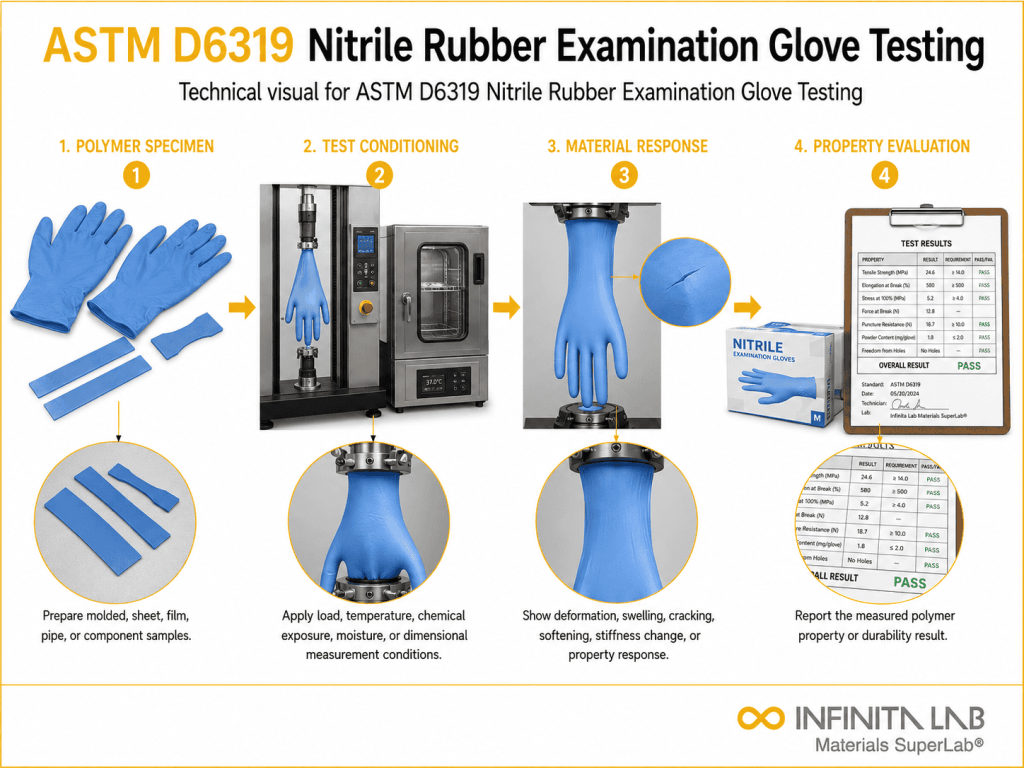


What Is ASTM D6319 Nitrile Examination Glove?
ASTM D6319 defines the requirements and specifications for nitrile examination gloves intended for medical applications. It establishes performance criteria such as tensile strength, elongation, and barrier protection to ensure gloves provide adequate safety for both healthcare professionals and patients.
These gloves are widely used in medical, laboratory, and healthcare environments where protection against contamination, chemicals, and biological hazards is essential. The standard ensures consistent quality, reliability, and performance, making nitrile gloves a preferred alternative to latex gloves due to their durability and allergy-free properties.
Applications and Benefits of ASTM D6319 Nitrile Examination Glove Testing
Scope
ASTM D6319 covers nitrile rubber examination gloves used in medical and healthcare applications. It defines physical, mechanical, and barrier performance requirements, ensuring the gloves meet safety and usability standards for medical professionals.
Key scope elements include:
- Examination gloves made from nitrile rubber latex
- Medical and healthcare usage compliance
- Evaluation of physical properties such as strength and elasticity
- Barrier protection against biological and chemical hazards
- Applicability to powdered and powder-free gloves
Applications
- Medical examinations and procedures
- Surgical and clinical environments
- Laboratory and diagnostic testing
- Pharmaceutical handling
- Chemical and biological sample handling
- Healthcare and patient care
- Emergency and trauma response
- Infection control practices
Benefits
- Provides high resistance to punctures and chemicals
- Reduces risk of allergic reactions (latex-free)
- Ensures reliable barrier protection
- Offers durability and flexibility for extended use
- Improves safety for healthcare professionals
- Maintains consistent quality and performance
- Suitable for sensitive and critical applications
Our ASTM D6319 Testing Procedure
Sample Conditioning
Gloves are conditioned under controlled temperature and humidity before testing to stabilize material properties.
1Physical Testing
Mechanical properties such as tensile strength and elongation are measured using standardized equipment.
2Barrier Evaluation
Gloves are tested for defects and barrier integrity to ensure protection against leaks or contamination.
3Performance Analysis
Test results are analyzed against ASTM requirements to determine compliance and suitability for medical use.
4ASTM D6319 Test Parameters and Requirements
| Parameter | Details |
|---|---|
| Material Type | Nitrile rubber latex |
| Tensile Strength | Minimum strength requirements specified |
| Elongation | Defined minimum elongation percentage |
| Barrier Integrity | Tested for holes and defects |
| Powder Content | Controlled or powder-free options |
| Thickness | Specified minimum thickness requirements |
| Force at Break | Standardized mechanical property |


- Tensile testing machine
- Thickness gauge
- Leak testing apparatus
- Conditioning chamber
- Micrometer or caliper
- Visual inspection tools
Equipment and Instrumentation Used for ASTM D6319 Testing
What You Receive: Test Report, Data, and Certification
- Tensile strength values
- Elongation percentage
- Barrier integrity results
- Defect detection report
- Compliance certification
- Detailed test report with conditions
- Quality assurance documentation
ASTM D6319 Nitrile Examination Glove FAQs
ASTM D6319 establishes performance and safety requirements for nitrile examination gloves used in medical applications. It ensures that gloves provide adequate strength, flexibility, and barrier protection against contaminants, helping protect healthcare professionals and patients during clinical and laboratory procedures.
Nitrile gloves are preferred because they are latex-free, reducing the risk of allergic reactions. They also offer excellent resistance to punctures, chemicals, and bodily fluids, making them more durable and suitable for a wide range of medical and laboratory applications.
Key requirements include minimum tensile strength, elongation capacity, acceptable defect limits, and barrier protection. These ensure that the gloves are strong, flexible, and capable of preventing contamination during use.
Tensile strength measures the glove’s ability to withstand stretching without breaking. Higher tensile strength indicates better durability, ensuring that gloves remain intact during medical procedures and reduce the risk of exposure to contaminants.
Although ASTM D6319 focuses on physical properties, nitrile material inherently provides chemical resistance. Additional testing may be conducted separately to evaluate resistance against specific chemicals.
ASTM D6319 establishes requirements for nitrile rubber examination gloves used in medical examinations and diagnostic or therapeutic procedures. The evaluation includes checking glove dimensions, thickness, freedom from holes, tensile strength, and ultimate elongation before and after accelerated aging. Additional requirements address sterility and powder content, where applicable. The results help verify glove quality, physical durability, and compliance with the specification for medical examination applications.
ASTM D6319 evaluates the performance and safety characteristics of nitrile examination gloves through specified physical and quality requirements. Glove samples are examined for dimensions and thickness, while mechanical testing measures tensile strength and elongation before and after aging. Watertightness testing is used to detect holes, and powder content and sterility requirements are assessed as applicable. The test results are compared with the standard's acceptance criteria to determine whether the gloves meet the specified requirements.
Why Choose Infinita Lab for Nitrile Examination Glove Testing
When your Nitrile Examination Glove results have to hold up - for compliance, a customer audit, or an engineering decision - ASTM D6319 accuracy and an unbiased third-party report matter more than price. Infinita Lab routes your ASTM D6319 nitrile examination glove testing to ISO/IEC 17025-accredited U.S. partner labs with hands-on method experience, so you get defensible data, transparent reporting, and turnaround times built around your project deadline - not ours.

Need ASTM D6319 Nitrile Examination Glove Testing You Can Rely On?
Send query us at hello@infinitalab.com or call us at (888) 878-3090 to learn more about our services and how we can support you.