


ASTM C146 Chemical Analysis Testing for Glass Sand
Accredited ASTM C146 glass sand chemical analysis testing from Infinita Lab, performed to the exact standard requirements - accurate, reproducible results with full documentation for compliance, R&D, and quality control programs.
TRUSTED BY


Get ASTM C146 compliant results - request your glass sand chemical analysis testing quote
- Overview
- Scope, Applications, and Benefits
- Test Process
- Specifications
- Instrumentation
- Results and Deliverables
What Is ASTM C146 Glass Sand Chemical Analysis?
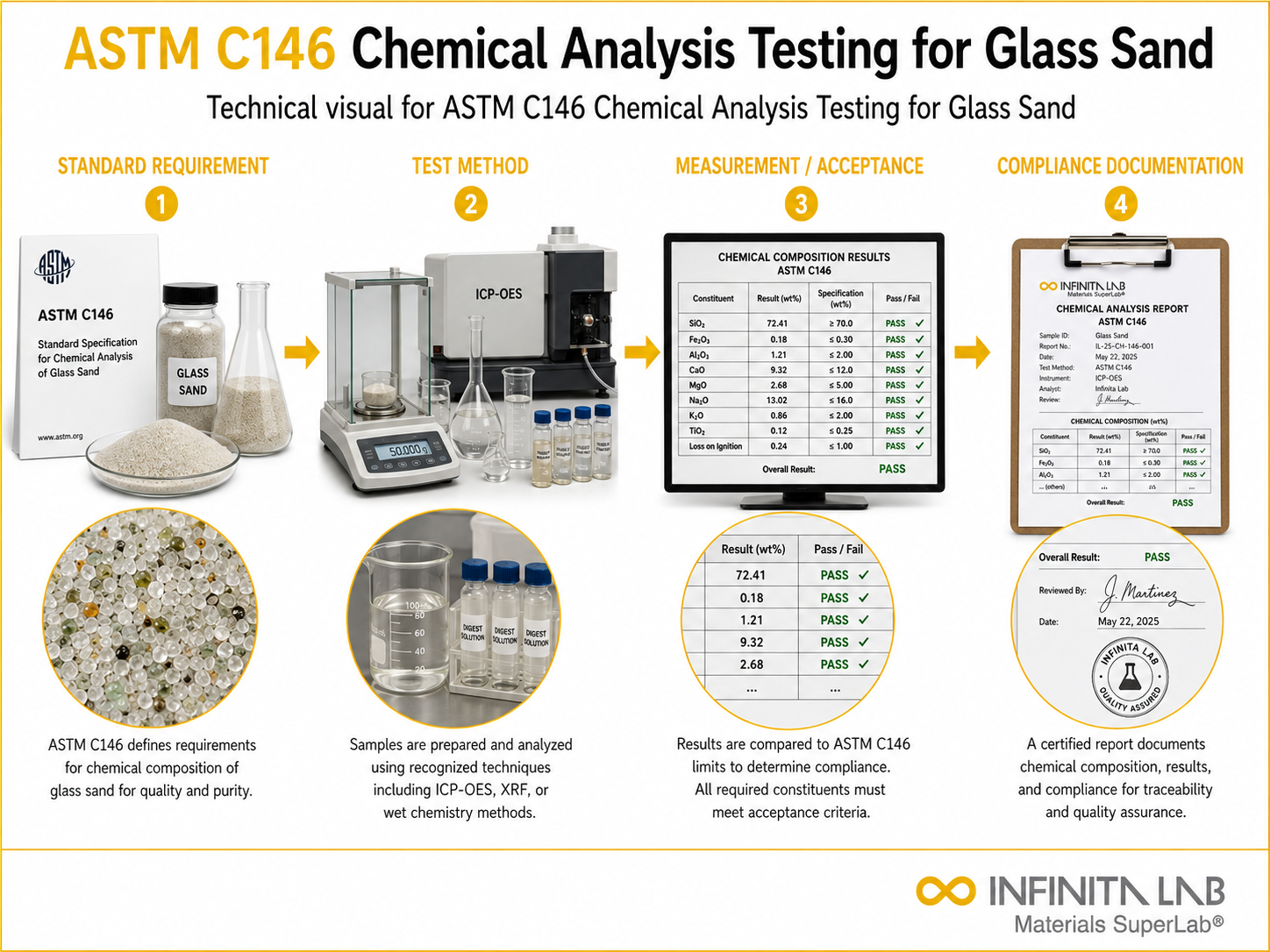
ASTM C146, formerly “Standard Test Methods for Chemical Analysis of Glass Sand” (current edition C146-26), lays out the procedures a lab follows to determine exactly what’s in a batch of glass sand before it’s accepted for glassmaking. The standard doesn’t stop at naming what gets measured – silica, the combined R₂O₃ oxides, total iron reported as iron oxide, titania, chromium oxide, zirconia, alkalies, alkaline earths, loss on ignition – it specifies how each one gets measured, and that methodology is really the backbone of the whole document.
Two analytical pathways run side by side under C146. The referee, or classical, route is wet chemistry from start to finish: gravimetric and titrimetric procedures, silica pulled out by double dehydration, combined oxides precipitated and weighed. It’s the slower path, but the standard calls for it when a result has to be beyond dispute. Alongside it sits the routine methodology, which swaps in atomic absorption spectrophotometry and flame emission photometry – instrumental techniques built for production-paced testing that still hold to the interlaboratory agreement the standard is built around. A lab picks one path or the other depending on whether the moment calls for speed or airtight rigor.
Scope-wise, C146 applies specifically to glass sand as a raw material: high-silica sand running upward of 99% SiO₂, and high-alumina variants that can carry alumina in the 12 to 13% range. Both the referee and routine procedures are built to hold up across that range. What the standard ultimately delivers is a consistent, reproducible way to characterize glass sand chemistry, so a result from one lab carries the same weight as a result from another.

Applications and Benefits of ASTM C146 Glass Sand Chemical Analysis Testing
Scope
ASTM C146 outlines procedures for chemical analysis of glass sand to determine major constituents and trace impurities, ensuring suitability for glass production processes.
- ASTM C146 lays out standard test methods for the chemical analysis of glass sand as a raw material in glass manufacturing.
- Primarily, it covers high-silica glass sands running upward of 99% SiO₂, plus high-alumina glass sands that can carry alumina in the 12 to 13% range.
- Silica determination sits at the core, alongside the combined “R₂O₃” group, with total iron broken out and reported separately as iron oxide.
- Trace and minor constituents get their own procedures too: titania, chromium oxide, zirconia, all common in glass sand deposits.
- Loss on ignition is a standard determination here, capturing moisture, carbonates, and whatever else burns or volatilizes off.
- High-alumina sands in particular can carry meaningfully higher alkali and alkaline earth content, sometimes several percent, and the standard addresses both.
- Referee methods (classical, gravimetric, titrimetric) are kept distinct from routine methods, which trade a bit of rigor for speed in day-to-day production testing.
- Jurisdiction falls to ASTM Committee C14 on Glass and Glass Products, under the subcommittee handling chemical properties and analysis.
- Editions get reviewed and reissued periodically. Labs should double-check they’re working from the current one, not an older version sitting in a file somewhere.
- Reproducibility across labs is really the whole point. It’s what lets the standard function as shared ground for commercial specifications.
Applications
- Checking incoming glass sand shipments against a buyer’s chemical spec before the material gets anywhere near inventory.
- Quality control at sand processing and beneficiation plants that feed the glass industry.
- Confirming raw-material consistency across container glass, flat glass, fiberglass, and specialty glass lines.
- Tracing colour or clarity problems in finished glass back to iron oxide or other colouring oxides in the sand itself.
- Independent, third-party chemistry when a supplier and buyer can’t agree on what’s actually in the material.
- Baseline testing for a new sand deposit or source, before anyone commits to it for glassmaking.
- R&D and formulation work, where the batch chemistry needs to be nailed down precisely ahead of scale-up.
Benefits
- Results come out standardized and repeatable, so buyers, suppliers, and regulators are all working from the same numbers.
- Chemistry drift shows up early, before it turns into a furnace problem or a product-quality complaint.
- Whether it’s a referee or routine, the lab picks based on what the data actually needs: accuracy or speed.
- Iron and the other colouring oxides get caught early. Iron’s usually the biggest reason clear glass isn’t actually clear.
- A documented chemistry record builds up over time, useful for supplier qualification and long-term tracking alike.
- Disputes get easier to settle when both sides are anchored to the same recognized test method.
Our ASTM C146 Testing Procedure
Sample Preparation
Dry, crush, and homogenize the sand sample to obtain a representative test portion.
1Chemical Treatment
Dissolve or fuse the sample using appropriate reagents for analysis.
2Elemental Analysis
Measure oxide composition using analytical techniques such as titration or spectroscopy.
3Result Calculation
Calculate percentage composition of each constituent based on measured data.
4ASTM C146 Test Parameters and Requirements
| Parameter | Details |
|---|---|
| Material Type | Silica sand for glass manufacturing |
| Key Components | SiO₂, Al₂O₃, Fe₂O₃, CaO, MgO |
| Impurity Detection | Trace elements including iron and alkalis |
| Sample Preparation | Drying, crushing, and homogenization |
| Analytical Techniques | Titration, gravimetric, or spectroscopic methods |
| Output Data | Percentage composition of oxides |


- Atomic Absorption Spectrophotometer (AAS). Handles routine determination of oxides like alumina, calcium oxide, and magnesium oxide; fast and reliable enough for production work.
- Flame Emission Photometer – measures alkali content, mainly sodium and potassium oxides, on the routine method side.
- Analytical Balance: the high-precision mass measurements that gravimetric silica and R₂O₃ work depend on. Full stop.
- Muffle Furnace. Used for ignition steps, loss on ignition, plus the gravimetric dehydration work that silica determination requires.
- Spectrophotometer/Colorimeter. Supports photometric determination where colour-development chemistry comes into play, titania being a good example.
- Laboratory Drying Oven. Conditions and dries samples before anyone weighs or digests them.
- Volumetric Glassware and Titration Apparatus – the backbone of the titrimetric steps in classical reference-method work.
Equipment and Instrumentation Used for ASTM C146 Testing
What You Receive: Test Report, Data, and Certification
- A full chemical composition report: silica, R₂O₃, total iron oxide, and everything else the test covers.
- Whether the referee or routine pathway produced the numbers is stated plainly, not buried in a footnote.
- Loss-on-ignition sits right alongside the oxide chemistry, so the picture’s complete in one place.
- Data formatted for direct comparison against a buyer’s or manufacturer’s internal specification.
- Documentation built for raw-material qualification files, supplier audits, or a dispute that needs resolving.
- A final report, referencing ASTM C146, ready to hand to regulators, customers, or whoever else needs it.
ASTM C146 Glass Sand Chemical Analysis FAQs
ASTM C146 is used to determine the chemical composition of glass sand by analyzing major oxides and impurities. It ensures that raw materials meet required specifications for glass manufacturing and helps maintain product quality and consistency.
Glass sand is high-purity silica sand used as a primary raw material in glass production. Its chemical composition, especially silica content and impurity levels, directly affects the quality, clarity, and performance of the final glass product.
Chemical analysis is important to ensure that the sand meets strict quality requirements. Impurities such as iron can affect glass color and clarity, while composition variations can impact melting efficiency and product performance.
Silica is the primary component of glass sand and determines the basic structure of glass. High silica content is essential for producing high-quality, durable, and transparent glass products.
Iron impurities can impart unwanted color to glass, reducing clarity. Controlling iron levels is crucial for producing clear or colorless glass, especially in optical and high-quality applications.
High-grade glass sand is evaluated primarily by its SiO₂ content and impurity levels. The sand is chemically analyzed to verify silica purity and control impurities such as iron, aluminium, calcium, and magnesium that can affect glass quality.
Why Choose Infinita Lab for Glass Sand Chemical Analysis Testing
When your Glass Sand Chemical Analysis results have to hold up - for compliance, a customer audit, or an engineering decision - ASTM C146 accuracy and an unbiased third-party report matter more than price. Infinita Lab routes your ASTM C146 glass sand chemical analysis testing to ISO/IEC 17025-accredited U.S. partner labs with hands-on method experience, so you get defensible data, transparent reporting, and turnaround times built around your project deadline - not ours.

Need ASTM C146 Glass Sand Chemical Analysis Testing You Can Rely On?
Send query us at hello@infinitalab.com or call us at (888) 878-3090 to learn more about our services and how we can support you.



Request a Quote
Submit your material details and receive testing procedures, pricing, and turnaround time within 24 hours.
 Quick Turnaround and Hasslefree process
 Confidentiality Guarantee
 Free, No-obligation Consultation
 100% Customer Satisfaction
