


ICP MS ICP OES Guide Testing Services
An Inductively Coupled Plasma (ICP) is a particular kind of plasma source where the energy is provided by electric currents generated by electromagnetic induction, i.e. changing magnetic fields over time. ICP is used in analytical testing to determine how much of certain elements are present in a sample.
TRUSTED BY


Get compliant results — request your ICP MS ICP OES guide testing quote
- Overview
- Scope, Applications, and Benefits
- Test Process
- Specifications
- Instrumentation
- Results and Deliverables
What Is ICP MS ICP OES Guide?
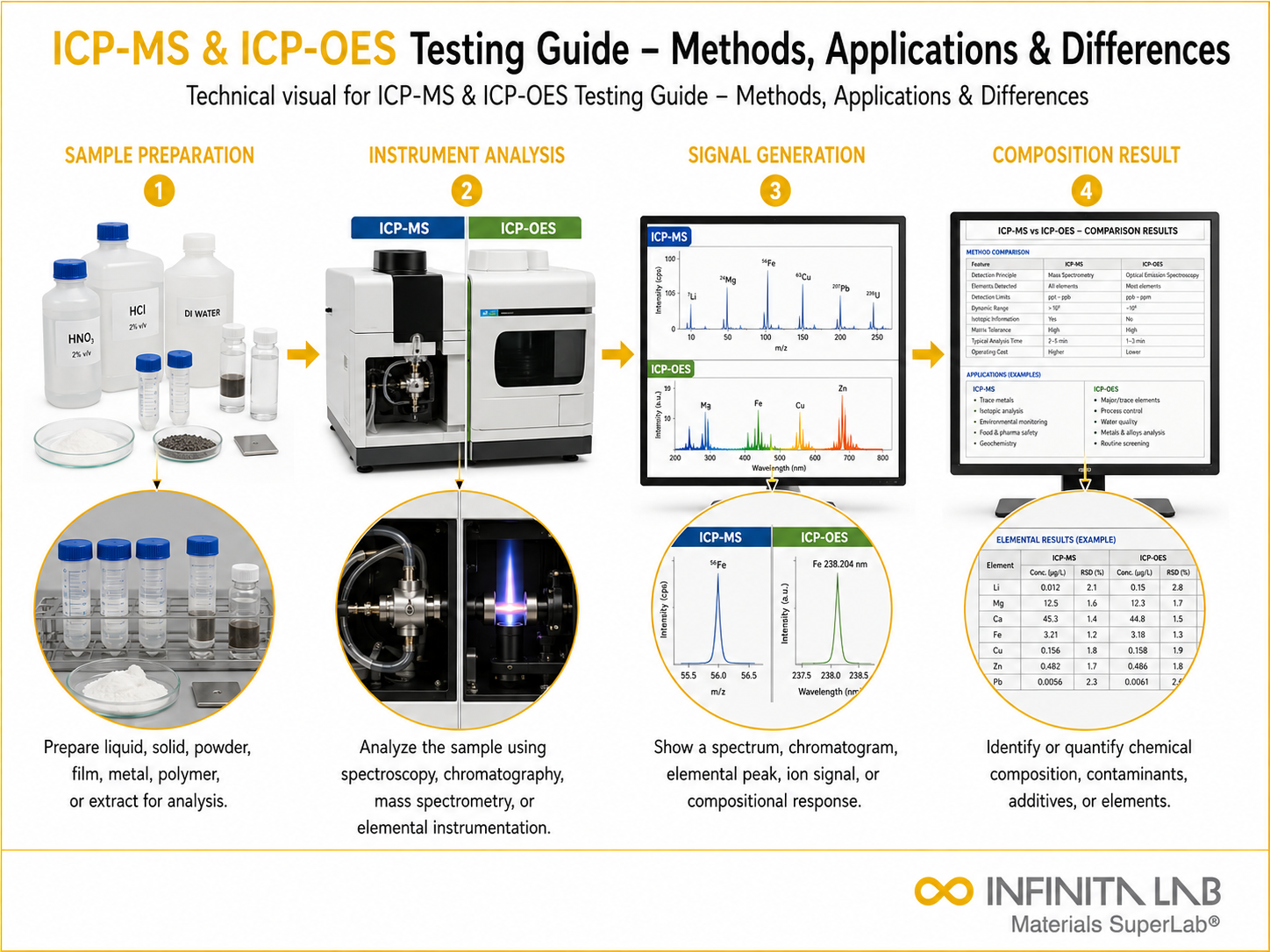
Inductively Coupled Plasma (ICP) testing is an advanced analytical technique used to determine the elemental composition of materials with high accuracy and sensitivity. It utilizes a high-temperature argon plasma to atomize and ionize samples, enabling precise detection of metals and trace elements.
ICP-based techniques such as ICP-OES (Optical Emission Spectroscopy) and ICP-MS (Mass Spectrometry) are widely used for multi-element analysis. ICP-OES is suitable for routine analysis at ppm–ppb levels, while ICP-MS provides ultra-trace detection down to ppt levels, making it one of the most sensitive elemental analysis methods available.

Applications and Benefits of ICP MS ICP OES Guide Testing
Scope
ICP testing evaluates:
- Elemental composition (major to trace levels)
- Detection range from ppm to ppt levels
- Multi-element analysis (up to ~70 elements simultaneously)
- Impurity and contamination profiling
Applications
- Environmental and water analysis
- Pharmaceuticals and food safety
- Metallurgy and alloy analysis
- Petrochemicals and oils
- Electronics and semiconductor materials
Benefits
- High sensitivity and accuracy
- Simultaneous multi-element detection
- Wide dynamic range (ppm to ppt)
- Fast and reliable analysis
- Suitable for diverse sample types
Our Testing Procedure
Sample Preparation
Samples are dissolved or digested into liquid form using acids (e.g., nitric acid digestion).
1Sample Introduction
The solution is nebulized into an aerosol and introduced into argon plasma (~6000–10,000 K).
2Ionization/Excitation
At high temperature, atoms are atomized and ionized or excited in the plasma.
3Detection & Analysis
Emission (ICP-OES) or ions (ICP-MS) are measured to determine elemental concentration.
4Test parameters and requirements
| Parameter | Details |
|---|---|
| Standard | ASTM E1479, ASTM D5185, ISO methods |
| Plasma Temperature | ~6000–10,000 K |
| Techniques | ICP-OES, ICP-MS |
| Detection Range | ppm–ppb (ICP-OES), ppb–ppt (ICP-MS) |
| Elements Detected | Up to ~70 elements simultaneously |
| Sample Type | Liquids, digested solids |


- ICP-OES spectrometer
- ICP-MS system
- Nebulizer and spray chamber
- Argon plasma torch
- Peristaltic pump
- Data acquisition and analysis software
Equipment and Instrumentation Used for Testing
What You Receive: Test Report, Data, and Certification
- Quantitative elemental composition (ppm–ppt levels)
- Trace impurity and contamination analysis
- Multi-element concentration profiles
- Comparative material analysis
- Input for process control and material selection
ICP MS ICP OES Guide FAQs
ICP testing is used to determine elemental composition in materials, including metals and trace impurities. It is widely applied in environmental testing, pharmaceuticals, and metallurgy for accurate and multi-element analysis.
ICP-OES measures light emitted by excited atoms and is suitable for ppm–ppb analysis, while ICP-MS detects ions and provides much higher sensitivity, reaching ppt levels for trace element detection.
ICP uses extremely high plasma temperatures (~6000–10,000 K), which ensures efficient atomization and ionization, allowing detection of elements at very low concentrations with high accuracy.
ICP can analyze liquids, dissolved solids, environmental samples, metals, food, pharmaceuticals, and chemicals, provided the sample can be converted into a liquid form.
ICP techniques can detect and quantify up to around 70 elements simultaneously, making them highly efficient for multi-element analysis in a single run.
Why Choose Infinita Lab for ICP MS ICP OES Guide Testing
At the core of this breadth is our network of 2,000+ accredited laboratories across the USA, offering access to over 10,000 testing methods and analytical services. From advanced materials characterization (SEM, TEM, RBS, XPS) to mechanical, chemical, environmental, biological, and standardized ASTM/ISO-compliant testing, we deliver unmatched flexibility, specialization, and scale. You are never limited by geography, facility, or methodology — Infinita Lab connects you to the right expertise and testing solution, every time.

Looking for an Accredited Partner for ICP MS ICP OES Guide Testing?
Send query us at hello@infinitalab.com or call us at (888) 878-3090 to learn more about our services and how we can support you.



Request a Quote
Submit your material details and receive testing procedures, pricing, and turnaround time within 24 hours.
 Quick Turnaround and Hasslefree process
 Confidentiality Guarantee
 Free, No-obligation Consultation
 100% Customer Satisfaction
