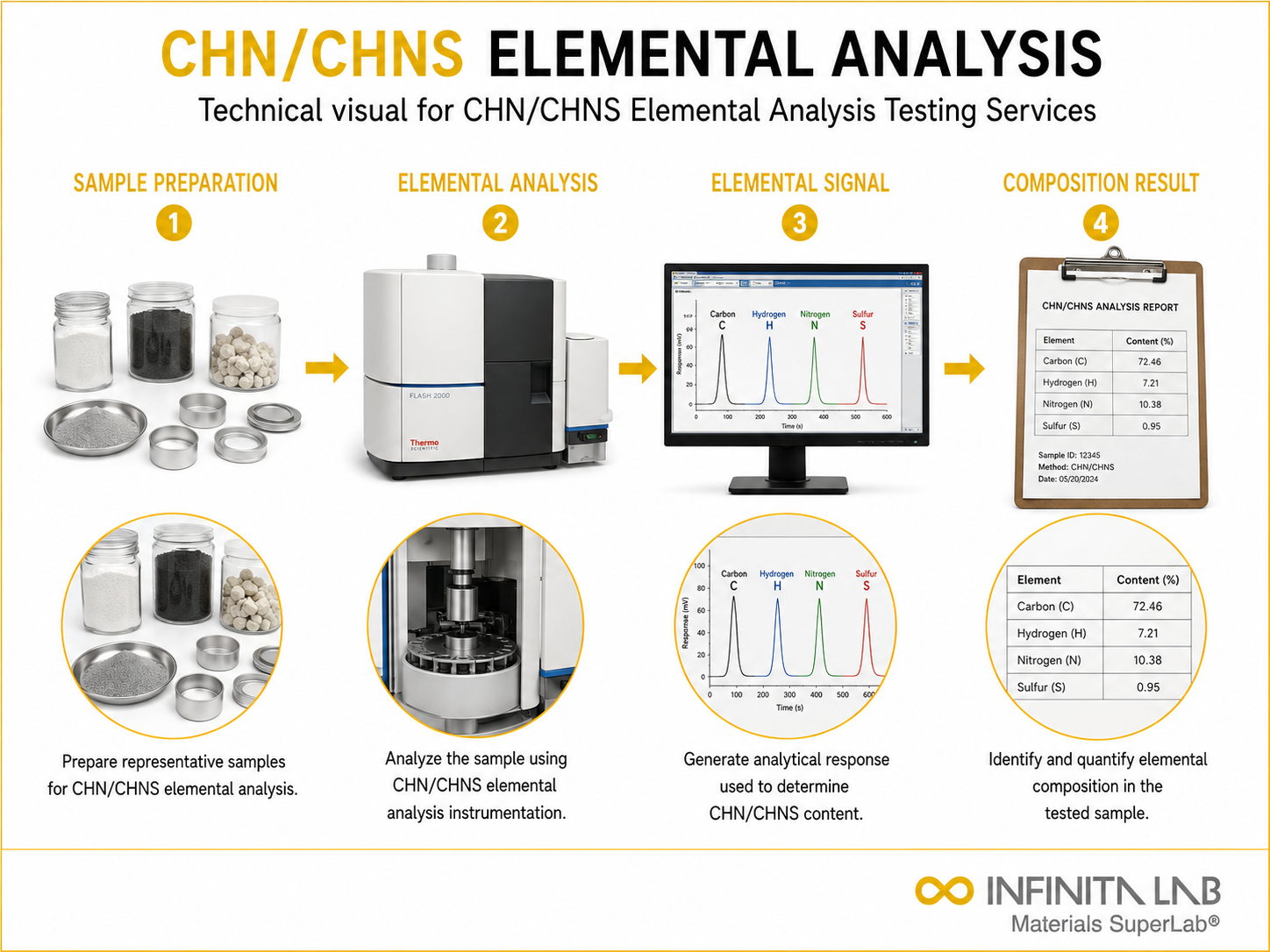


What Is CHN CHNS Elemental Analysis?
Elemental or CHN Analysis is a combustion-based analytical technique used to determine the weight percentages of carbon (C), hydrogen (H), and nitrogen (N) in organic and inorganic materials. The method provides rapid, precise quantification of elemental composition, making it indispensable for characterising polymers, fuels, soil, and biomass.
This service supports research institutions, quality control labs, and manufacturers who require accurate elemental data for material identification, purity verification, and compliance with industry standards.

Applications and Benefits of CHN CHNS Elemental Analysis Testing
Scope
CHN analysis evaluates:
- Carbon, hydrogen, and nitrogen content (weight %)
- Optional sulfur and oxygen determination (CHNS/O mode)
- Organic and inorganic sample matrices
- Solid, liquid, and volatile sample forms
Applications
- Active ingredient characterisation
- Polymer and resin composition verification
- Soil, sediment, and environmental sample analysis
- Fuel and biofuel quality assessment
- Food and agricultural product testing
Benefits
- Rapid simultaneous multi-element detection
- High sensitivity with microgram-level sample quantities
- Supports regulatory compliance and QC workflows
- Applicable to a wide range of sample types
- Generates reproducible, traceable results
Our Testing Procedure
Sample Preparation
A precisely weighed sample (1–5 mg) is encapsulated in a tin or silver vessel suitable for combustion.
1Combustion
The sample is flash-combusted at 950–1800 °C in an oxygen-rich environment, converting elements to gases (CO₂, H₂O, N₂).
2Gas Separation & Detection
Combustion gases pass through reduction and adsorption columns and are detected using thermal conductivity detectors (TCD).
3Data Analysis
Peak areas are compared against calibration standards to calculate elemental weight percentages and generate the final report.
4Test parameters and requirements
| Parameter | Details |
|---|---|
| Applicable Materials | Organics, polymers, soils, fuels |
| Detection Range | 0.001%–100% for C, H, N |
| Accuracy | ±0.1–0.3% absolute |
| Sample Size | 1–5 mg (solid/liquid) |
| Instrumentation | CHNS/O elemental analyzer |


- Flash combustion elemental analyser (e.g., LECO, PerkinElmer, Elementar)
- Precision microbalance (±0.001 mg)
- Thermal conductivity detectors
- Calibration reference standards (acetanilide, BBOT)
- Data acquisition and processing software
Equipment and Instrumentation Used for Testing
What You Receive: Test Report, Data, and Certification
- Weight % of C, H, and N (and optional S/O)
- Calibration curves and reference data
- Empirical formula estimations
- Pass/fail assessments against specification limits
- Full analytical report with traceability documentation
CHN CHNS Elemental Analysis FAQs
CHN analysis accommodates solids, liquids, and gases in organic and inorganic matrices, including polymers, soils, coal, biomass, and food products.
Typically 1–5 mg of sample is sufficient. Homogeneous samples yield the most accurate results, so proper grinding or mixing is recommended prior to analysis.
Yes. Many elemental analysers offer a CHNS/O configuration that includes oxygen determination through pyrolysis at elevated temperatures.
Commonly referenced standards include ASTM D5291 (hydrocarbons), ASTM E191, ISO 29541, and various methods depending on the industry.
A single analysis typically takes 3–6 minutes per sample.
Organic elemental analysis determines the percentage of elements such as carbon, hydrogen, nitrogen, and sulfur in a sample. The sample is combusted at high temperature, and the resulting gases are separated and measured to calculate each element's concentration. Results help verify chemical composition and sample purity.
CHN elemental analysis measures carbon, hydrogen, and nitrogen in a sample using high-temperature combustion. The resulting gases are separated and detected by an analyzer, which calculates the percentage of each element by mass.
A small, accurately weighed sample is combusted in an oxygen-rich environment. The resulting gases are separated and measured using a detector, and the results are reported as weight percentages of carbon, hydrogen, and nitrogen. These values help assess a compound's composition and confirm its expected chemical formula.
Why Choose Infinita Lab for CHN CHNS Elemental Analysis Testing
When your CHN CHNS Elemental Analysis results have to hold up - for compliance, a customer audit, or an engineering decision - accuracy and an unbiased third-party report matter more than price. Infinita Lab routes your CHN CHNS elemental analysis testing to ISO/IEC 17025-accredited U.S. partner labs with hands-on method experience, so you get defensible data, transparent reporting, and turnaround times built around your project deadline - not ours.

Looking for an Accredited Partner for CHN CHNS Elemental Analysis Testing?
Send query us at hello@infinitalab.com or call us at (888) 878-3090 to learn more about our services and how we can support you.





