

What Is ASTM E363 Chromium Ferrochromium Chemical Analysis?
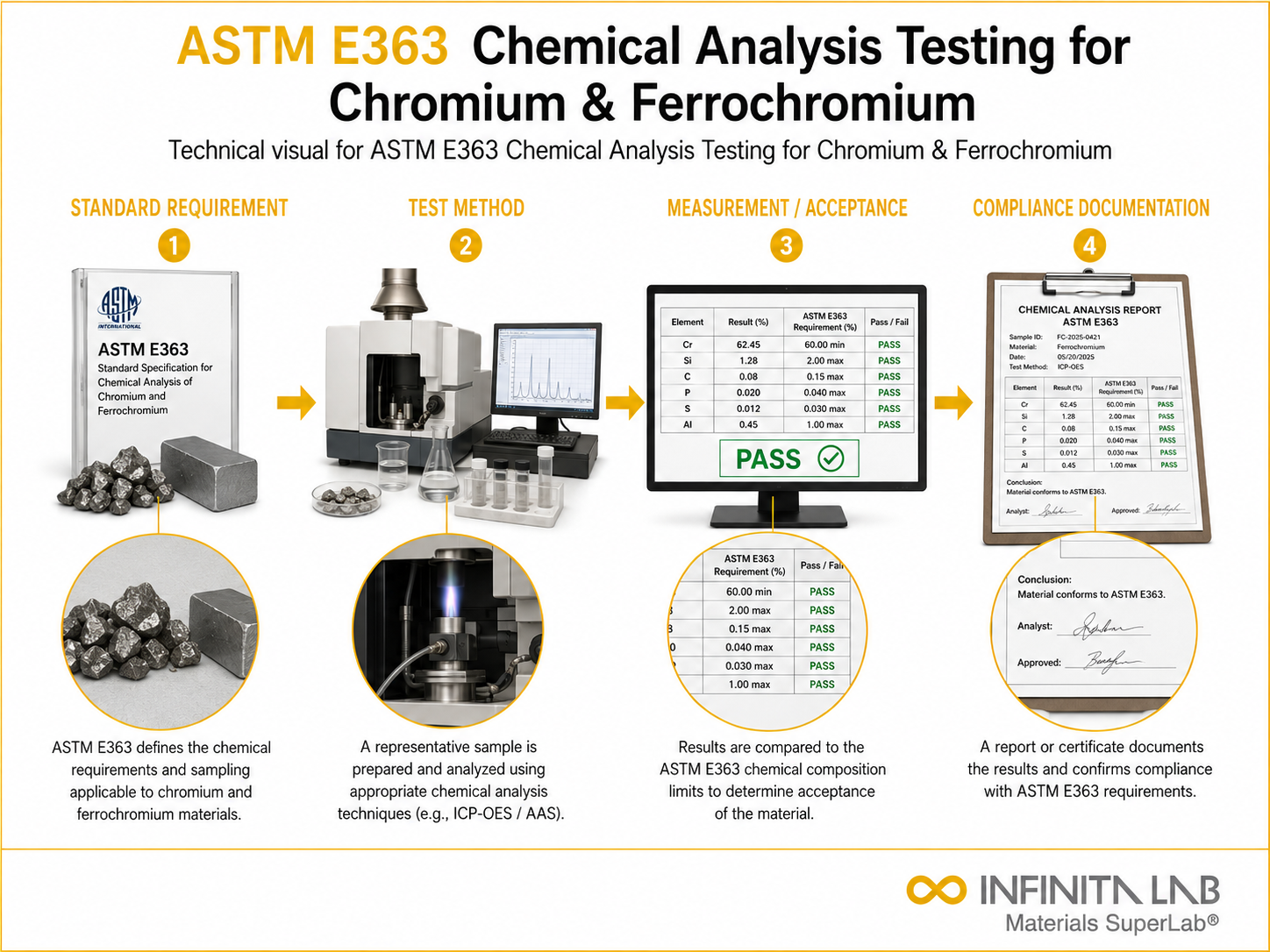
ASTM E363-09 describes standard test methods for the chemical analysis of chromium and ferrochromium to determine their elemental composition. Accurate analysis is essential for ensuring material quality, performance, and compliance with specifications in metallurgical applications.
Chromium and ferrochromium are critical raw materials in stainless steel and alloy production, where precise composition directly affects corrosion resistance, strength, and durability. This standard provides reliable procedures for multi-element determination.

Applications and Benefits of ASTM E363 Chromium Ferrochromium Chemical Analysis Testing
Scope
ASTM E363-09 outlines procedures for determining the chemical composition of chromium and ferrochromium using chemical and instrumental methods. It evaluates:
- Chromium (Cr) content (%)
- Major alloying elements (Fe, Si, C, etc.)
- Minor and trace elements
- Impurities affecting material quality
Applications
- Stainless steel manufacturing
- Ferroalloy production
- Metallurgical processing
- Quality control laboratories
- Research and development
Benefits
- Provides accurate multi-element analysis
- Supports alloy grade verification
- Ensures product quality and consistency
- Enables compliance with standards
- Improves process control and efficiency
Our ASTM E363 Testing Procedure
Sample Preparation
The sample is crushed, ground, or dissolved depending on the analytical method used.
1Method Selection
Appropriate analytical technique is selected based on elements and required accuracy.
2Elemental Analysis
Elements are measured using wet chemistry or instrumental techniques such as spectrometry.
3Data Evaluation & Reporting
Results are calculated and reported as percentage composition of each element.
4ASTM E363 Test Parameters and Requirements
| Parameter | Details |
|---|---|
| Applicable Materials | Chromium metal and ferrochromium alloys |
| Sample Type | Solid or dissolved samples depending on method |
| Measured Elements | Cr, Fe, Si, C, P, S, and trace elements |
| Methods Included | Wet chemistry, OES, AAS, ICP, and related techniques |
| Detection Range | Major (%) to trace levels (ppm) |


- Analytical balance
- Sample preparation tools (crushing, grinding, polishing)
- Wet chemistry setup (burettes, flasks)
- Spectrometers (OES, AAS, ICP)
- X-ray fluorescence (optional)
- Data acquisition systems
Equipment and Instrumentation Used for ASTM E363 Testing
What You Receive: Test Report, Data, and Certification
- Elemental composition (% and ppm levels)
- Chromium content verification
- Alloy grade assessment
- Compliance reports
ASTM E363 Chromium Ferrochromium Chemical Analysis FAQs
It determines the chemical composition of chromium and ferrochromium by analyzing major, minor, and trace elements, ensuring material quality, verifying alloy grades, and supporting compliance with specifications for metallurgical and industrial applications.
The standard includes analytical techniques such as wet chemical analysis, optical emission spectrometry, atomic absorption spectroscopy, and ICP methods to accurately determine elemental composition depending on required precision and application needs.
Chromium content directly affects corrosion resistance and strength in stainless steels and alloys, making accurate analysis essential for ensuring performance, consistency, and suitability in demanding industrial and metallurgical applications.
Chromium metal and ferrochromium alloys in various forms can be analyzed to determine their chemical composition and ensure compliance with required material standards and specifications.
Industries such as steel manufacturing, ferroalloy production, metallurgy, and research laboratories use ASTM E363-09 to verify composition, ensure quality control, and maintain performance standards in alloy production and processing.
Why Choose Infinita Lab for Chromium Ferrochromium Chemical Analysis Testing?
At the core of this breadth is our network of 2,000+ accredited laboratories across the USA, offering access to over 10,000 testing methods and analytical services. From advanced materials characterization (SEM, TEM, RBS, XPS) to mechanical, chemical, environmental, biological, and standardized ASTM/ISO-compliant testing, we deliver unmatched flexibility, specialization, and scale. You are never limited by geography, facility, or methodology — Infinita Lab connects you to the right expertise and testing solution, every time.

Looking for an Accredited Partner for ASTM E363 Chromium Ferrochromium Chemical Analysis Testing?
Send query us at hello@infinitalab.com or call us at (888) 878-3090 to learn more about our services and how we can support you.





