


ASTM E478: Copper Alloy Chemical Analysis Testing Services
Accredited ASTM E478 copper alloy chemical analysis testing from Infinita Lab, performed to the exact standard requirements - accurate, reproducible results with full documentation for compliance, R&D, and quality control programs.
TRUSTED BY


Get ASTM E478 compliant results - request your copper alloy chemical analysis testing quote
- Overview
- Scope, Applications, and Benefits
- Test Process
- Specifications
- Instrumentation
- Results and Deliverables
What Is ASTM E478 Copper Alloy Chemical Analysis?
ASTM E478, Standard Test Methods for Chemical Analysis of Copper Alloys, is the primary ASTM specification for classical wet-chemical and instrumental analysis of copper-based alloys – brass, bronze, and other coppers containing at least around 40% copper by mass. It isn’t a single test so much as a toolkit: a family of individually validated methods that a lab picks from depending on which element it’s targeting and what concentration range is expected. Four analytical approaches make up that toolkit. Gravimetric analysis isolates an element and weighs it as a pure compound or through electrodeposition. Titrimetric analysis relies on controlled chemical reactions – EDTA complexometric or iodometric titrations, for instance – to quantify how much of an element is present. Spectrophotometric analysis measures how much light coloured complexes absorb once they’ve formed with reagents like 1,10-phenanthroline or dimethylglyoxime. And instrumental atomic absorption spectrometry handles trace-to-moderate concentrations of elements such as lead, silver, and zinc. Between them, these procedures cover major, minor, and trace constituents – copper, aluminium, antimony, arsenic, cadmium, cobalt, iron, lead, manganese, nickel, phosphorus, silicon, silver, sulfur, tin, and zinc – with the exact list depending on the alloy grade in question. Manufacturers, foundries, and metal distributors turn to ASTM E478 to confirm that copper alloy heats, castings, and mill products meet their specified compositional limits, to settle disagreements between a supplier’s analysis and a purchaser’s own testing, and to back up quality control and material certification programs. Because so many elements have more than one validated method available, labs can pick whichever procedure best fits their instrumentation, the precision required, and the sample matrix at hand – which is exactly what makes E478 such a flexible, widely referenced standard across the copper alloy supply chain.

Applications and Benefits of ASTM E478 Copper Alloy Chemical Analysis Testing
Scope
- Both referee-grade and routine chemical analysis methods are covered for copper and copper alloys with a minimum copper content of roughly 40%.
- Four analytical approaches are folded into one standard: gravimetric, titrimetric, spectrophotometric, and instrumental (atomic absorption spectrometry) methods.
- Individual procedures are spelt out for elements such as aluminium, iron, lead, nickel, silver, tin, and zinc, among others.
- Each method comes with its own applicable concentration range, so the right procedure gets matched to the alloy grade under test.
- Cast and wrought product forms are both in scope – bar, plate, tube, fittings, and castings included.
- Referee methods are built in specifically to resolve compositional disputes between supplier and customer laboratories.
- ASTM Subcommittee E01.05 maintains the standard, overseeing copper, lead, zinc, cadmium, tin, beryllium, precious metals, and related alloys.
- Like other ASTM standards, it’s periodically reviewed and reapproved or revised to keep pace with analytical practice.
- It complements related copper alloy standards that handle mechanical and dimensional acceptance testing.
- Internal quality labs and independent third-party labs alike treat it as a common reference point.
Applications
- Confirming that incoming copper alloy raw material or castings actually meet the chemical composition limits of the specified grade.
- Release testing during melting, casting, and mill processing relies on E478 for quality control sign-off.
- Referee analysis under the standard settles disagreements between a supplier’s certificate of analysis and a purchaser’s own independent testing.
- New copper alloy suppliers or foundries get qualified through it, as part of a material approval or vendor qualification program.
- Suspected material substitution, mislabeling, or in-service nonconformance investigations often start here.
- Documented chemical composition data generated this way supports certifications and regulatory or contractual requirements.
- Before mechanical, corrosion, or metallurgical evaluation goes any further, this confirms alloy identity and composition.
Benefits
- Rather than locking labs into one rigid procedure, E478 offers a validated, industry-recognised method set with flexibility across element concentration ranges.
- Referee-grade precision makes it a reliable way to resolve disputes between different testing parties.
- One standard, broad coverage – major and trace elements relevant to copper alloy quality are all addressed within it.
- Traceable, defensible documentation comes out the other end, useful for procurement, quality, and regulatory purposes.
- Foundries, mills, distributors, and end users across the copper alloy world recognise it broadly.
- Modern instrumental techniques and classical wet-chemical methods sit side by side, so labs keep the older approach where it’s still the most accurate option.
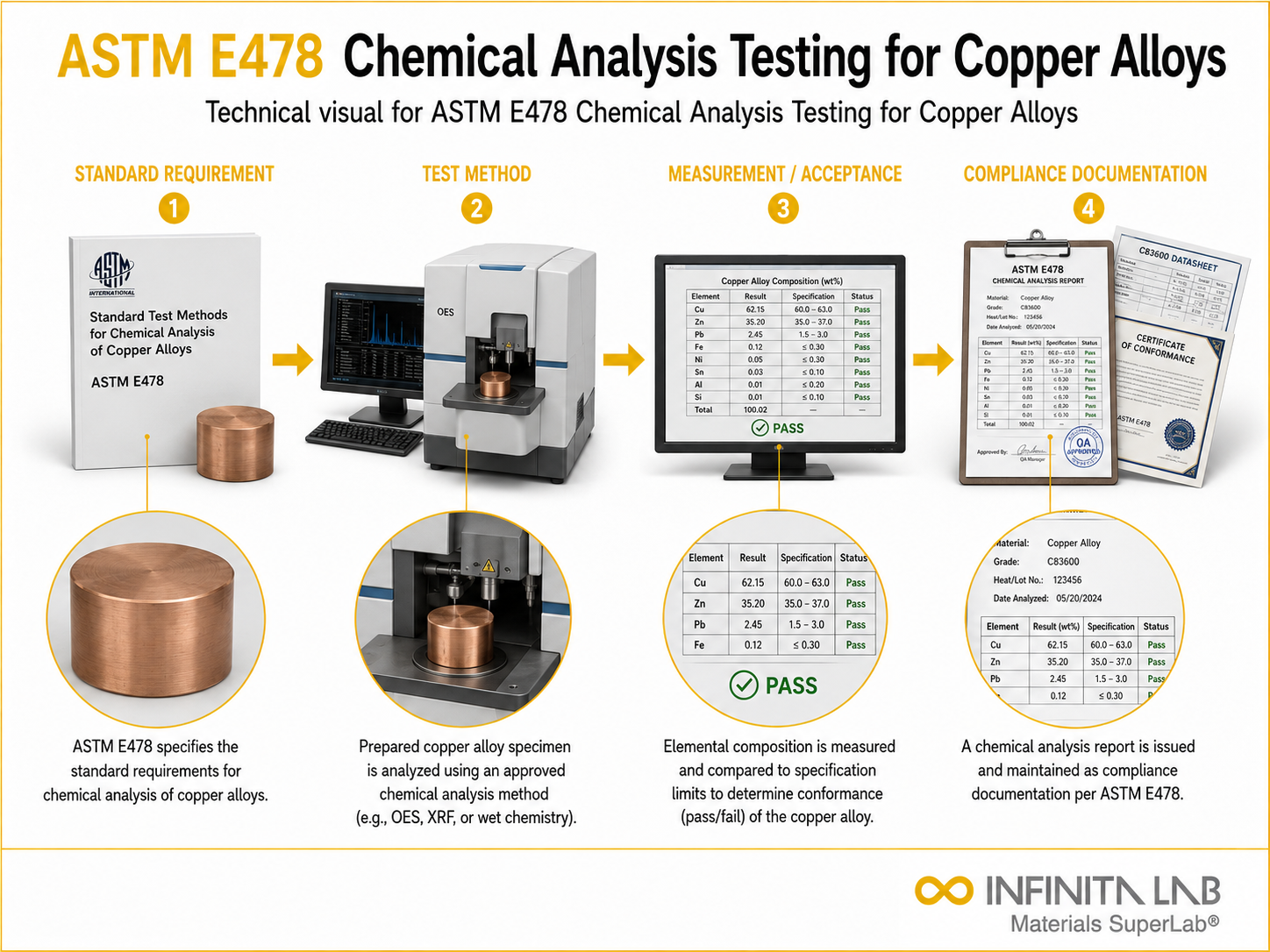
Our ASTM E478 Testing Procedure
Sample Preparation
Prepare representative alloy sample through cutting and cleaning procedures.
1Chemical Analysis
Perform elemental analysis using wet chemistry or instrumental methods.
2Element Quantification
Determine concentrations of major and trace elements present.
3Grade Verification
Compare results with standard specifications to confirm alloy grade.
4ASTM E478 Test Parameters and Requirements
| Parameter | Details |
|---|---|
| Standard | ASTM E478 |
| Method | Wet chemical and instrumental analysis |
| Analytes | Copper and alloying elements (Zn, Sn, Pb, etc.) |
| Sample Type | Solid metallic copper alloy samples |
| Detection Range | Major to trace element levels |
| Measurement Basis | Elemental concentration determination |
| Units | Percentage (%) or ppm |


- Atomic absorption spectrometer (AAS) – Handles trace-to-moderate concentrations of elements such as lead, silver, and zinc, using instrumental absorption techniques.
- UV-Vis spectrophotometer – Reads the absorbance of coloured complexes formed during spectrophotometric determinations of iron, nickel, and tin.
- Analytical balance – Delivers the precision mass measurements that gravimetric determinations and reagent preparation depend on.
- Titration apparatus – Used for EDTA complexometric and iodometric titrations to determine elements such as aluminium, lead, tin, and zinc.
- Electrodeposition (electrolysis) apparatus – Isolates copper from solution so it can be weighed for gravimetric copper determination.
- Laboratory digestion equipment – Dissolves alloy samples in acid systems under controlled heating, keeping sample prep consistent run to run.
- Certified reference materials – Calibrate instruments and validate method accuracy against known copper alloy composition standards.
Equipment and Instrumentation Used for ASTM E478 Testing
What You Receive: Test Report, Data, and Certification
- A detailed test report that spells out exactly which ASTM E478 methods were used for each element analysed.
- Quantitative results for every requested element, reported in the units and to the precision the applicable method specifies.
- Where requested, a comparison of measured composition against the referenced alloy specification or purchase order limits.
- A certificate of analysis you can use for supplier qualification, quality records, or contractual documentation.
- Supporting QC data – reference material recovery, replicate results – available on request.
- Interpretive guidance from the lab, plus recommendations for follow-up or referee testing where it’s warranted.
ASTM E478 Copper Alloy Chemical Analysis FAQs
ASTM E478 determines precise elemental composition and compares it against standard alloy specifications. This ensures that the material meets required compositional limits, enabling reliable identification and preventing incorrect grade usage in critical applications.
Elemental composition directly influences mechanical, electrical, and corrosion properties. Even small deviations can affect conductivity, strength, and durability, making accurate chemical analysis essential for ensuring expected material performance.
ASTM E478 relies on high-precision elemental quantification and tight tolerance comparison against specification limits. Even small variations in alloying elements like Zn, Sn, or Pb are critically evaluated to differentiate grades with otherwise similar nominal compositions.
Minor and trace elements can significantly influence properties such as machinability, corrosion resistance, and conductivity. ASTM E478 ensures complete compositional profiling to detect unintended additions or contamination that could alter performance.
Matrix effects alter signal response due to interactions between elements, leading to biased measurements. ASTM E478 mitigates this through matrix-matched calibration standards and correction techniques to maintain analytical accuracy across different alloy systems.
Why Choose Infinita Lab for Copper Alloy Chemical Analysis Testing
When your Copper Alloy Chemical Analysis results have to hold up - for compliance, a customer audit, or an engineering decision - ASTM E478 accuracy and an unbiased third-party report matter more than price. Infinita Lab routes your ASTM E478 copper alloy chemical analysis testing to ISO/IEC 17025-accredited U.S. partner labs with hands-on method experience, so you get defensible data, transparent reporting, and turnaround times built around your project deadline - not ours.

Need ASTM E478 Copper Alloy Chemical Analysis Testing You Can Rely On?
Send query us at hello@infinitalab.com or call us at (888) 878-3090 to learn more about our services and how we can support you.



Request a Quote
Submit your material details and receive testing procedures, pricing, and turnaround time within 24 hours.
 Quick Turnaround and Hasslefree process
 Confidentiality Guarantee
 Free, No-obligation Consultation
 100% Customer Satisfaction
