


ASTM C1494 C, N & O Mass Fraction Testing in Silicon Nitride Powder
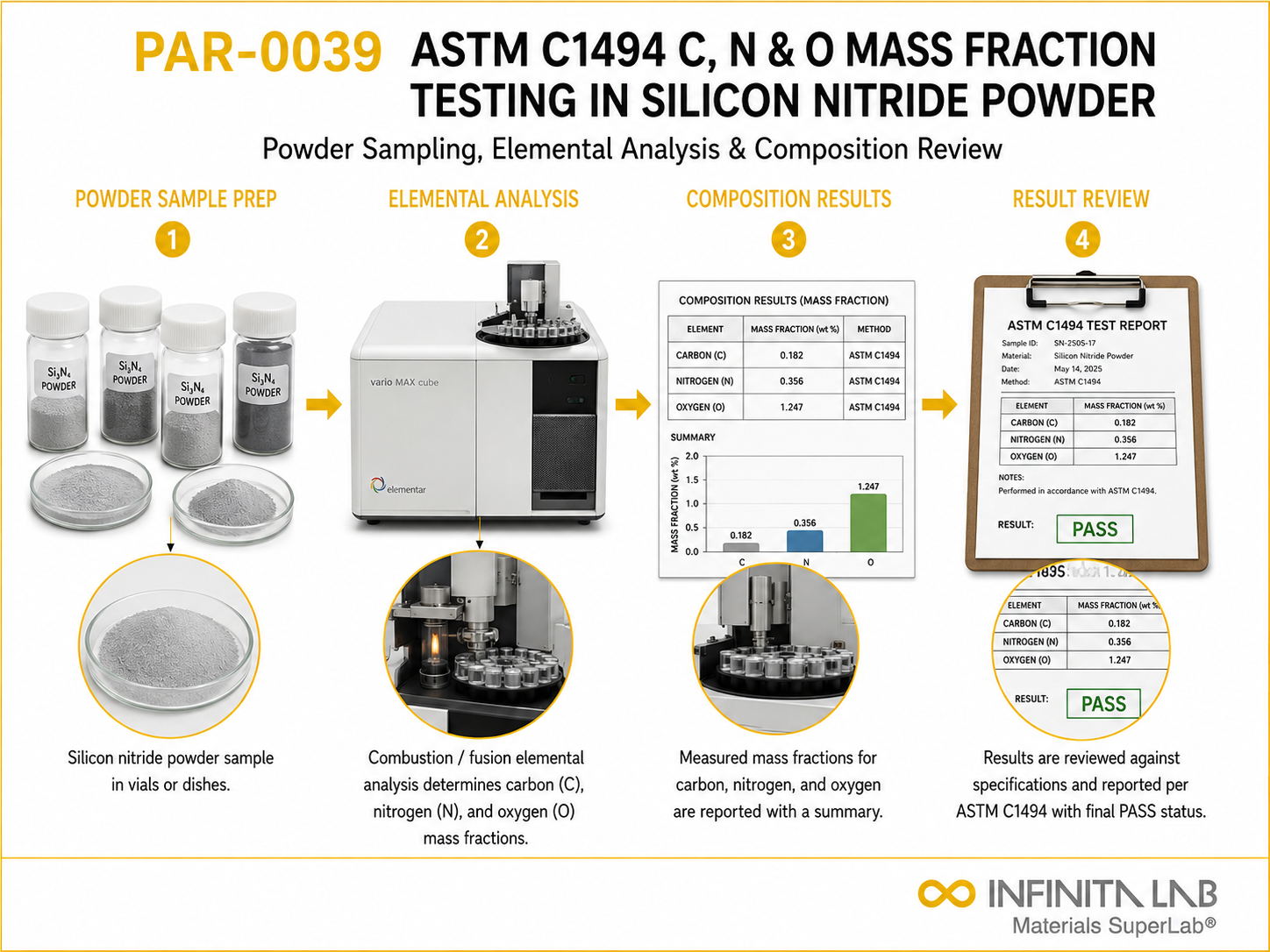
Two test methods appear in ASTM C1494. These test methods determine the mass fraction % of Carbon (C), Nitrogen (N), and Oxygen (O) in silicon nitride powder having chemical compositions within limits.
TRUSTED BY


Precision-driven testing for dimensional accuracy and compliance
- Overview
- Scope, Applications, and Benefits
- Test Process
- Specifications
- Instrumentation
- Results and Deliverables
Overview
ASTM C1494 defines a standardized method for determining the mass fractions of carbon, nitrogen, and oxygen in silicon nitride powder. These elements significantly influence the material’s sintering behavior, mechanical properties, and overall performance in advanced ceramic applications. Accurate quantification ensures material consistency and process reliability.
This test is essential for quality control and research involving silicon nitride powders, as impurities and elemental variations can affect densification and final product properties. ASTM C1494 supports precise compositional analysis, enabling manufacturers to optimize material processing and maintain high-performance standards.

Scope, Applications, and Benefits
Scope
ASTM C1494 specifies procedures for analyzing carbon, nitrogen, and oxygen content in silicon nitride powders using controlled analytical techniques to ensure accurate and reproducible results.
- Applicable to silicon nitride (Si₃N₄) powders
- Determines mass fraction of carbon, nitrogen, and oxygen
- Covers combustion and inert gas fusion techniques
- Includes sample preparation and handling procedures
- Ensures high precision and repeatability
- Suitable for quality control and research applications
Applications
- Quality control of silicon nitride powders
- Advanced ceramic manufacturing
- Aerospace and high-temperature components
- Electronic and semiconductor materials
- Research and development of ceramic materials
- Powder characterization and certification
Benefits
- Ensures accurate elemental composition
- Detects impurities affecting performance
- Supports process optimization and sintering control
- Enhances material consistency and quality
- Provides standardized and reliable analysis
- Assists in research and product development
Test Process
Sample Preparation
Prepare a representative powder sample ensuring proper drying and homogenization.
1Combustion/Fusion
Subject the sample to high-temperature combustion or inert gas fusion to release gases.
2Gas Detection
Measure released gases corresponding to carbon, nitrogen, and oxygen using detectors.
3Result Calculation
Calculate mass fractions based on detected gas quantities and sample weight.
4Technical Specifications
| Parameter | Details |
|---|---|
| Material Type | Silicon nitride (Si₃N₄) powder |
| Elements Measured | Carbon (C), Nitrogen (N), Oxygen (O) |
| Sample Requirement | Finely divided, homogeneous powder |
| Temperature Range | High-temperature combustion/fusion conditions |
| Detection Method | Infrared and thermal conductivity detectors |
| Output Data | Mass fraction (%) of C, N, and O |


- Combustion analyzer
- Inert gas fusion analyzer
- Infrared detectors
- Thermal conductivity detectors
- Analytical balance
- Sample preparation tools
Instrumentation Used for Testing
Results and Deliverables
- Mass fraction of carbon, nitrogen, and oxygen (%)
- Elemental composition analysis report
- Impurity level assessment
- Quality verification of powder
- Compliance with material specifications
- Detailed analytical report with data
Frequently Asked Question
ASTM C1494 is used to determine the mass fractions of carbon, nitrogen, and oxygen in silicon nitride powder. It helps ensure material quality and consistency for advanced ceramic applications requiring precise compositional control.
Elemental composition affects sintering behavior, mechanical strength, and thermal stability. Accurate analysis ensures optimal processing conditions and high-performance characteristics in final ceramic products.
Inert gas fusion involves heating the sample in an inert atmosphere to release gases. These gases are measured to determine oxygen and nitrogen content accurately.
Homogeneity ensures that the sample represents the entire batch. It is essential for obtaining accurate and reliable results in elemental analysis.
Nitrogen is a primary component of silicon nitride. Its content influences the material’s structure, strength, and thermal stability.
Why Choose Infinita Lab for Advanced Materials Testing and Characterization?
At the core of this breadth is our network of 2,000+ accredited laboratories across the USA, offering access to over 10,000 testing methods and analytical services. From advanced materials characterization (SEM, TEM, RBS, XPS) to mechanical, chemical, environmental, biological, and standardized ASTM/ISO-compliant testing, we deliver unmatched flexibility, specialization, and scale. You are never limited by geography, facility, or methodology — Infinita Lab connects you to the right expertise and testing solution, every time.

Looking for a Trusted Partner for Accurate and Reliable Testing Services?
Send query us at hello@infinitalab.com or call us at (888) 878-3090 to learn more about our services and how we can support you.



Request a Quote
Submit your material details and receive testing procedures, pricing, and turnaround time within 24 hours.
 Quick Turnaround and Hasslefree process
 Confidentiality Guarantee
 Free, No-obligation Consultation
 100% Customer Satisfaction
