


ASTM E350: Carbon Low Alloy Steel Chemical Analysis Testing Services
Accredited ASTM E350 carbon low alloy steel chemical analysis testing from Infinita Lab, performed to the exact standard requirements - accurate, reproducible results with full documentation for compliance, R&D, and quality control programs.
TRUSTED BY


Get ASTM E350 compliant results - request your carbon low alloy steel chemical analysis testing quote
- Overview
- Scope, Applications, and Benefits
- Test Process
- Specifications
- Instrumentation
- Results and Deliverables
What Is ASTM E350 Carbon Low Alloy Steel Chemical Analysis?
ASTM E350, Standard Test Methods for Chemical Analysis of Carbon Steel, Low-Alloy Steel, Silicon Electrical Steel, Ingot Iron, and Wrought Iron, sets out how a laboratory determines the elemental makeup of ferrous materials. The core approach is classical wet chemistry, with a handful of instrumental techniques layered in where they’re genuinely needed. ASTM Committee E01 on Analytical Chemistry for Metals, Ores, and Related Materials holds jurisdiction over it. Current edition: E350-23, last updated December 2023.
E350 isn’t one fixed procedure. It’s a library – dozens of individual test methods, each tied to a specific element and matched to the composition range you’d expect in carbon steel, low-alloy steel, silicon electrical steel, ingot iron, or wrought iron. You pick the method that fits your element and your expected concentration, not the other way around.
Roughly 26 elements fall under the standard’s scope: aluminum, antimony, arsenic, bismuth, boron, calcium, cerium, chromium, cobalt, columbium (niobium), copper, lanthanum, lead, manganese, molybdenum, nickel, nitrogen, oxygen, phosphorus, selenium, silicon, sulfur, tin, titanium, tungsten, vanadium, and zirconium. Most of these lean on gravimetric, titrimetric, and spectrophotometric (colorimetric) chemistry – dissolve the sample, isolate or develop color for the target element, then measure carefully by mass or volume. A smaller set gets handed to atomic absorption spectrometry (AAS) or direct-current plasma atomic emission spectrometry (DCP-AES) instead, wherever those instruments beat wet chemistry on sensitivity or repeatability.
Every method section spells out its own reagents, apparatus, known interferences, and calculations. That’s what makes E350 usable as a referee standard: a dispute over composition gets settled against a specific, documented procedure, not a vague average of several. Because it’s organized method by method rather than grade by grade, a lab only runs the procedures a given specification actually calls for. Nothing more.

Applications and Benefits of ASTM E350 Carbon Low Alloy Steel Chemical Analysis Testing
Scope
ASTM E350-12 outlines procedures for determining the chemical composition of various ferrous materials. It evaluates:
- ASTM E350 covers test methods for the chemical analysis of carbon steel, low-alloy steel, silicon electrical steel, ingot iron, and wrought iron.
- Roughly two dozen elements sit within scope: aluminum, antimony, arsenic, bismuth, boron, calcium, cerium, chromium, cobalt, columbium/niobium, copper, lanthanum, lead, manganese, molybdenum, nickel, nitrogen, oxygen, phosphorus, selenium, silicon, sulfur, tin, titanium, tungsten, vanadium, and zirconium.
- Each method is tied to a defined composition range – the right procedure depends on how much of the element you actually expect in the sample.
- Wet chemistry carries most of the load here. Gravimetric analysis, titrimetric, and spectrophotometric (colorimetric) determination – that’s the bulk of the methods.
- A handful of elements get instrumental treatment instead. Atomic absorption spectrometry is specified for aluminum, bismuth, chromium, copper, manganese, nickel, and vanadium.
- Calcium, cerium, and lanthanum are assigned to direct-current plasma atomic emission spectrometry, since wet-chemical separation doesn’t work well for them.
- Apparatus, reagents, interferences, calculations – each method spells these out individually rather than following one unified workflow.
- E350 mainly functions as a referee method: the method of record when checking whether a material’s composition meets a purchase or mill specification.
- Ferrous product specifications maintained under ASTM Committees A01 (Steel) and A04 (Iron Castings) cross-reference the standard.
- Since E350 is organized by element and method rather than by material grade, laboratories run only the subset of procedures a given specification actually calls for.
Applications
- Verifying incoming steel or iron raw materials meet the chemical composition limits set in purchase orders or mill specifications.
- Resolving disputes between suppliers and purchasers when results from other analytical methods are called into question.
- Backing up quality control during steelmaking and refining – manganese, phosphorus, sulfur, and silicon all shape melt chemistry directly.
- Certifying silicon electrical steel intended for transformer and motor lamination work, where silicon content drives magnetic performance.
- Confirming trace and residual element levels in low-alloy steels used in pressure vessels, structural members, and automotive components.
- Supporting metallurgical research and failure investigations, where exact elemental data helps explain mechanical or corrosion behavior.
- Giving mill test reports and material certifications a documented analytical basis.
Benefits
- Referee-grade accuracy that holds up under scrutiny in contractual or regulatory disputes.
- Covers dozens of elements in one standard, so labs aren’t juggling a pile of disparate test methods.
- Pairs decades-old wet-chemistry procedures with instrumental methods – proven reliability sitting next to modern sensitivity.
- Method-specific guidance on interferences and sample preparation helps keep systematic error down.
- Results are recognized across the steel and iron industry, which smooths communication between suppliers, buyers, and regulators.
- Gives manufacturers a consistent way to compare composition data across different heats, lots, or production facilities.
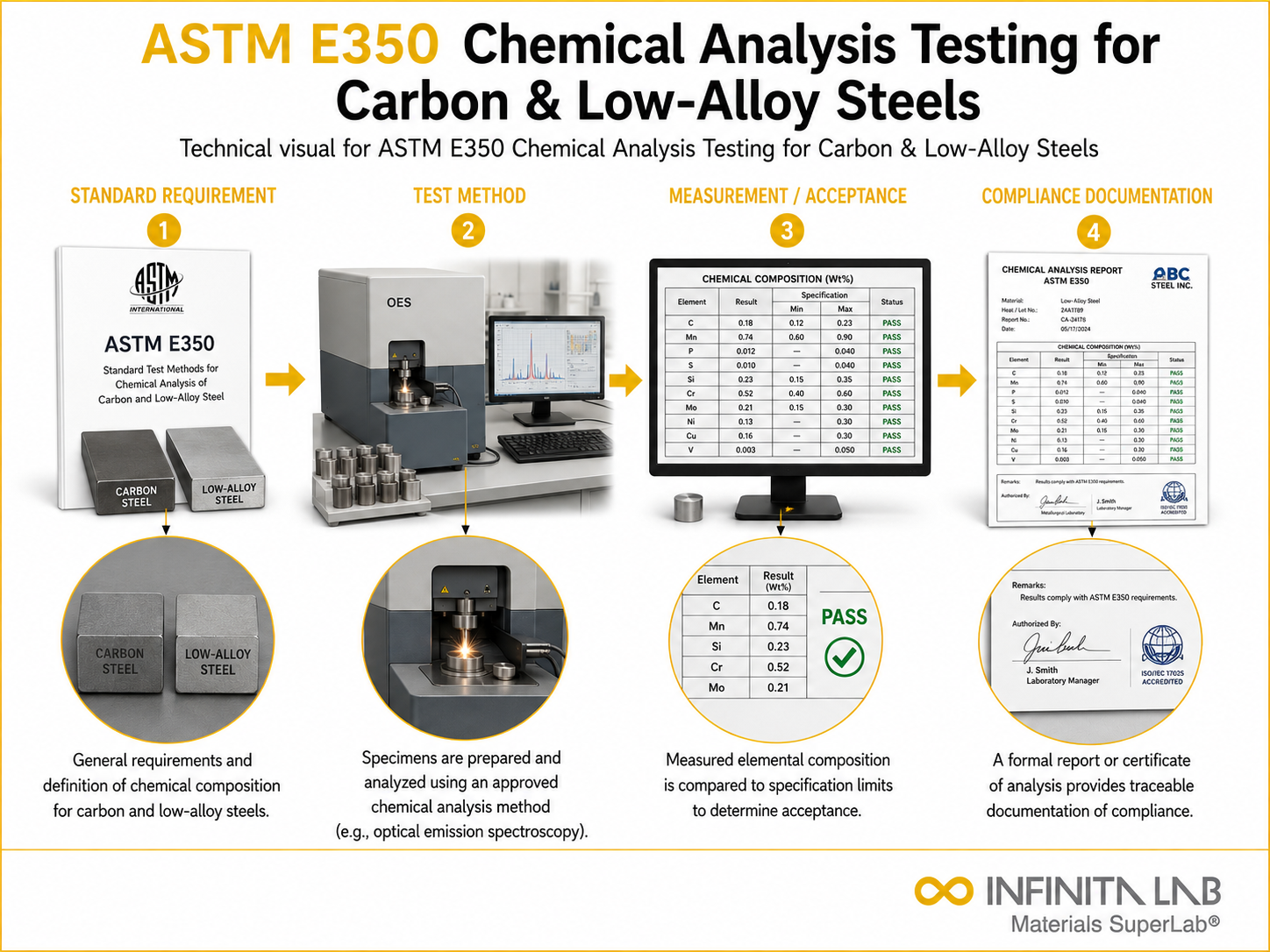
Our ASTM E350 Testing Procedure
Sample Preparation
The specimen is cleaned, machined, or dissolved depending on the analysis technique used.
1Method Selection
Appropriate analytical method (wet chemistry or instrumental) is selected based on elements.
2Elemental Analysis
Elements are measured using titration, spectrometry, or other analytical techniques.
3Data Evaluation & Reporting
Results are calculated and reported as percentage composition of each element.
4ASTM E350 Test Parameters and Requirements
| Parameter | Details |
|---|---|
| Applicable Materials | Carbon steel, low-alloy steel, silicon electrical steel, ingot iron, wrought iron |
| Sample Type | Solid or dissolved samples depending on method |
| Measured Elements | C, Mn, Si, P, S, Cr, Ni, Mo, V, Cu, and trace elements |
| Detection Range | Major (%) to trace levels (ppm) |
| Methods Included | Wet chemistry, OES, AAS, ICP, and other techniques |
| Test Environment | Controlled laboratory conditions |


- Analytical Balance – handles the precision mass measurements that gravimetric work and initial sample weighing both need.
- Atomic Absorption Spectrometer (AAS) – measures elements such as aluminum, bismuth, chromium, copper, manganese, nickel, and vanadium at trace to minor concentration levels.
- Direct-Current Plasma Atomic Emission Spectrometer (DCP-AES) – determines calcium, cerium, lanthanum, and related elements where wet-chemical separation isn’t practical.
- UV-Vis Spectrophotometer – runs the colorimetric methods for phosphorus, silicon, titanium, molybdenum, and cobalt.
- Titration Apparatus – handles the volumetric titrations specified for elements such as manganese and phosphorus.
- Acid Digestion Equipment and Fume Hoods – keep sample dissolution safe and controlled ahead of analysis.
- Muffle Furnace and Drying Ovens – support ignition, drying, and gravimetric sample preparation steps.
Equipment and Instrumentation Used for ASTM E350 Testing
What You Receive: Test Report, Data, and Certification
- A certificate of analysis reporting the measured percentage of each requested element.
- A pass/fail determination against the governing purchase order or mill specification.
- Clear documentation of which E350 method was used for each element.
- Quality-control and reference-material data backing the traceability of reported results.
- Retained raw data suitable for audit or compositional dispute resolution.
- Reports formatted for direct submission to suppliers, purchasers, or regulatory reviewers.
ASTM E350 Carbon Low Alloy Steel Chemical Analysis FAQs
It determines the chemical composition of various ferrous materials by analyzing major, minor, and trace elements, ensuring material quality, verifying alloy grades, and supporting compliance with specifications for industrial and engineering applications.
The standard includes multiple analytical techniques such as wet chemical analysis, optical emission spectrometry, atomic absorption spectroscopy, and ICP methods to accurately determine elemental composition depending on required precision and application.
Chemical composition directly affects mechanical properties, corrosion resistance, and processing behavior, making accurate analysis essential for ensuring product quality, maintaining consistency, and meeting application-specific requirements in industrial and structural applications.
Carbon steels, low-alloy steels, silicon electrical steels, ingot iron, and wrought iron in various forms can be tested to determine elemental composition and ensure compliance with required material standards.
Industries such as automotive, construction, manufacturing, and steel production use ASTM E350-12 to verify material composition, ensure quality control, and maintain compliance with specifications for reliable performance in engineering applications.
ASTM E350 provides test methods for determining the chemical composition of carbon steel, low-alloy steel, electrical steel, and wrought iron. It uses techniques such as wet chemical analysis to measure elements and verify material composition.
Why Choose Infinita Lab for Carbon Low Alloy Steel Chemical Analysis Testing
When your Carbon Low Alloy Steel Chemical Analysis results have to hold up - for compliance, a customer audit, or an engineering decision - ASTM E350 accuracy and an unbiased third-party report matter more than price. Infinita Lab routes your ASTM E350 carbon low alloy steel chemical analysis testing to ISO/IEC 17025-accredited U.S. partner labs with hands-on method experience, so you get defensible data, transparent reporting, and turnaround times built around your project deadline - not ours.

Need ASTM E350 Carbon Low Alloy Steel Chemical Analysis Testing You Can Rely On?
Send query us at hello@infinitalab.com or call us at (888) 878-3090 to learn more about our services and how we can support you.



Request a Quote
Submit your material details and receive testing procedures, pricing, and turnaround time within 24 hours.
 Quick Turnaround and Hasslefree process
 Confidentiality Guarantee
 Free, No-obligation Consultation
 100% Customer Satisfaction
