


ASTM E207: Thermocouple Thermal EMF Testing Services
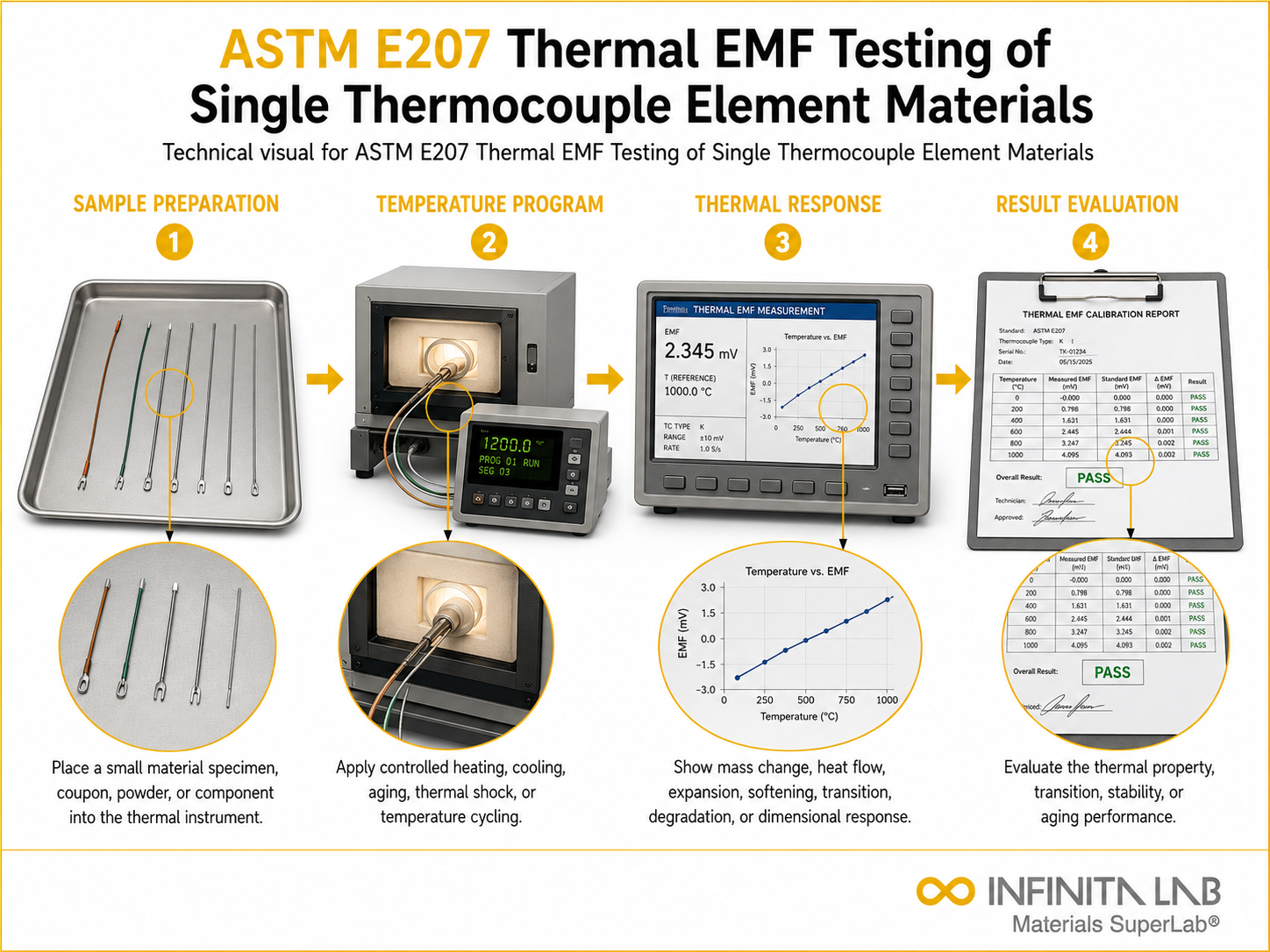
The ASTM E207 test method covers a test for determining the thermoelectric EMF of a thermoelement versus NIST platinum 67 (Pt-67) by measuring the difference between the EMF of the test thermoelement and the EMF of a referenced, which has a known relationship to NIST Pt-67.
TRUSTED BY


Get ASTM E207 compliant results — request your thermocouple thermal EMF testing quote
- Overview
- Scope, Applications, and Benefits
- Test Process
- Specifications
- Instrumentation
- Results and Deliverables
What Is ASTM E207 Thermocouple Thermal EMF?
ASTM E207 describes the test method for determining the thermal electromotive force (EMF) of individual thermocouple wire materials relative to platinum reference wire. The method establishes the thermoelectric relationship for a single thermocouple leg material, providing the fundamental data used to verify thermocouple wire conformance with the standard EMF-temperature tables defined in ASTM E230.
Accurate thermocouple wire qualification is essential for temperature measurement systems in aerospace, heat treatment, nuclear, and industrial process applications where measurement accuracy and traceability directly affect product quality and safety.

Applications and Benefits of ASTM E207 Thermocouple Thermal EMF Testing
Scope
ASTM E207 evaluates:
- Thermal EMF output vs. temperature for individual thermocouple leg materials
- Conformance to ASTM E230 thermocouple type reference tables
- Inhomogeneity assessment along the wire length
- Calibration and verification of Type K, J, T, E, N, R, S, and B wires
Applications
- Thermocouple wire manufacturing quality control
- Incoming inspection of thermocouple wire for critical measurement systems
- Heat treatment furnace thermocouple calibration
- Aerospace and nuclear temperature measurement system qualification
- Calibration laboratory reference standard verification
Benefits
- Verifies thermocouple wire accuracy before deployment
- Identifies out-of-tolerance wire before system installation
- Enables traceability to the ITS-90 temperature scale
- Supports NADCAP and AMS 2750 thermocouple requirements
- Detects inhomogeneity that causes in-situ measurement error
Our ASTM E207 Testing Procedure
Reference Junction Setup
The thermocouple material under test is paired with a reference platinum wire (Pt-67 or Pt-100 standard); both junctions are formed and one reference junction is maintained at 0 °C using an ice bath.
1Temperature Calibration Points
The test junction is immersed in a stirred liquid bath or tube furnace at a series of calibration temperatures (e.g., 0–1200 °C depending on wire type)
2EMF Measurement
The thermal EMF generated between the test wire and the platinum reference is measured at each calibration temperature using a precision nanovoltmeter; readings are recorded at thermal equilibrium.
3Deviation Calculation
Measured EMF values are compared to the ASTM E230 reference EMF-temperature table for the relevant thermocouple type; deviations are calculated and reported as temperature equivalent errors.
4ASTM E207 Test Parameters and Requirements
| Parameter | Details |
|---|---|
| Test Principle | Thermal EMF measurement vs. platinum reference wire |
| Applicable Materials | Type K, J, T, E, N, R, S, B thermocouple wire materials |
| Reference Wire | Pt-67 or Pt-100 platinum standard |
| Temperature Range | 0–1750 °C (material dependent) |
| EMF Measurement Resolution | 0.1 µV (nanovoltmeter) |


- Precision nanovoltmeter (resolution 0.1 µV)
- Ice bath reference junction (0 °C)
- Stirred liquid bath or tube furnace (calibration temperature source)
- Reference platinum resistance thermometer (PRT) traceable to ITS-90
- Platinum reference wire (Pt-67 or Pt-100)
- Data acquisition and deviation analysis software
Equipment and Instrumentation Used for ASTM E207 Testing
What You Receive: Test Report, Data, and Certification
- EMF-temperature data table for the tested wire
- Deviation from ASTM E230 reference table (µV and °C equivalent)
- Conformance assessment per ASTM E230 tolerance classes
- Inhomogeneity assessment (if multiple test positions evaluated)
- Calibration certificate with traceability statement
- Full ASTM E207 test report
ASTM E207 Thermocouple Thermal EMF FAQs
Individual leg testing per ASTM E207 reveals inhomogeneity and material-specific deviations before assembly. Complete thermocouple testing (ASTM E220) verifies the assembled pair but cannot identify which leg is the source of any deviation — critical information for wire selection and manufacturing quality control.
ASTM E207 applies to all standard thermocouple materials defined in ASTM E230/E230M, including Types K, J, T, E, N (base metal) and Types R, S, B (noble metal). The platinum reference wire and temperature range are selected to match the material under test.
Inhomogeneity is a variation in thermoelectric properties along the wire length, caused by cold working, contamination, or alloy segregation. When a temperature gradient falls on an inhomogeneous wire section in service, it introduces a measurement error not detectable by junction-to-junction calibration alone.
Per ASTM E230, standard-grade Type K wire must be within ±2.2 °C or ±0.75% (whichever is greater) from 0–1260 °C. Special-grade wire must be within ±1.1 °C or ±0.4%. NADCAP and AMS 2750 aerospace heat treatment specifications impose additional calibration frequency and tolerance requirements.
Wire is typically tested at manufacture and on incoming inspection. In-service re-calibration frequency depends on application: AMS 2750 requires periodic thermocouple replacement/recalibration intervals (typically 90 days for base metal types in heat treatment furnaces). Wires exposed to contaminating atmospheres or high temperatures degrade faster and require more frequent verification.
Why Choose Infinita Lab for Thermocouple Thermal EMF Testing?
At the core of this breadth is our network of 2,000+ accredited laboratories across the USA, offering access to over 10,000 testing methods and analytical services. From advanced materials characterization (SEM, TEM, RBS, XPS) to mechanical, chemical, environmental, biological, and standardized ASTM/ISO-compliant testing, we deliver unmatched flexibility, specialization, and scale. You are never limited by geography, facility, or methodology — Infinita Lab connects you to the right expertise and testing solution, every time.

Need ASTM E207 Thermocouple Thermal EMF Testing You Can Rely On?
Send query us at hello@infinitalab.com or call us at (888) 878-3090 to learn more about our services and how we can support you.



Request a Quote
Submit your material details and receive testing procedures, pricing, and turnaround time within 24 hours.
 Quick Turnaround and Hasslefree process
 Confidentiality Guarantee
 Free, No-obligation Consultation
 100% Customer Satisfaction
