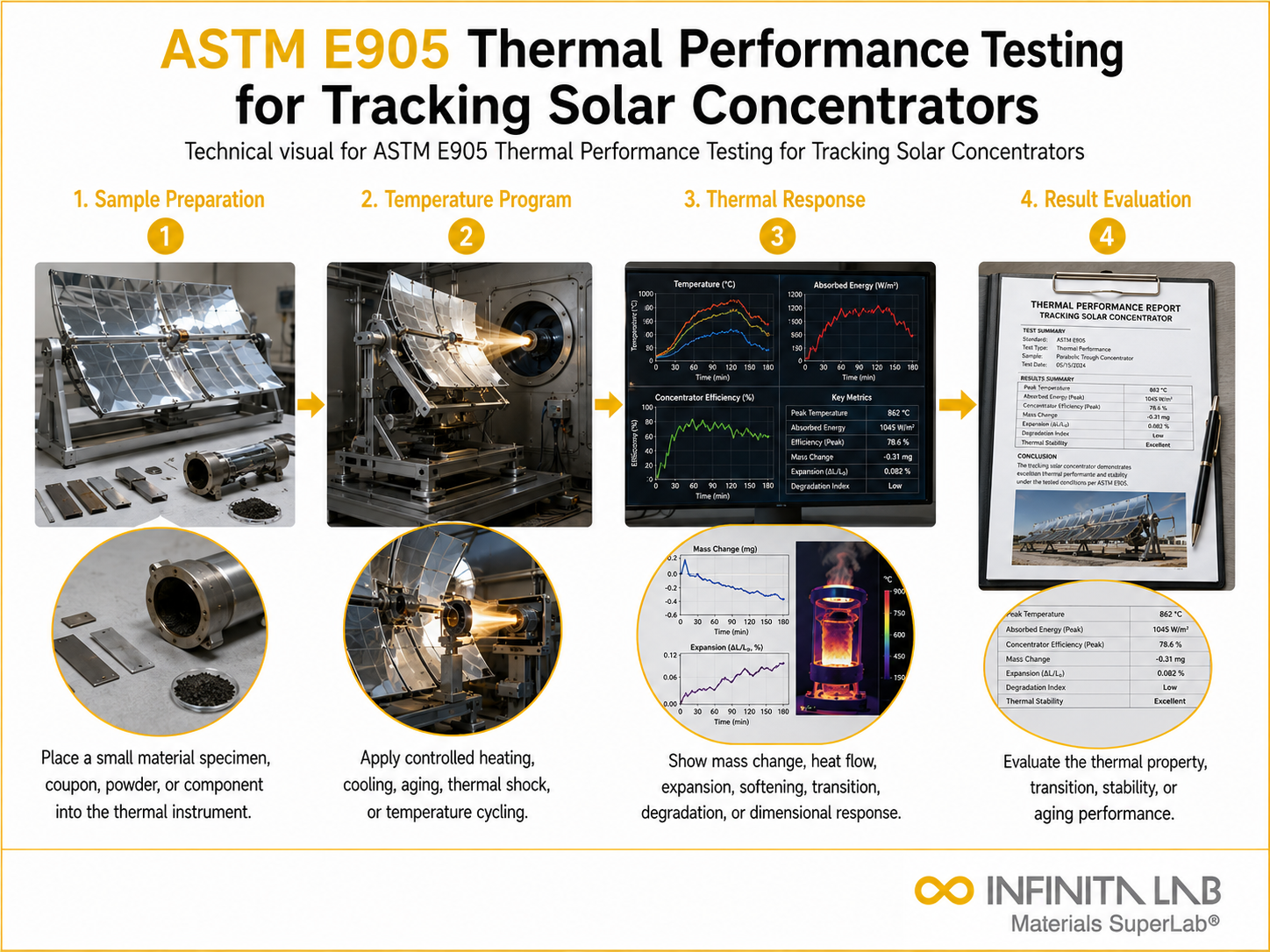


What Is ASTM E905 Solar Concentrating Collector Performance?
ASTM E905 defines procedures for evaluating the thermal performance of tracking solar concentrator systems by measuring their ability to convert incident solar radiation into usable thermal energy. The standard focuses on efficiency, heat gain, and system response under real operating conditions.
This method is essential for assessing concentrator-based solar thermal systems used in energy generation and research applications. It provides reliable performance data under varying solar angles, helping optimize optical alignment, heat collection efficiency, and overall system design.

Applications and Benefits of ASTM E905 Solar Concentrating Collector Performance Testing
Scope
ASTM E905 establishes test methods for determining the thermal output and efficiency of solar tracking concentrators under controlled or field conditions. It evaluates system performance based on solar input and thermal energy output.
The method applies to parabolic, linear, and other tracking concentrator designs used in solar thermal energy systems. It ensures consistent evaluation under varying solar radiation conditions.
- Applicable to tracking solar concentrator systems
- Measures thermal energy conversion efficiency
- Evaluates optical and thermal performance
- Suitable for field and laboratory testing
- Accounts for varying solar radiation conditions
- Supports system comparison and optimization
Applications
- Solar thermal power generation systems
- Renewable energy performance evaluation
- Concentrated solar heating systems
- Research and development of solar collectors
- Industrial solar process heat systems
- Efficiency benchmarking of solar concentrators
- Design validation of tracking mechanisms
- Energy system optimization studies
Benefits
- Provides accurate solar-to-thermal efficiency data
- Supports optimization of tracking systems
- Improves design of solar concentrators
- Enables performance comparison across systems
- Enhances renewable energy system reliability
- Reduces energy loss through better alignment
- Standardizes solar thermal testing procedures
- Supports sustainable energy development
Our ASTM E905 Testing Procedure
System Setup
Install and align solar concentrator with tracking system under controlled or field conditions.
1Solar Input Measurement
Measure incident solar radiation using calibrated pyranometers or radiometers.
2Thermal Output Measurement
Record heat transfer fluid temperature rise and flow rate to determine thermal energy gain.
3Performance Evaluation
Calculate efficiency by comparing thermal output with solar energy input under test conditions.
4ASTM E905 Test Parameters and Requirements
| Parameter | Details |
|---|---|
| Collector Type | Tracking concentrating solar collectors (parabolic trough, dish, linear Fresnel, etc.) |
| Collector Orientation | Sun-tracking with an automatic tracking system |
| Temperature Measurement | Inlet and outlet fluid temperatures measured using calibrated sensors |
| Aperture Area | Defined and measured collector aperture area |
| Data Recording Interval | Fixed and uniform time intervals during steady operation |
| Energy Basis | Incident solar radiation and heat gain |
| Units | W/m², kW, or efficiency (%) |


- Pyranometer or solar radiation sensor
- Temperature sensors (thermocouples or RTDs)
- Flow meters for heat transfer fluid
- Data acquisition system
- Solar tracking control system
- Heat exchanger or thermal loop setup
Equipment and Instrumentation Used for ASTM E905 Testing
What You Receive: Test Report, Data, and Certification
- Solar thermal conversion efficiency (%)
- Incident solar radiation data
- Heat gain and energy output values
- System performance curves
- Environmental test conditions record
- Final thermal performance report
ASTM E905 Solar Concentrating Collector Performance FAQs
ASTM E905 measures incident solar radiation and corresponding thermal output from the concentrator system, allowing calculation of real-time efficiency based on actual operating conditions including tracking accuracy and environmental variability.
Tracking accuracy directly affects solar beam alignment with the receiver. Even small angular deviations can significantly reduce energy concentration and overall thermal efficiency.
The heat transfer fluid carries absorbed thermal energy. Its temperature rise and flow rate are used to calculate total thermal energy output of the system.
Advanced sensors, real-time tracking correction, and high-resolution data systems improve measurement precision and system evaluation.
Optical losses occur due to reflection and misalignment, while thermal losses occur through convection and radiation from the receiver, both evaluated through efficiency comparison.
Why Choose Infinita Lab for Solar Concentrating Collector Performance Testing?
When your Solar Concentrating Collector Performance results have to hold up - for compliance, a customer audit, or an engineering decision - ASTM E905 accuracy and an unbiased third-party report matter more than price. Infinita Lab routes your ASTM E905 solar concentrating collector performance testing to ISO/IEC 17025-accredited U.S. partner labs with hands-on method experience, so you get defensible data, transparent reporting, and turnaround times built around your project deadline - not ours.

Need ASTM E905 Solar Concentrating Collector Performance Testing You Can Rely On?
Send query us at hello@infinitalab.com or call us at (888) 878-3090 to learn more about our services and how we can support you.