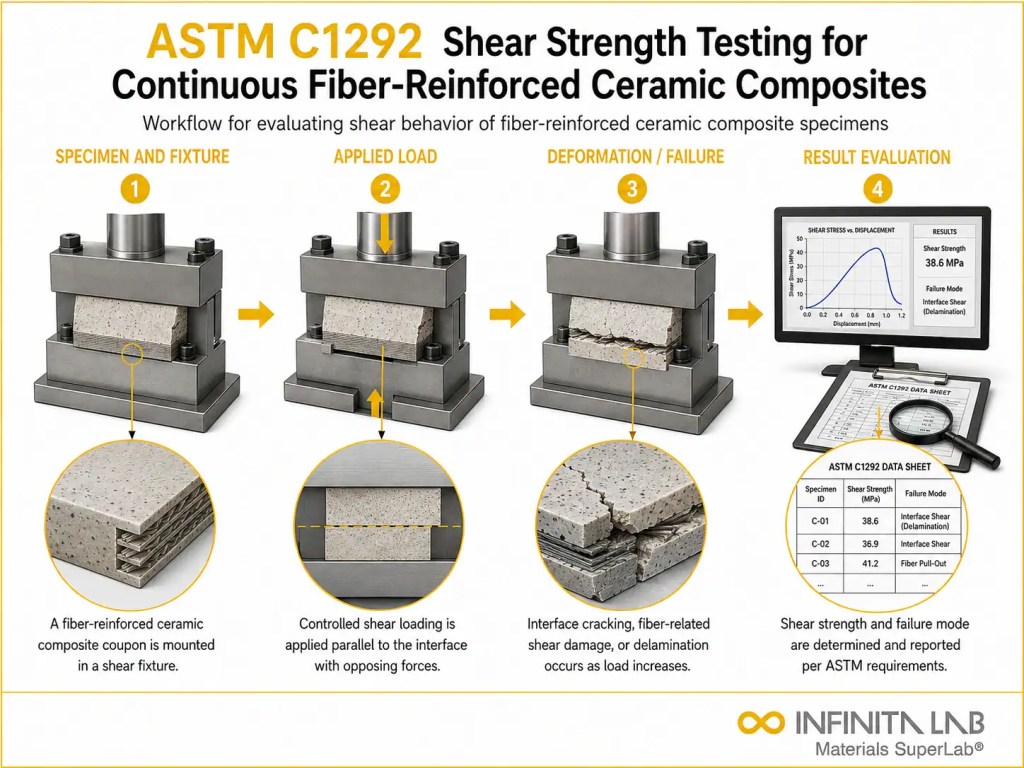


What Is ASTM C1292 Continuous Fiber Ceramic Composite Shear Strength?
ASTM C1292 specifies the test method for determining the shear strength of continuous fiber-reinforced ceramic composites. These materials exhibit complex behavior due to fiber-matrix interactions, making shear strength a critical property for evaluating structural performance under load conditions.
This standard is widely used in aerospace, defense, and high-temperature engineering applications where ceramic matrix composites are subjected to shear forces. ASTM C1292 ensures accurate and repeatable measurement, supporting material development, quality control, and structural design validation.
Applications and Benefits of ASTM C1292 Continuous Fiber Ceramic Composite Shear Strength Testing
Scope
ASTM C1292 covers the determination of shear strength of continuous fiber-reinforced ceramic composites using standardized mechanical testing procedures. It includes specimen preparation, loading conditions, and calculation methods to ensure reliable and reproducible results.
Includes:
- Shear strength measurement of ceramic matrix composites
- Evaluation of fiber-matrix interaction under shear loading
- Standardized specimen preparation and geometry
- Controlled loading and testing procedures
- Data analysis and reporting requirements
Applications
- Aerospace structural components
- Defense and military systems
- High-temperature engineering materials
- Turbine and engine components
- Advanced composite research
- Structural material development
Benefits
- Accurate measurement of shear properties
- Supports design of composite structures
- Evaluates fiber-matrix bonding performance
- Improves material reliability and safety
- Standardized and repeatable testing method
- Essential for high-performance applications
Our ASTM C1292 Testing Procedure
Specimen Preparation
Composite specimens are machined to specified dimensions ensuring proper fiber orientation.
1Test Setup
Specimen is mounted in a shear testing fixture aligned within a universal testing machine.
2Load Application
Shear load is applied at a controlled rate until failure occurs.
3Result Calculation
Shear strength is calculated using maximum load and specimen dimensions.
4ASTM C1292 Test Parameters and Requirements
| Parameter | Details |
|---|---|
| Material Type | Continuous fiber-reinforced ceramic composites |
| Loading Type | Controlled shear load application |
| Specimen Geometry | Defined dimensions with fiber orientation control |
| Measurement Parameter | Shear strength at failure |
| Test Environment | Typically ambient conditions |
| Failure Mode | Fiber-matrix interface or matrix failure |


- Universal Testing Machine (UTM)
- Shear test fixtures
- Vernier calipers or micrometers
- Data acquisition system
- Alignment tools
- Optical microscope
Equipment and Instrumentation Used for ASTM C1292 Testing
What You Receive: Test Report, Data, and Certification
- Shear strength test report
- Load versus displacement data
- Failure mode analysis
- Specimen dimension records
- Compliance certification as per ASTM C1292
- Test summary and evaluation report
ASTM C1292 Continuous Fiber Ceramic Composite Shear Strength FAQs
ASTM C1292 is used to determine the shear strength of continuous fiber-reinforced ceramic composites, providing essential data for evaluating structural performance, material reliability, and suitability for high-performance applications such as aerospace and defense systems.
Shear strength is critical for understanding how materials resist sliding forces between layers, especially in composites where fiber-matrix bonding significantly influences mechanical performance and failure behavior.
Fiber-matrix interaction refers to the bonding and load transfer between fibers and the surrounding matrix, which plays a key role in determining overall mechanical properties.
The method requires precise specimen preparation and alignment, and results may vary depending on fiber orientation and material uniformity, requiring careful testing and interpretation.
Fiber orientation influences load distribution and failure behavior, making it a critical factor in determining shear strength and overall material performance.
Ceramic matrix composite testing evaluates the mechanical properties and structural performance of ceramic composites reinforced with continuous fibers. According to ASTM C1292, shear testing is performed at ambient temperature using double-notched compression specimens or the Iosipescu method. The results help assess shear strength, material deformation, and performance for material characterization, quality assurance, and design applications.
According to ASTM C1292, interlaminar shear strength testing evaluates the resistance of continuous fiber-reinforced ceramic matrix composites to shear failure between layers. A double-notched specimen is subjected to compressive loading, creating shear stresses in the section between the notches. The maximum force at failure is recorded and used with the specimen’s shear area to calculate shear strength. This method helps characterize composite integrity and compare material performance at ambient temperature.
Why Choose Infinita Lab for Continuous Fiber Ceramic Composite Shear Strength Testing
When your Continuous Fiber Ceramic Composite Shear Strength results have to hold up - for compliance, a customer audit, or an engineering decision - ASTM C1292 accuracy and an unbiased third-party report matter more than price. Infinita Lab routes your ASTM C1292 continuous fiber ceramic composite shear strength testing to ISO/IEC 17025-accredited U.S. partner labs with hands-on method experience, so you get defensible data, transparent reporting, and turnaround times built around your project deadline - not ours.

Need ASTM C1292 Continuous Fiber Ceramic Composite Shear Strength Testing You Can Rely On?
Send query us at hello@infinitalab.com or call us at (888) 878-3090 to learn more about our services and how we can support you.



