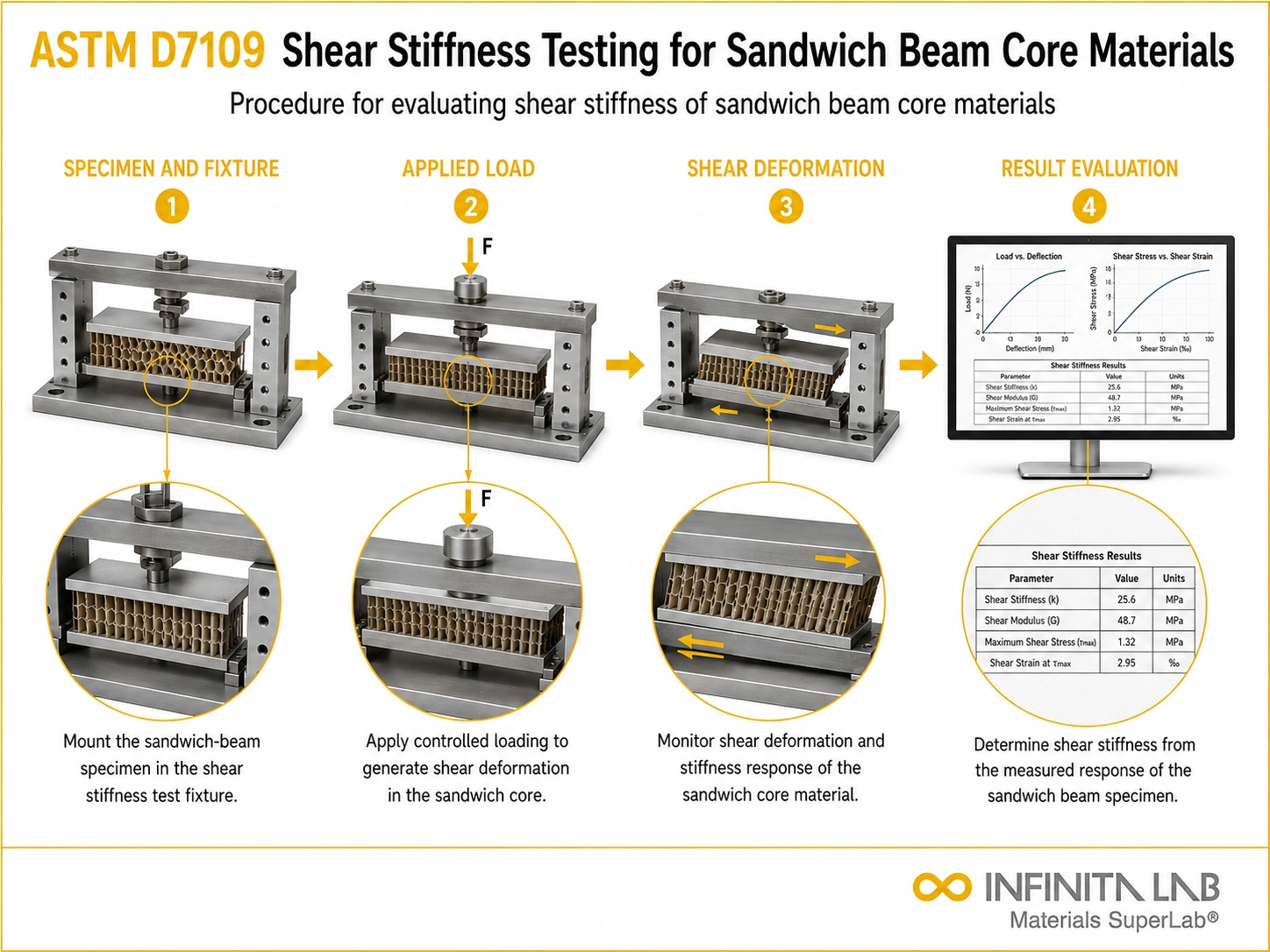


What Is ASTM D7109 Shear Stiffness Sandwich Core?
ASTM D7109-12 describes a test method for evaluating the shear stability of polymer-containing lubricating fluids using a diesel injector nozzle apparatus. High-molecular-weight polymers used as viscosity index improvers (VII) in lubricants are subject to mechanical shearing in engine components, which permanently degrades the polymers and reduces the fluid’s viscosity.
This test predicts the permanent viscosity loss that polymer-containing lubricants will experience under high shear conditions in diesel engines, providing critical data for lubricant formulation and specification compliance.

Applications and Benefits of ASTM D7109 Shear Stiffness Sandwich Core Testing
Scope
ASTM D7109-12 applies to polymer-containing engine oils, hydraulic fluids, and gear oils and measures:
- Permanent viscosity loss after defined shear cycles
- Percent shear stability index (SSI) of the polymer additive
- Effect of shear cycles on kinematic viscosity grade retention
- Compliance with API, ACEA, or OEM viscosity grade specifications
Applications
- Engine oil viscosity index improver evaluation
- Multigrade engine oil formulation and qualification
- Hydraulic fluid shear stability assessment
- Gear oil shear stability screening
- API engine oil certification testing
Benefits
- Rapid, bench-scale prediction of field shear degradation
- Enables comparison of VII polymer shear stability
- Identifies viscosity grade dropout risk under mechanical shear
- Supports extended drain interval formulation development
- Reproducible and well-correlated to field performance data
Our ASTM D7109 Testing Procedure
Initial Viscosity Measurement
Kinematic viscosity of the test fluid is measured at 100°C before shearing per ASTM D445.
1Shear Cycling
The fluid is passed through a calibrated diesel injector nozzle under defined pressure for a specified number of cycles (typically 30 or 90).
2Post-Shear Viscosity Measurement
Kinematic viscosity is re-measured at 100°C after shearing.
3SSI Calculation
Shear stability index (SSI) is calculated from the viscosity before and after shearing relative to the base fluid viscosity.
4ASTM D7109 Test Parameters and Requirements
| Parameter | Details |
|---|---|
| Test Principle | High-pressure injector nozzle shear of polymer-containing fluid |
| Applicable Materials | Multigrade engine oils, polymer-containing lubricants |
| Shear Cycles | 30 or 90 passes as specified |
| Measured Output | KV after shear (mm²/s), shear stability index (SSI, %) |
| Reference Viscosity | Per ASTM D445 at 100°C |


- KRL diesel injector shear stability apparatus
- Calibrated diesel injector nozzle
- Kinematic viscosity bath (per ASTM D445)
- Calibrated glass capillary viscometer
- Thermostatic bath for temperature control
Equipment and Instrumentation Used for ASTM D7109 Testing
What You Receive: Test Report, Data, and Certification
- Kinematic viscosity before and after shear (mm²/s at 100°C)
- Permanent viscosity loss (%)
- Shear stability index (SSI, %)
- Viscosity grade retention assessment
- Test report for lubricant specification compliance
ASTM D7109 Shear Stiffness Sandwich Core FAQs
SSI expresses the percentage of viscosity contributed by the polymer that is permanently lost after shearing; a lower SSI value indicates a more shear-stable polymer.
Viscosity index improving polymers used in multigrade oils are long-chain molecules that can be mechanically broken into shorter segments by high-shear engine components, permanently reducing viscosity.
Both measure permanent shear loss; D7109 uses a diesel injector geometry, while D6278 uses a tapered roller bearing — results can differ depending on polymer architecture.
Lower SSI is better — it means less viscosity is lost from shearing. SSI values below 25–30% are typically required for modern engine oil specifications.
Yes — D7109 is applicable to polymer-containing hydraulic fluids (HV type) in addition to engine oils, where viscosity grade retention is important for system performance.
Why Choose Infinita Lab for Shear Stiffness Sandwich Core Testing
When your Shear Stiffness Sandwich Core results have to hold up - for compliance, a customer audit, or an engineering decision - ASTM D7109 accuracy and an unbiased third-party report matter more than price. Infinita Lab routes your ASTM D7109 shear stiffness sandwich core testing to ISO/IEC 17025-accredited U.S. partner labs with hands-on method experience, so you get defensible data, transparent reporting, and turnaround times built around your project deadline - not ours.

Need ASTM D7109 Shear Stiffness Sandwich Core Testing You Can Rely On?
Send query us at hello@infinitalab.com or call us at (888) 878-3090 to learn more about our services and how we can support you.





