


ASTM D5574: Wood Bonding Adhesive Mechanical Testing Services
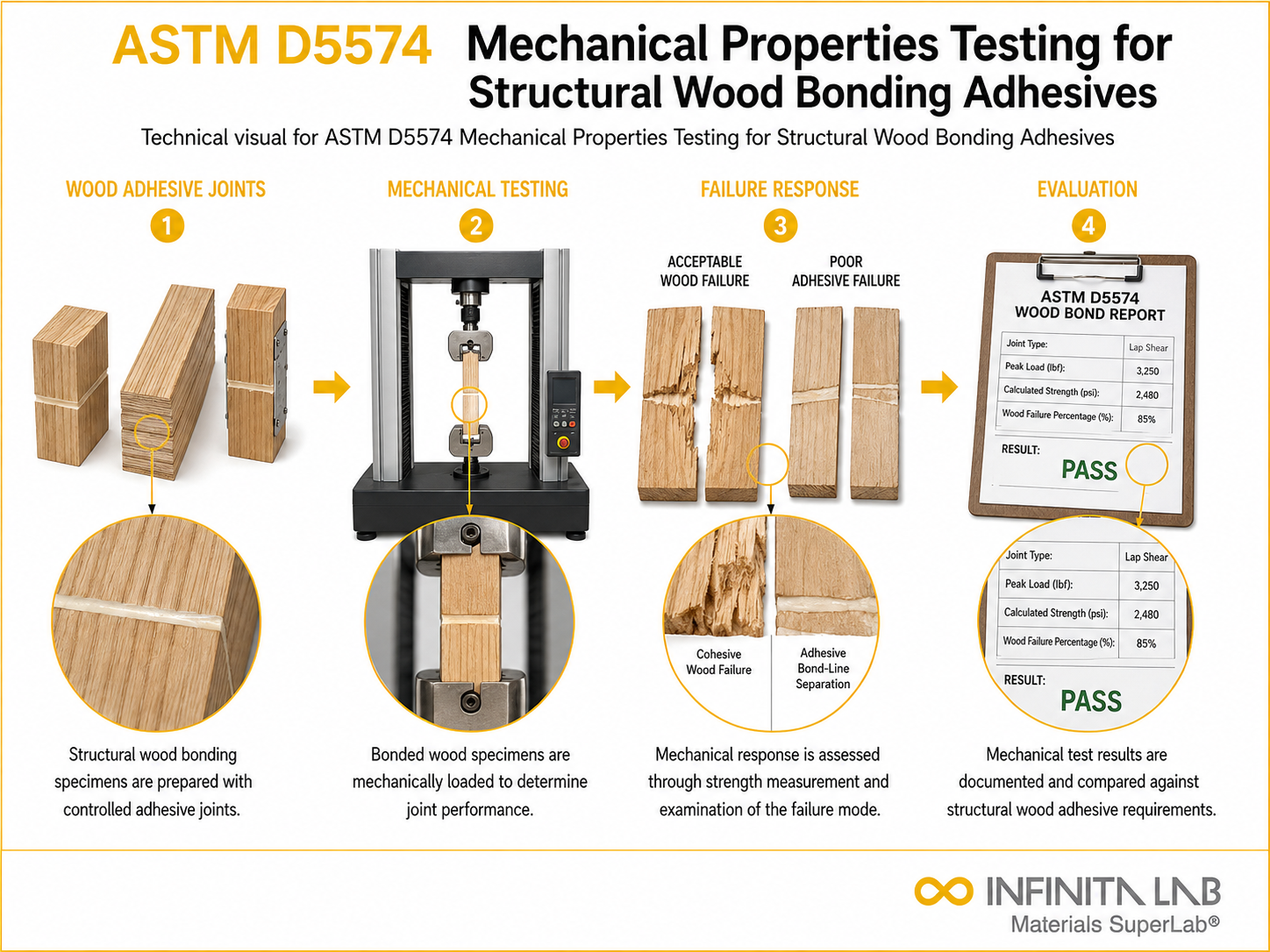
ASTM D5574 covers a set of standard test methods addressing how to establish allowable mechanical properties of adhesives for the structural design of adhesive-bonded joints and assemblies of wood, or wood with other materials. The allowable shear strength is reported in pounds per square inch (psi).
TRUSTED BY


Get ASTM D5574 compliant results — request your wood bonding adhesive mechanical testing quote
- Overview
- Scope, Applications, and Benefits
- Test Process
- Specifications
- Instrumentation
- Results and Deliverables
What Is ASTM D5574 Wood Bonding Adhesive Mechanical?
The ASTM D5574 standard guides the determination of acceptable mechanical properties of adhesives used in structural wood bonding applications. For timber buildings to be strong, durable, and reliable over time, adhesive performance is essential.
An adhesive’s capacity to transmit loads and maintain structural integrity under various operating conditions is determined by mechanical properties, including tensile strength, shear strength, and elasticity. ASTM D5574 emphasizes performance testing to ensure compliance with safety regulations and long-term durability, given that construction sites subject adhesives to moisture, temperature fluctuations, and sustained stresses.

Applications and Benefits of ASTM D5574 Wood Bonding Adhesive Mechanical Testing
Scope
ASTM D5574 establishes standard test procedures for evaluating the allowable mechanical properties of adhesives used in:
- Wood-to-wood bonded joints
- Wood-to-other material assemblies
- Structurally bonded components
It determines:
- Permissible shear stress
- Permissible tensile stress
- Permissible shear modulus
- Long-term performance through creep and durability testing
The standard supports design decisions by defining safety factors applied to allowable stresses.
Applications
- Structural timber construction
- Engineered wood products
- Plywood and composite panels
- Furniture and cabinetry assembly
- Laminated beams and columns
- Doors, windows, and frames
- Industrial wood structures
Benefits
- Ensures long-term structural safety
- Supports adhesive selection for wood bonding
- Evaluates durability under environmental exposure
- Predicts the service life of bonded joints
- Provides standardized mechanical property data
- Improves the reliability of timber structures
Our ASTM D5574 Testing Procedure
Specimen Preparation
Adhesive-bonded wood or composite specimens are fabricated in accordance with standards.
1Creep-Rupture & Aging Testing
Time-to-failure tests are performed, and specimens are aged to assess durability.
2Tensile, Shear & Treated Wood Testing
Strength tests are conducted, including on treated wood if required.
3Data Analysis
Results are analyzed and adjusted to meet design limits using safety factors.
4ASTM D5574 Test Parameters and Requirements
| Parameter | Details |
|---|---|
| Applicable Materials | Wood and wood-to-material bonded joints |
| Tensile & Shear Sample Size | Minimum 30 specimens |
| Durability Testing Sample Size | Minimum 20 specimens per condition |
| Test Focus | Strength, durability, stiffness |
| Output Units | MPa |


- Universal testing machine
- Environmental aging chambers
- Load and displacement sensors
- Creep testing equipment
- Precision grips and fixtures
- Data acquisition software
Equipment and Instrumentation Used for ASTM D5574 Testing
What You Receive: Test Report, Data, and Certification
- Allowable tensile strength values
- Allowable shear strength values
- Elastic (shear) modulus data
- Durability and permanence performance metrics
- Time-to-failure creep curves
- Environmental performance evaluation reports
- Design safety factor recommendations
ASTM D5574 Wood Bonding Adhesive Mechanical FAQs
The objective is to develop a sound method for determining the allowable mechanical properties of wood-bonding adhesives to ensure safety and performance in structural applications.
Durability is determined by exposing test specimens to environmental stressors such as moisture, heat, and chemical agents that simulate real-world conditions.
A representative sample size encompasses the material variability and allows statistical testing with reliable results; thus, there is less chance of overestimating the adhesive's performance.
No, this deals explicitly with adhesives designed for structural wood bonding, not general-purpose or non-load-bearing adhesives.
Changes in production, new formulations, or updates to the structural codes will determine testing frequency. Testing should be done periodically to maintain compliance with safety standards.
Why Choose Infinita Lab for Wood Bonding Adhesive Mechanical Testing?
At the core of this breadth is our network of 2,000+ accredited laboratories across the USA, offering access to over 10,000 testing methods and analytical services. From advanced materials characterization (SEM, TEM, RBS, XPS) to mechanical, chemical, environmental, biological, and standardized ASTM/ISO-compliant testing, we deliver unmatched flexibility, specialization, and scale. You are never limited by geography, facility, or methodology — Infinita Lab connects you to the right expertise and testing solution, every time.

Need ASTM D5574 Wood Bonding Adhesive Mechanical Testing You Can Rely On?
Send query us at hello@infinitalab.com or call us at (888) 878-3090 to learn more about our services and how we can support you.



Request a Quote
Submit your material details and receive testing procedures, pricing, and turnaround time within 24 hours.
 Quick Turnaround and Hasslefree process
 Confidentiality Guarantee
 Free, No-obligation Consultation
 100% Customer Satisfaction
