

What Is ASTM D3163 Rigid Plastic Adhesive Lap Shear?
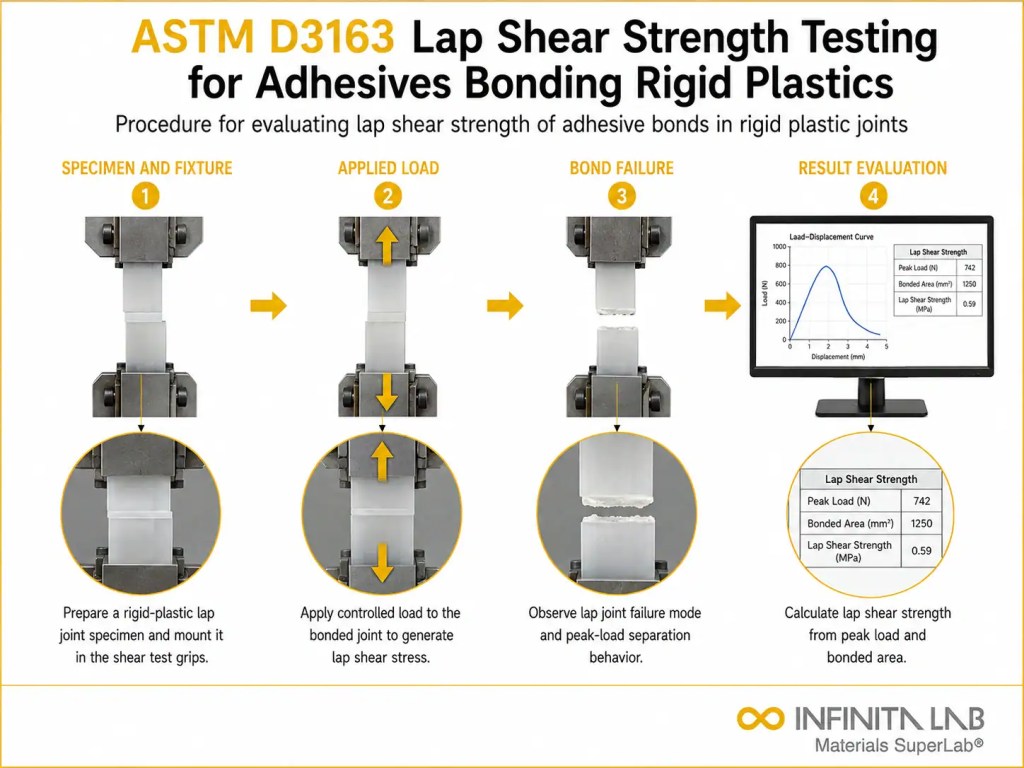
ASTM D3163 defines a standardised method for determining the shear strength of adhesive bonds between rigid plastic adherends using the single-lap shear tension test geometry. As adhesive bonding of plastic components becomes increasingly important in automotive, electronics, and consumer product assembly, this test provides a direct measure of the tensile-shear performance of adhesives on plastic substrates.
The test uses single-lap shear specimens fabricated from rigid plastic adherends bonded with the adhesive under evaluation. The bonded assembly is loaded in tension until failure, and the maximum shear load per unit bond area is reported as the lap shear strength. The test also captures the failure mode — adhesive, cohesive, or substrate failure — which provides additional insight into the bonding performance relative to the substrate and adhesive system.
Applications and Benefits of ASTM D3163 Rigid Plastic Adhesive Lap Shear Testing
Scope
ASTM D3163 evaluates:
- Tensile-shear strength of adhesive bonds on rigid plastics
- Effect of surface preparation on adhesion to plastic
- Influence of adhesive thickness on joint strength
- Substrate failure vs. adhesive failure behaviour
- Comparative performance of different adhesives on plastics
- Effect of environmental conditioning on plastic-adhesive bond strength
Applications
- Automotive plastic component assembly
- Electronic device housing bonding
- Consumer product plastic assembly
- Medical device bonded plastic components
- Appliance plastic structure bonding
- Sporting goods plastic assembly
- Research and development in plastic bonding
Benefits
- Provides directly relevant data for plastic bonding applications
- Enables selection of adhesives optimised for plastic substrates
- Identifies optimal surface preparation methods for plastics
- Detects adhesion failures related to plastic surface energy
- Supports product assembly process development
- Reduces field failures from inadequate plastic-adhesive bonds
Our ASTM D3163 Testing Procedure
Substrate Preparation
Rigid plastic adherends are cut and surface-prepared per the specified method (abrading, priming, plasma treatment).
1Bonding
Adhesive is applied and specimens are assembled with the specified overlap area and bondline thickness.
2Curing
Bonded specimens are cured per the adhesive supplier's specifications.
3Tensile-Shear Testing
Specimens are pulled apart at a controlled rate; peak load and failure mode are recorded.
4ASTM D3163 Test Parameters and Requirements
| Parameter | Details |
|---|---|
| Applicable Materials | Rigid plastics (reinforced and non-reinforced) |
| Specimen Types | Single lap-shear bonded joint specimens |
| Formula Used | Shear Strength = Maximum Load / Bonded Area |
| Maximum Load | Load at joint failure (N) |
| Bonded Area | Overlap bonded area (mm²) |
| Test Environment | Controlled ambient conditions; below plastic softening point |
| Failure Modes Reported | Adhesive, cohesive, or substrate failure |


- Universal testing machine (UTM) with tensile grips
- Single-lap shear alignment fixture
- Surface preparation equipment (abrasive, plasma treater)
- Film thickness gauge for bond line control
- Micrometre and callipers
- Data acquisition software
Equipment and Instrumentation Used for ASTM D3163 Testing
What You Receive: Test Report, Data, and Certification
- Lap-shear strength values (MPa or psi)
- Failure mode classification (adhesive, cohesive, substrate)
- Load-displacement curves
- Surface preparation effect comparison
- Quality assurance reports
ASTM D3163 Rigid Plastic Adhesive Lap Shear FAQs
It measures the lap shear strength of adhesively bonded rigid plastic joints under tensile loading.
The standard is used for rigid plastic substrates, including both reinforced and non-reinforced plastics.
Results are typically reported in MPa (megapascal) or N/mm².
The test records adhesive failure, cohesive failure, or substrate failure, which helps evaluate bond quality.
It is widely used in automotive, aerospace, electronics, and plastic assembly applications for adhesive performance comparison.
ASTM D3163 is a standard test method used to determine the shear strength of adhesively bonded rigid plastic joints under tensile loading. Two plastic specimens are joined with an adhesive in a single-lap configuration and cured under specified conditions. The bonded assembly is placed in a universal testing machine and pulled until the joint fails. The maximum load is used to calculate the apparent shear strength of the adhesive bond. This test helps compare adhesive performance, evaluate plastic surface treatments, and assess bonding quality for manufacturing applications.
Why Choose Infinita Lab for Rigid Plastic Adhesive Lap Shear Testing
When your Rigid Plastic Adhesive Lap Shear results have to hold up — for compliance, a customer audit, or an engineering decision — ASTM D3163 accuracy and an unbiased third-party report matter more than price. Infinita Lab routes your ASTM D3163 rigid plastic adhesive lap shear testing to ISO/IEC 17025-accredited U.S. partner labs with hands-on method experience, so you get defensible data, transparent reporting, and turnaround times built around your project deadline — not ours.

Need ASTM D3163 Rigid Plastic Adhesive Lap Shear Testing You Can Rely On?
Send query us at hello@infinitalab.com or call us at (888) 878-3090 to learn more about our services and how we can support you.



