


ASTM D2919 Durability Testing for Adhesive Joints Stressed in Shear by Tension
The ASTM D2919 test technique offers information on the durability of adhesive lap-shear joints when they are stressed in various settings, including air, the air in equilibrium with specific solutions, water, aqueous solutions, and other environments at various temperatures.
TRUSTED BY


Precision-driven testing for dimensional accuracy and compliance
- Overview
- Scope, Applications, and Benefits
- Test Process
- Specifications
- Instrumentation
- Results and Deliverables
Overview
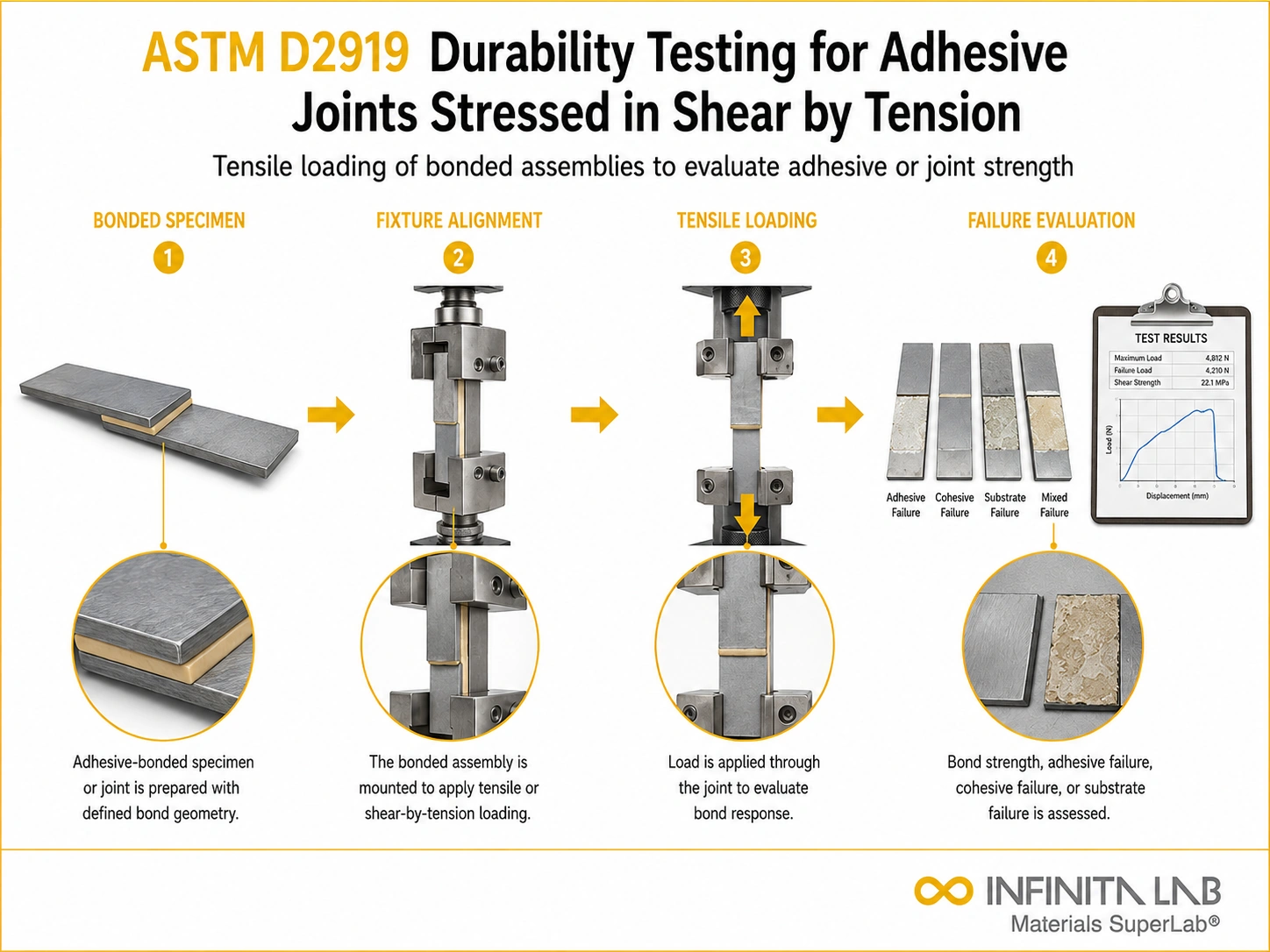
ASTM D2919 defines a standardised procedure for determining the durability of adhesive joints subjected to sustained tensile-shear stress under environmental exposure. This test is designed to evaluate how well an adhesive bond maintains its integrity when simultaneously stressed and exposed to degrading conditions such as elevated temperature, high humidity, or fluid immersion over an extended period.
Single-lap shear specimens are loaded with a constant tensile force and placed in a controlled environment for the specified test duration. At the end of the exposure, the residual shear strength is measured, or the failure mode and extent of bond degradation are recorded. This combined mechanical and environmental challenge provides a realistic measure of adhesive durability that is difficult to assess from short-term strength tests alone.

Scope, Applications, and Benefits
Scope
ASTM D2919 evaluates:
- Durability of shear adhesive bonds under sustained stress
- Environmental degradation of tensile-shear strength
- Time-to-failure under combined shear load and environment
- Effect of moisture, temperature, and fluid exposure on bond integrity
- Comparative durability of different adhesive systems
- Long-term bond performance in aggressive environments
Applications
- Structural aerospace adhesive bonds
- Automotive body structure adhesives
- Marine and offshore adhesive assemblies
- Industrial equipment bonded joints
- Construction adhesive durability
- Medical device bonded assemblies
- Defence and military structural bonding
Benefits
- Reveals adhesive degradation under realistic service conditions
- Enables prediction of long-term joint performance
- Supports adhesive selection for sustained load applications
- Identifies moisture-sensitive adhesive systems
- Reduces in-service bond failures in harsh environments
- Provides data for design allowables in bonded structures
Test Process
Specimen Fabrication
Single-lap shear specimens are bonded and fully cured per adhesive manufacturer guidelines.
1Load Application
Specimens are placed in a shear loading frame under the specified constant tensile-shear load.
2Environmental Exposure
Loaded specimens are conditioned in the test environment for the required duration.
3Failure / Residual Strength Assessment
Specimens are examined for failure; surviving specimens are tested for residual shear strength.
4Technical Specifications
| Parameter | Details |
|---|---|
| Specimen Types | Single lap-shear bonded specimens |
| Applicable Materials | Adhesive-bonded lap shear joints |
| Loading Type | Shear by tension loading |
| Test Environment | Air, water, aqueous solutions, controlled humidity / temperature |
| Test Conditions | Controlled stress, temperature, and moisture exposure |


- Shear loading frame with dead-weight application
- Environmental conditioning chamber
- Universal testing machine (for residual strength)
- Timer and data logging system
- Micrometre and callipers
- Failure surface examination tools
Instrumentation Used for Testing
Results and Deliverables
- Time-to-failure under sustained shear loading
- Residual shear strength values
- Failure mode classification
- Environmental durability comparison data
- Long-term adhesive performance reports
Frequently Asked Question
It measures the durability and time-to-failure of adhesive joints when subjected to sustained shear stress under tensile loading.
It is used for adhesive-bonded lap joints in metals, plastics, composites, and other engineering substrates.
It helps assess how adhesive joints perform in humid, wet, or temperature-controlled service environments.
Typical results include time to failure, durability comparison, and performance under environmental exposure.
This test is widely used in automotive, aerospace, construction, electronics, and structural bonding applications.
Why Choose Infinita Lab for Advanced Materials Testing and Characterization?
At the core of this breadth is our network of 2,000+ accredited laboratories across the USA, offering access to over 10,000 testing methods and analytical services. From advanced materials characterization (SEM, TEM, RBS, XPS) to mechanical, chemical, environmental, biological, and standardized ASTM/ISO-compliant testing, we deliver unmatched flexibility, specialization, and scale. You are never limited by geography, facility, or methodology — Infinita Lab connects you to the right expertise and testing solution, every time.

Looking for a Trusted Partner for Accurate and Reliable Testing Services?
Send query us at hello@infinitalab.com or call us at (888) 878-3090 to learn more about our services and how we can support you.



Request a Quote
Submit your material details and receive testing procedures, pricing, and turnaround time within 24 hours.
 Quick Turnaround and Hasslefree process
 Confidentiality Guarantee
 Free, No-obligation Consultation
 100% Customer Satisfaction
