


ASTM D6204: Unvulcanized Rubber Rotorless Rheometer Testing Services
ASTM D6204-19a test method is used to determine the flow properties of raw rubber and unvulcanized rubber compounds using an oscillating shear rheometer. The values stated in SI units are to be regarded as standard.
TRUSTED BY


Get ASTM D6204 compliant results — request your unvulcanized rubber rotorless rheometer testing quote
- Overview
- Scope, Applications, and Benefits
- Test Process
- Specifications
- Instrumentation
- Results and Deliverables
What Is ASTM D6204 Unvulcanized Rubber Rotorless Rheometer?
ASTM D6204-19a is a standardized method used to evaluate the rheological properties of unvulcanized rubber compounds using rotorless shear rheometers. These properties are critical for understanding processing behavior, flow characteristics, and curing response during manufacturing.
The method measures torque response as the rubber is subjected to oscillatory shear under controlled temperature conditions. It provides valuable insight into viscosity, stiffness, and cure characteristics, helping manufacturers optimize processing conditions and ensure consistent product quality in rubber-based applications.

Applications and Benefits of ASTM D6204 Unvulcanized Rubber Rotorless Rheometer Testing
Scope
This test method determines rheological properties of unvulcanized rubber using rotorless shear rheometers to evaluate processing and curing behavior.
Includes:
- Measurement of torque and viscosity-related properties
- Evaluation of curing characteristics
- Applicability to unvulcanized rubber compounds
- Use of oscillatory shear testing
- Support for quality control and formulation analysis
Applications
- Rubber manufacturing industries
- Tire production
- Automotive rubber components
- Elastomer formulation development
- Quality control laboratories
- Research and development
Benefits
- Rubber manufacturing industries
- Tire production
- Automotive rubber components
- Elastomer formulation development
- Quality control laboratories
- Research and development
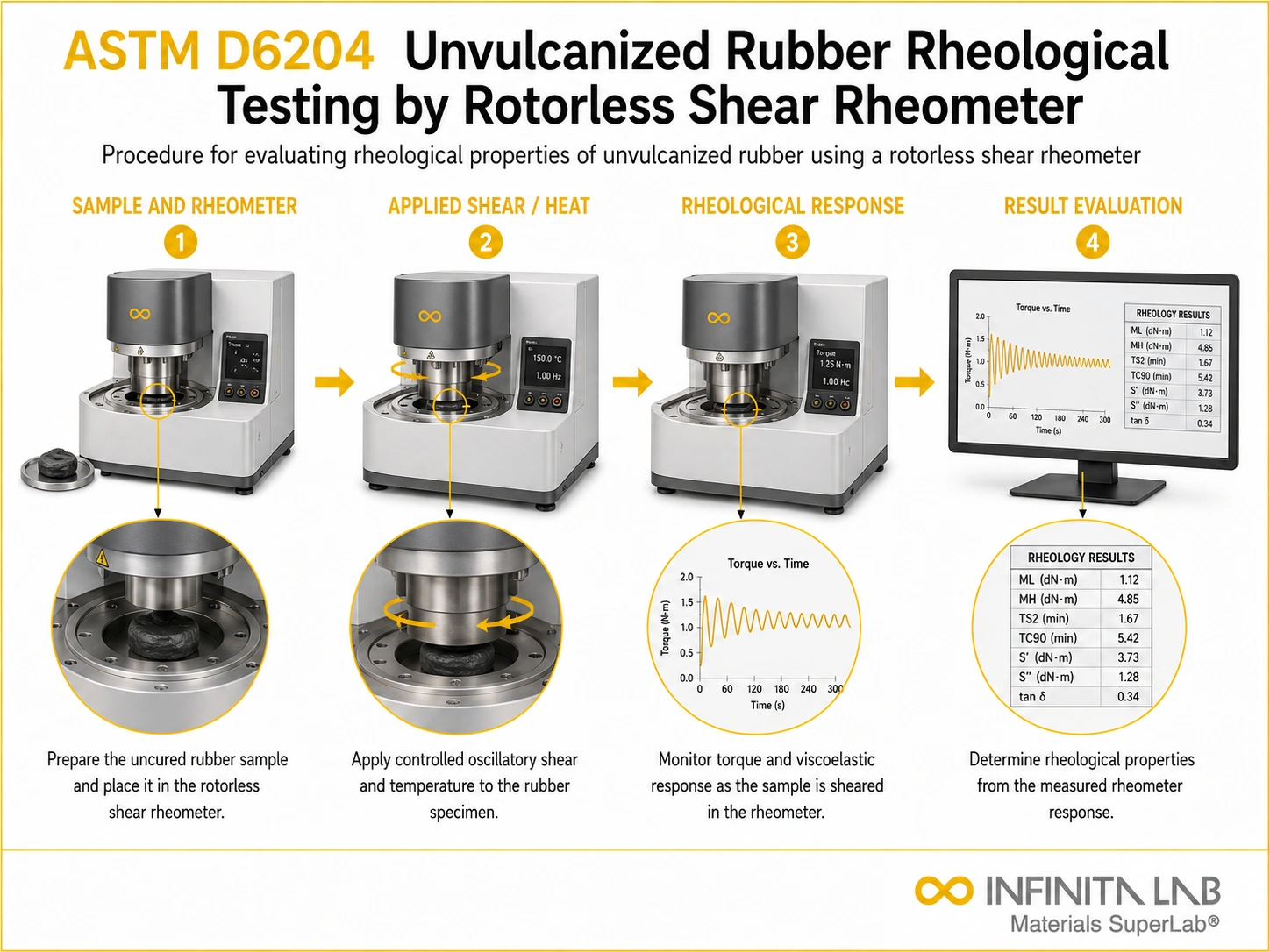
Our ASTM D6204 Testing Procedure
Sample Preparation
Unvulcanized rubber sample is prepared and placed in the rheometer test chamber.
1Temperature Conditioning
The sample is heated to a specified temperature for controlled testing conditions.
2Oscillatory Shear Application
The rheometer applies oscillatory shear and measures torque response over time.
3Data Analysis
Rheological parameters such as minimum torque, maximum torque, and cure time are determined.
4ASTM D6204 Test Parameters and Requirements
| Parameter | Details |
|---|---|
| Property Measured | Rheological behavior and cure characteristics |
| Material Type | Unvulcanized rubber |
| Method | Rotorless shear rheometry |
| Measurement | Torque vs time |
| Output | Minimum torque, maximum torque, cure time |
| Temperature | Controlled test condition |
| Frequency | Oscillatory shear |


- Rotorless shear rheometer (Moving Die Rheometer)
- Temperature-controlled chamber
- Torque measurement system
- Data acquisition software
- Sample preparation tools
- Calibration standards
Equipment and Instrumentation Used for ASTM D6204 Testing
What You Receive: Test Report, Data, and Certification
- Torque vs time curve
- Minimum and maximum torque values
- Cure characteristics (e.g., scorch time, cure time)
- Test conditions and parameters
- Material performance evaluation
- Detailed analytical report
ASTM D6204 Unvulcanized Rubber Rotorless Rheometer FAQs
ASTM D6204-19a provides detailed torque and cure data, enabling manufacturers to adjust processing temperature, mixing conditions, and curing cycles. This helps improve flow behavior, prevent premature curing, and ensure consistent product quality during large-scale production.
Rheological properties determine how rubber flows and reacts during processing. Understanding these properties ensures proper mold filling, uniform curing, and prevention of defects such as incomplete curing or poor mechanical performance.
Rotorless rheometers eliminate mechanical rotor contact, reducing slippage and improving measurement accuracy. They provide more reliable data on rubber behavior under controlled shear and temperature conditions.
Key parameters include minimum torque, maximum torque, scorch time, and cure time. These values help evaluate viscosity, stiffness, and curing characteristics of rubber compounds.
By identifying improper curing behavior or flow characteristics, the method helps adjust formulations and processing conditions, reducing defects such as under-curing, over-curing, or inconsistent material properties.
Why Choose Infinita Lab for Unvulcanized Rubber Rotorless Rheometer Testing?
At the core of this breadth is our network of 2,000+ accredited laboratories across the USA, offering access to over 10,000 testing methods and analytical services. From advanced materials characterization (SEM, TEM, RBS, XPS) to mechanical, chemical, environmental, biological, and standardized ASTM/ISO-compliant testing, we deliver unmatched flexibility, specialization, and scale. You are never limited by geography, facility, or methodology — Infinita Lab connects you to the right expertise and testing solution, every time.

Need ASTM D6204 Unvulcanized Rubber Rotorless Rheometer Testing You Can Rely On?
Send query us at hello@infinitalab.com or call us at (888) 878-3090 to learn more about our services and how we can support you.



Request a Quote
Submit your material details and receive testing procedures, pricing, and turnaround time within 24 hours.
 Quick Turnaround and Hasslefree process
 Confidentiality Guarantee
 Free, No-obligation Consultation
 100% Customer Satisfaction
