

What Is ASTM D6128 Bulk Solid Jenike Shear Cell?
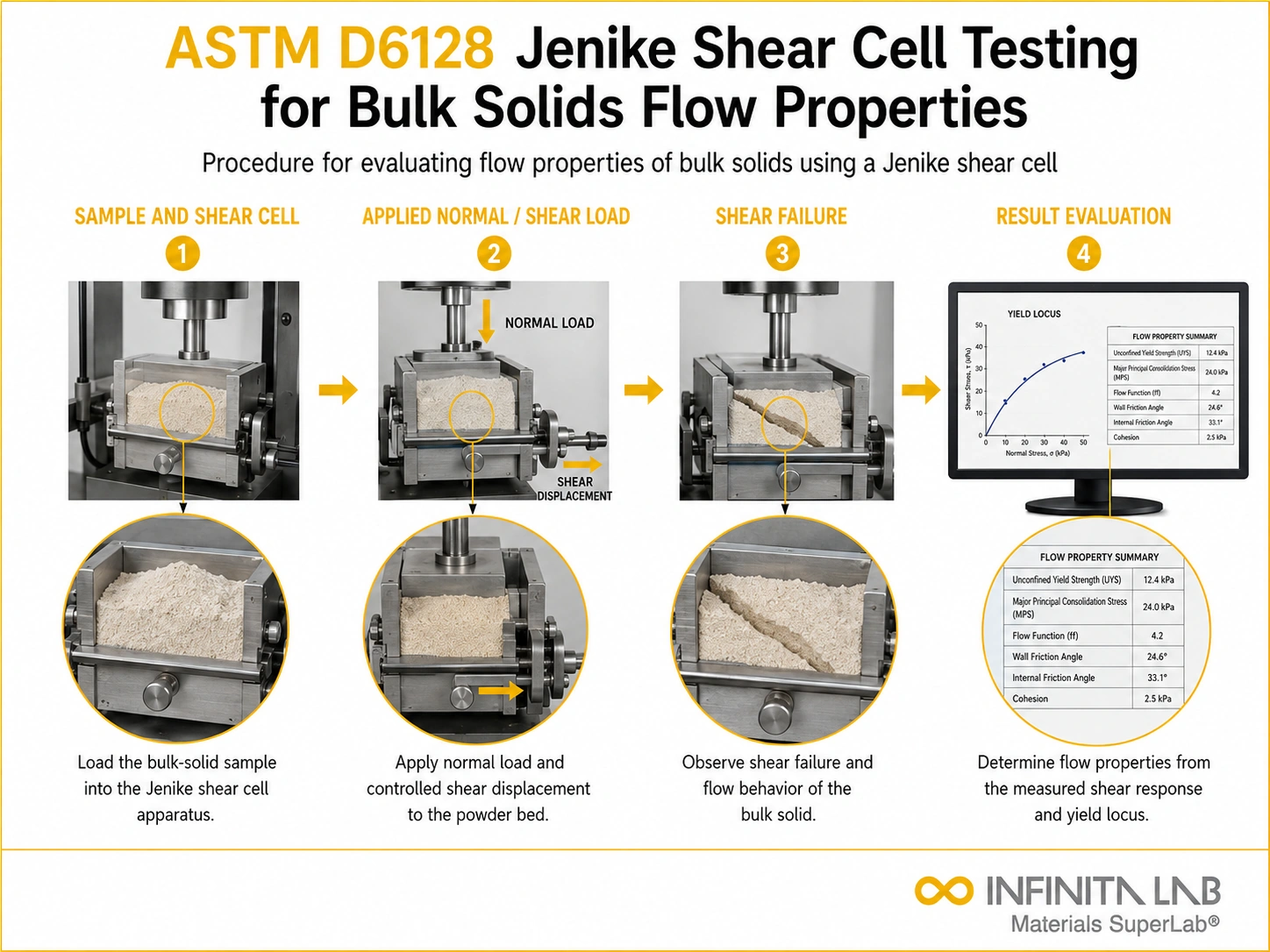
ASTM D6128 specifies a procedure for evaluating the resistance of bulk solids to shearing and their flow properties using the Jenike Shear Cell. This standard is concerned with the cohesive properties of powders and granules under different consolidation pressures.
This test procedure helps in the prediction and prevention of common flow problems such as arching, ratholing, and flow rate variations in bins and hoppers. By identifying the flow properties of the material, designers can design equipment to provide a consistent flow of bulk material.

Applications and Benefits of ASTM D6128 Bulk Solid Jenike Shear Cell Testing
Scope
ASTM D6128 applies to bulk solids, granular materials, powders, and particulate materials, particularly those containing a large fraction of particles smaller than 6 mm. The standard describes a method for determining the shear strength and cohesive strength of bulk solids under consolidation. It also evaluates material flow properties during continuous flow conditions and after storage at rest, providing important data for handling, storage, and processing system design.
Applications
- Design of bins and hoppers
- Silo and storage vessel engineering
- Prevention of arching and ratholing
- Powder handling system design
- Chemical and mineral bulk materials
- Cement and construction materials
Benefits
- Prevents flow obstructions in storage systems
- Improves hopper and bin design accuracy
- Determines cohesive strength of materials
- Evaluates flow behavior after storage
- Reduces material handling downtime
- Enhances process reliability
- Supports safe and efficient bulk material storage
- Provides standardized and repeatable testing
Our ASTM D6128 Testing Procedure
Sample Preparation & Consolidation
Place and level the bulk solid in the Jenike shear cell, then consolidate under a specified normal stress to simulate storage.
1Shear Testing
Apply shear force while maintaining controlled normal stress.
2Data Recording
Record shear force vs. displacement data and determine bulk density after each test.
3Data Analysis
Identify valid shear points and analyze shear data for each pre-shear normal stress level.
4ASTM D6128 Test Parameters and Requirements
| Parameter | Details |
|---|---|
| Applicable Materials | Bulk solids with majority particle size < 6 mm |
| Measured Properties | Shear strength, cohesive strength, bulk density |
| Stress Conditions | Pre-shear and shear under defined normal stresses |
| Output Data | Shear stress vs normal stress relationship (flow function) |


- Jenike Shear Cell apparatus
- Normal load application system
- Shear force measurement system
- Displacement measurement device
- Bulk density measurement tools
- Data acquisition system
- Analysis software for flow function determination
Equipment and Instrumentation Used for ASTM D6128 Testing
What You Receive: Test Report, Data, and Certification
- Shear stress versus normal stress plots
- Flow function curves
- Cohesive strength values
- Bulk density measurements
- Flow classification of material
- Hopper design parameters
ASTM D6128 Bulk Solid Jenike Shear Cell FAQs
ASTM D6128 is a standard test method for measuring flow properties of bulk solids using the Jenike shear cell to determine shear strength and flow behavior.
The test involves applying controlled vertical (normal) stress to the sample in a split ring, followed by a horizontal shear force. This is representative of the compressive forces that a material is subjected to at different depths in a storage vessel.
Small increments of moisture can lead to substantial increases in cohesion and wall friction. Testing at worst-case levels of moisture and particle size distribution can ensure that environmental humidity or feedstock variations do not lead to catastrophic flow failures.
It evaluates flowability characteristics to support hopper design, storage system, and bulk material handling equipment.
Composite structures can experience accidental impacts during service; this test helps assess damage tolerance and structural reliability after impact events.
A Jenike shear tester applies a controlled normal load to a bulk powder or granular sample and measures the force required to shear it. The results determine cohesive strength, internal friction, and wall friction to assess material flow behavior and help design storage hoppers and bins.
The sample is placed in a shear cell, compressed under a specified load, and sheared while the required force is recorded. The measurements help evaluate powder flowability and identify risks such as arching and ratholing during storage or discharge.
Why Choose Infinita Lab for Bulk Solid Jenike Shear Cell Testing
When your Bulk Solid Jenike Shear Cell results have to hold up - for compliance, a customer audit, or an engineering decision - ASTM D6128 accuracy and an unbiased third-party report matter more than price. Infinita Lab routes your ASTM D6128 bulk solid jenike shear cell testing to ISO/IEC 17025-accredited U.S. partner labs with hands-on method experience, so you get defensible data, transparent reporting, and turnaround times built around your project deadline - not ours.

Need ASTM D6128 Bulk Solid Jenike Shear Cell Testing You Can Rely On?
Send query us at hello@infinitalab.com or call us at (888) 878-3090 to learn more about our services and how we can support you.





