


ASTM E143: Shear Modulus Room Temperature Testing Services
Accredited ASTM E143 shear modulus room temperature testing from Infinita Lab, performed to the exact standard requirements - accurate, reproducible results with full documentation for compliance, R&D, and quality control programs.
TRUSTED BY


Get ASTM E143 compliant results - request your shear modulus room temperature testing quote
- Overview
- Scope, Applications, and Benefits
- Test Process
- Specifications
- Instrumentation
- Results and Deliverables
What Is ASTM E143 Shear Modulus Room Temperature?
Shear modulus tells engineers how a material resists twisting or shearing forces, and ASTM E143 is the standard test method the industry relies on to measure it reliably at room temperature. Rather than pulling or compressing a specimen, this test twists it. A cylindrical or tubular sample is mounted in a torsion testing machine, a controlled torque is applied, and the resulting angle of twist is measured with precision instrumentation. Because the test stays within the material’s elastic range, where the relationship between applied torque and twist follows a straight line, the shear modulus can be calculated directly from that proportional response. It’s a deceptively simple setup, and yet it produces a number engineers depend on every day.
So why does this matter? Shear modulus, often called the modulus of rigidity, governs how components behave under torsional loading. Torsion shows up constantly in real-world engineering, from rotating shafts and drive components to springs, fasteners, and structural members that see twisting forces in service. Without an accurate shear modulus value, designers are essentially guessing at how much a part will deflect, where it might yield, and whether it can survive the loads it’s built for. ASTM E143 removes that guesswork by giving labs a controlled, repeatable procedure for generating this data.
The method applies across a broad range of structural materials and specimen sizes, provided the material behaves elastically and creep effects stay negligible during the short test duration. At Infinita Lab, this testing supports everything from routine material qualification to failure analysis and new alloy development, giving engineers the confidence that their torsional stiffness assumptions are grounded in verified, standards-based data rather than estimation.

Applications and Benefits of ASTM E143 Shear Modulus Room Temperature Testing
Scope
ASTM E143 applies to the determination of the shear modulus of materials at room temperature using torsion-based mechanical testing. It ensures accurate measurement of elastic shear properties.
- ASTM E143 establishes a standardized procedure for determining the shear modulus of structural materials using torsional loading at room temperature.
- The method applies specifically within the elastic range, where the twist angle remains proportional to the applied torque.
- Specimens are typically prepared in cylindrical or tubular geometries suited to torsional loading, though other cross-sections can be accommodated depending on the material and application.
- It’s assumed throughout that creep effects are negligible relative to the immediate elastic strain produced during the test.
- Testing takes place at ambient room temperature, which sets it apart from elevated- or low-temperature torsion methods.
- Rather than being restricted to a single class of material, the standard covers a wide range of material types and specimen sizes.
- Results only hold for materials that exhibit a linear stress-strain relationship in shear; materials with pronounced nonlinear elastic behaviour fall outside the method’s intended use.
- Because misalignment or apparatus drift can meaningfully skew the calculated modulus, proper specimen alignment and fixture calibration are essential.
- Tangent or chord shear modulus values for materials with nonlinear response aren’t something this method addresses.
- Surface defects or residual stresses can compromise the elastic response being measured, so laboratories performing this test must carefully control specimen preparation.
Applications
- Determining torsional stiffness for rotating shaft design in automotive, industrial, and aerospace drivetrains.
- Characterizing helical compression and torsion springs where twist-angle behaviour directly affects performance.
- Supporting structural design calculations for components subject to combined bending and torsional loads.
- Validating material property assumptions during new alloy or material development programs.
- Providing baseline shear modulus data for finite element analysis and other computational modelling efforts.
- Assisting failure analysis investigations where torsional loading is suspected as a contributing factor.
- Verifying incoming material properties as part of quality assurance and supplier qualification programs.
Benefits
- Delivers a standardized, repeatable measurement that engineers and regulators can trust across projects and suppliers.
- Provides essential input data for torsional stiffness and deflection calculations used in mechanical design.
- Helps catch material inconsistencies early, well before a component ever reaches production or field service.
- Works across a wide range of structural materials, which makes it a versatile tool for multi-material product development.
- Strengthens documentation for regulatory submissions, customer qualification packages, and internal engineering records.
- Reduces downstream risk by confirming that torsional stiffness assumptions actually match real material behaviour.
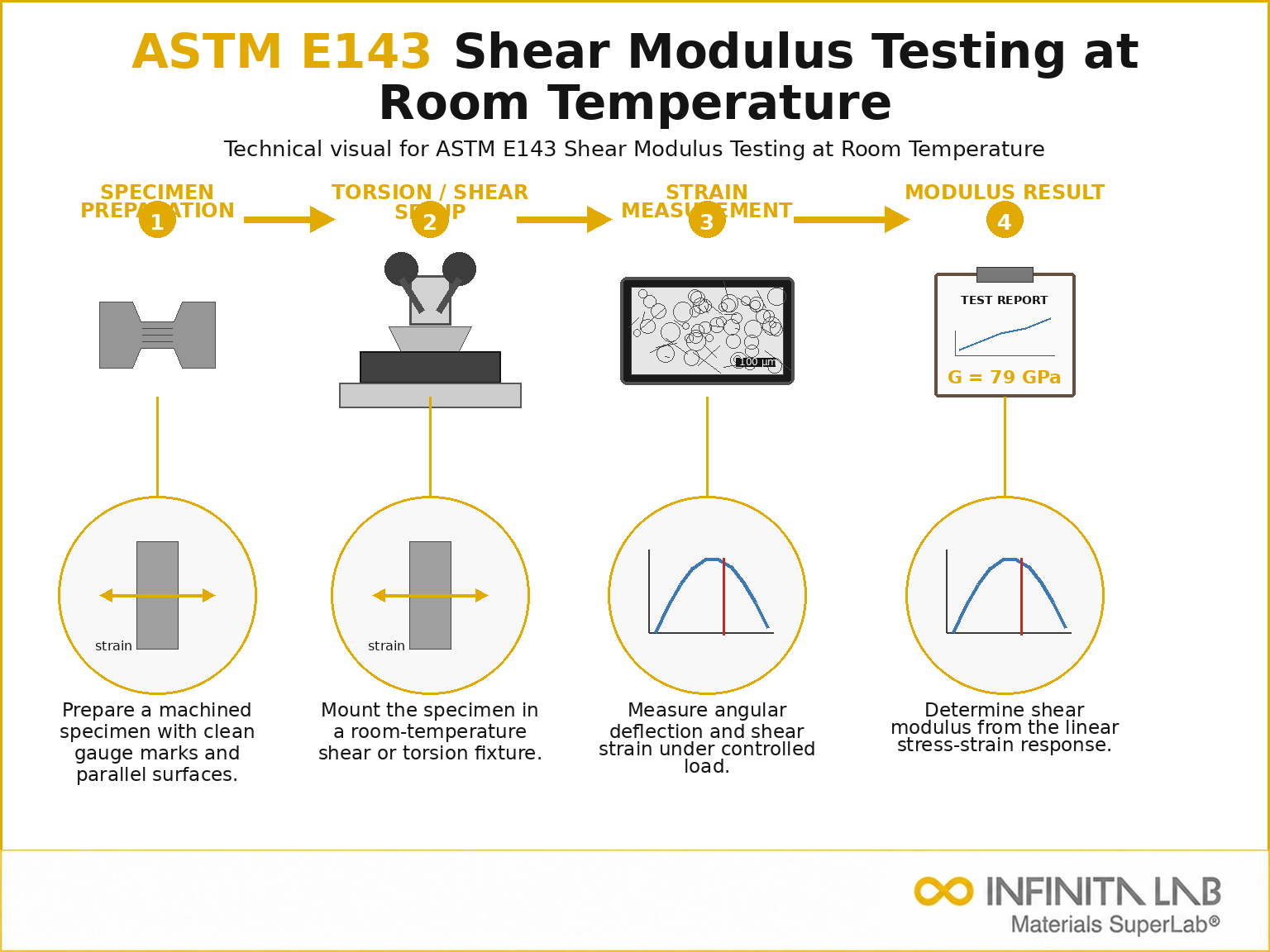
Our ASTM E143 Testing Procedure
Specimen Preparation
Prepare a cylindrical or prismatic specimen with specified dimensions.
1Mounting the Specimen
Secure the specimen in the torsion testing apparatus.
2Application of Torque
Apply controlled torsional load to induce shear stress.
3Measurement and Calculation
Measure angular deformation and calculate shear modulus from stress-strain data.
4ASTM E143 Test Parameters and Requirements
| Parameter | Details |
|---|---|
| Test Type | Torsional shear testing |
| Property Measured | Shear modulus (G) |
| Test Condition | Room temperature |
| Specimen Shape | Cylindrical or standardized geometry |
| Load Application | Controlled torque |
| Measurement Parameter | Angular displacement |
| Strain Type | Shear strain |
| Stress Type | Shear stress |
| Elastic Range | Within proportional limit |
| Data Output | Stress-strain curve for shear |


- Torsion Testing Machine – Applies controlled torque to the specimen while maintaining alignment throughout the loading sequence.
- Torsiometer – Measures the angle of twist along a defined gauge length as torque is applied, forming the core data used in the modulus calculation.
- Torque Transducer or Load Cell – Captures precise torque values in real time, ensuring the applied loading is accurately tracked.
- Extensometer or Strain Measurement Device – Supplements twist-angle data in certain configurations to refine strain measurement accuracy.
- Specimen Alignment Fixtures – Hold and center the specimen within the test frame to minimize eccentric loading and measurement error.
- Data Acquisition System – Continuously records torque and twist data, generating the torque-twist curve used to determine shear modulus.
Equipment and Instrumentation Used for ASTM E143 Testing
What You Receive: Test Report, Data, and Certification
- A calculated shear modulus (modulus of rigidity) value derived from the linear portion of the torque-twist curve.
- A detailed test report documenting specimen dimensions, test conditions, and instrumentation used.
- Graphical representation of the torque versus angle-of-twist relationship observed during testing.
- Supporting raw data suitable for engineering review, modelling input, or regulatory documentation.
- Observations regarding specimen behaviour, including any deviations from expected elastic response.
- A findings summary that can be incorporated directly into design, qualification, or failure-analysis reports.
ASTM E143 Shear Modulus Room Temperature FAQs
Torsional testing applies a controlled torque to a specimen and measures the resulting angular deformation. The shear modulus is calculated using the relationship between applied shear stress and resulting shear strain within the elastic range.
Shear modulus measures a material’s resistance to shear deformation. It is essential for predicting how materials respond under torsional or shear loads, influencing structural design, vibration analysis, and failure prediction in engineering applications.
The following factors influence the shear modulus of a material: Size and gradation of the individual particles, Shape of the individual particles, Void ratio or dry density, Confining pressure.
It helps the manufacturer to identify the flaws in their material’s structure and enhance its quality.
The test specimen used in ASTM E143 testing should be circular, cylindrical, or tubular. In the case of solid cylinders, the specimen should be straight and of uniform diameter for a length equal to the gauge length plus two to four diameters. Tubes should be straight and have a uniform diameter and wall thickness for a length equal to the gauge length plus at least four outside diameters. The gauge length should be at least four times the diameter.
ASTM E143 determines the shear modulus of structural materials at room temperature by applying torsional loading and measuring the resulting angular deformation.
The modulus of rigidity, or shear modulus, measures a material’s resistance to shear deformation. It relates applied shear stress to the resulting shear strain.
The shear modulus is calculated as shear stress divided by shear strain. A higher value indicates greater resistance to shear deformation.
Why Choose Infinita Lab for Shear Modulus Room Temperature Testing
When your Shear Modulus Room Temperature results have to hold up - for compliance, a customer audit, or an engineering decision - ASTM E143 accuracy and an unbiased third-party report matter more than price. Infinita Lab routes your ASTM E143 shear modulus room temperature testing to ISO/IEC 17025-accredited U.S. partner labs with hands-on method experience, so you get defensible data, transparent reporting, and turnaround times built around your project deadline - not ours.

Need ASTM E143 Shear Modulus Room Temperature Testing You Can Rely On?
Send query us at hello@infinitalab.com or call us at (888) 878-3090 to learn more about our services and how we can support you.



Request a Quote
Submit your material details and receive testing procedures, pricing, and turnaround time within 24 hours.
 Quick Turnaround and Hasslefree process
 Confidentiality Guarantee
 Free, No-obligation Consultation
 100% Customer Satisfaction
