


ASTM D6601: Rubber Cure After Cure Rheometer Testing Services
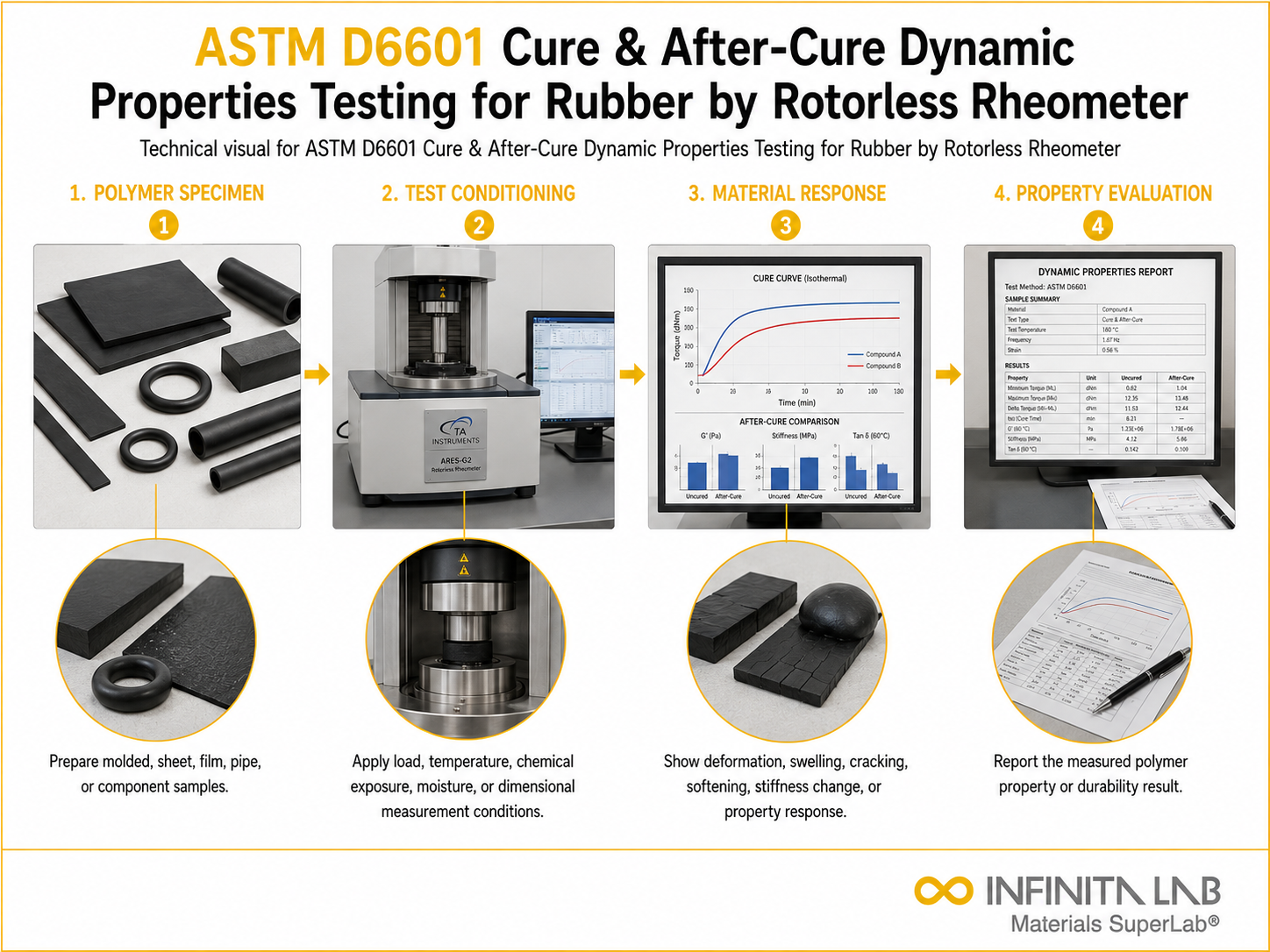
ASTM D6601 deals with the determination of cure dynamic properties at a determined temperature below the cure temperature by using a rotorless oscillating shear rheometer. Definite cure conditions that estimate a “static cure” are also covered to lessen the effects on cured rubber compound dynamic characteristics.
TRUSTED BY


Get ASTM D6601 compliant results — request your rubber cure after cure rheometer testing quote
- Overview
- Scope, Applications, and Benefits
- Test Process
- Specifications
- Instrumentation
- Results and Deliverables
What Is ASTM D6601 Rubber Cure After Cure Rheometer?
ASTM D6601 is a standard test method for measuring the dynamic viscoelastic properties of rubber vulcanizates during and after curing using a rotorless shear rheometer (RSR). This method characterizes the rheological behavior of rubber compounds throughout the vulcanization process and allows assessment of the cured compound’s dynamic properties.
Dynamic properties such as storage modulus, loss modulus, and tan delta are critical for predicting rubber performance in applications involving cyclic loading, vibration, and fatigue. ASTM D6601 provides the rubber industry with a precise, reproducible tool for compound development, quality control, and process optimization.

Applications and Benefits of ASTM D6601 Rubber Cure After Cure Rheometer Testing
Scope
ASTM D6601 evaluates:
- Storage modulus (G’) and loss modulus (G”) during and after cure
- Tan delta (damping factor) of rubber compounds
- Cure state and post-cure property development
- Frequency and strain dependence of dynamic properties
Applications
- Rubber compound development and optimization
- Tire tread and sidewall performance prediction
- Vibration isolation and damping component design
- Quality control in rubber manufacturing
- Research and development of elastomeric materials
Benefits
- Simultaneously characterizes cure and dynamic properties in one test
- Enables accurate prediction of in-service dynamic behavior
- Supports formula optimization for damping and stiffness targets
- Provides consistent, reproducible measurements for QC
- Reduces development time by combining cure and property data
Our ASTM D6601 Testing Procedure
Sample Loading
Uncured rubber compound is placed in the rotorless shear rheometer die cavity at the specified test temperature.
1Cure Monitoring
The rheometer applies oscillatory shear strain; storage and loss modulus are measured continuously as vulcanization proceeds.
2After-Cure Analysis
Following full cure, dynamic property measurements continue under varied frequency or amplitude to characterize the cured compound.
3Reporting
G', G", tan delta, cure time, and dynamic property curves are calculated and reported.
4ASTM D6601 Test Parameters and Requirements
| Parameter | Details |
|---|---|
| Standard | ASTM D6601 |
| Test Principle | Oscillatory shear using rotorless shear rheometer |
| Applicable Materials | Uncured and cured rubber vulcanizates |
| Measured Outputs | G', G", tan delta, cure state indicators |
| Temperature Range | As required by compound cure temperature |
| Frequency Range | Variable as specified |


- Rotorless shear rheometer (RSR) with heated die cavity
- Oscillatory drive and torque measurement system
- Temperature control and monitoring system
- Strain and frequency control unit
- Data acquisition and dynamic property analysis software
Equipment and Instrumentation Used for ASTM D6601 Testing
What You Receive: Test Report, Data, and Certification
- Storage modulus (G’) and loss modulus (G”) vs. cure time curves
- Tan delta (damping) values
- Cure time and state of cure indicators
- Frequency sweep dynamic property data
- Material comparison and compound development reports
ASTM D6601 Rubber Cure After Cure Rheometer FAQs
Storage modulus (G') represents the elastic (energy-storing) component of the rubber's response, while loss modulus (G") represents the viscous (energy-dissipating) component. Their ratio (tan delta) indicates damping.
Tan delta is a key predictor of hysteretic heat generation and rolling resistance in tires, vibration damping in mounts, and fatigue performance in dynamic seals and bushings.
While both measure cure behavior, ASTM D6601 specifically focuses on dynamic viscoelastic properties (G', G", tan delta) during and after cure, whereas MDR methods primarily track torque development as a cure indicator.
Yes, ASTM D6601 is well-suited for production QC as it provides rapid, reproducible measurements of cure state and dynamic properties in a single instrument with minimal sample preparation.
Natural rubber, SBR, EPDM, NBR, and other synthetic elastomer compounds used in tires, automotive mounts, seals, and industrial rubber products are routinely characterized by ASTM D6601.
Why Choose Infinita Lab for Rubber Cure After Cure Rheometer Testing?
At the core of this breadth is our network of 2,000+ accredited laboratories across the USA, offering access to over 10,000 testing methods and analytical services. From advanced materials characterization (SEM, TEM, RBS, XPS) to mechanical, chemical, environmental, biological, and standardized ASTM/ISO-compliant testing, we deliver unmatched flexibility, specialization, and scale. You are never limited by geography, facility, or methodology — Infinita Lab connects you to the right expertise and testing solution, every time.

Need ASTM D6601 Rubber Cure After Cure Rheometer Testing You Can Rely On?
Send query us at hello@infinitalab.com or call us at (888) 878-3090 to learn more about our services and how we can support you.



Request a Quote
Submit your material details and receive testing procedures, pricing, and turnaround time within 24 hours.
 Quick Turnaround and Hasslefree process
 Confidentiality Guarantee
 Free, No-obligation Consultation
 100% Customer Satisfaction
