


ASTM C1425: Ceramic Composite Elevated Temperature Interlaminar Shear Testing Services
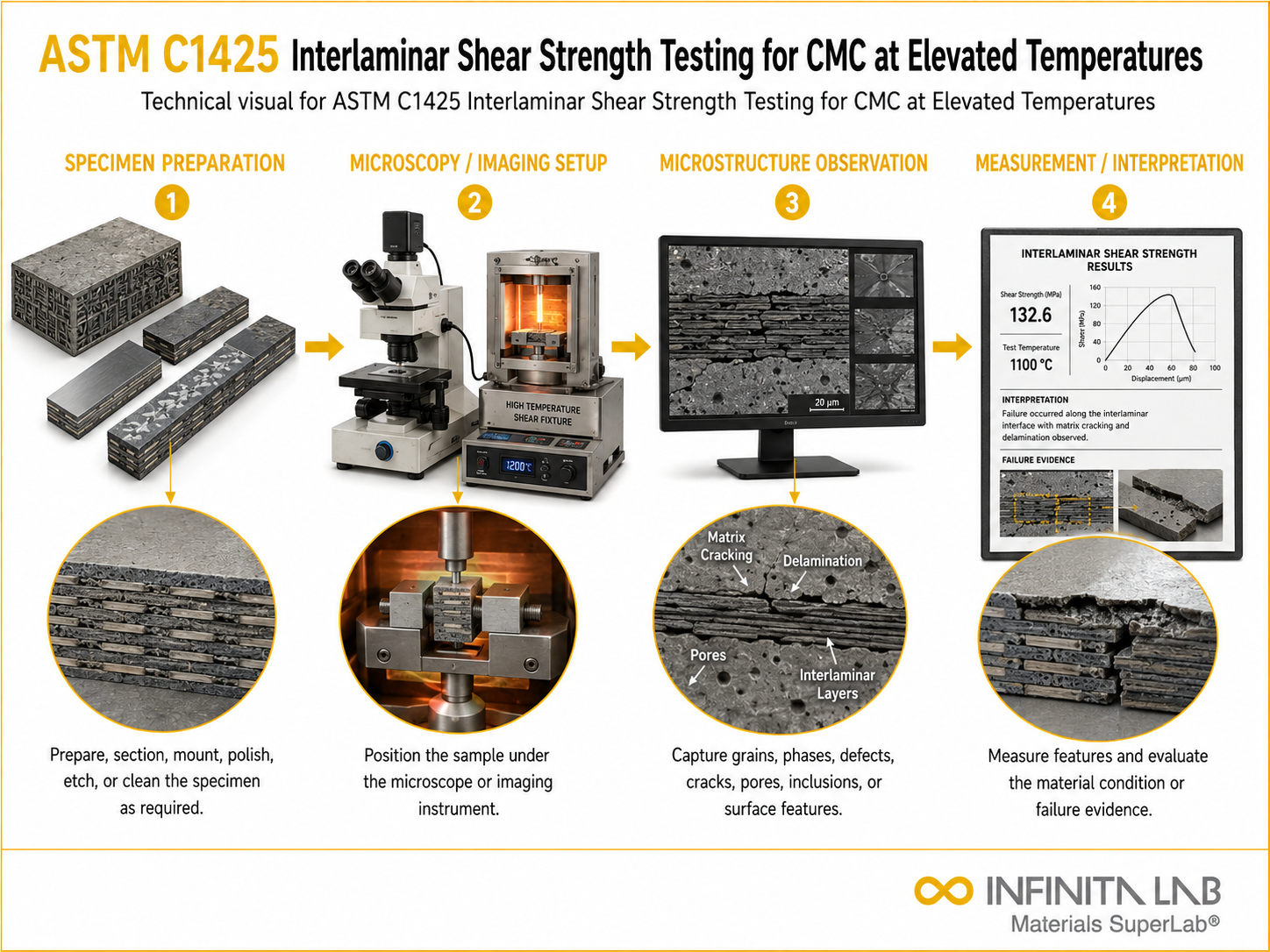
In ASTM C1425, a double notched specimen is compressed at elevated temperatures to determine the interlaminar shear strength of continuous fiber-reinforced ceramic composites (CFCCs). Shear tests provide information on the strength and deformation of materials under shear stresses. Values are expressed in SI units.
TRUSTED BY


Get ASTM C1425 compliant results — request your ceramic composite elevated temperature interlaminar shear testing quote
- Overview
- Scope, Applications, and Benefits
- Test Process
- Specifications
- Instrumentation
- Results and Deliverables
What Is ASTM C1425 Ceramic Composite Elevated Temperature Interlaminar Shear?
ASTM C1425 establishes a standardized method to determine the interlaminar shear strength (ILSS) of advanced ceramic composites at elevated temperatures. It focuses on evaluating the bonding integrity between layers when subjected to shear stress under controlled thermal conditions. The test is essential for understanding the mechanical performance of layered ceramic systems in demanding environments.
This method is particularly relevant for ceramic matrix composites where interlaminar properties govern structural reliability. By measuring shear strength at high temperatures, ASTM C1425 helps assess material behavior under service-like conditions, enabling improved design, durability prediction, and material optimization for high-performance applications.

Applications and Benefits of ASTM C1425 Ceramic Composite Elevated Temperature Interlaminar Shear Testing
Scope
ASTM C1425 specifies procedures for measuring interlaminar shear strength of advanced ceramics under elevated temperature conditions, ensuring accurate evaluation of layer bonding performance.
- Applicable to laminated and fiber-reinforced ceramic composites
- Focuses on interlaminar shear behavior under high temperatures
- Defines specimen geometry and preparation methods
- Covers controlled loading and thermal exposure conditions
- Ensures accurate alignment and stress application
- Suitable for research, development, and quality evaluation
Applications
- Aerospace ceramic composite structures
- High-temperature turbine components
- Thermal protection systems
- Advanced energy systems and reactors
- Structural components in extreme environments
- Material development and performance testing
Benefits
- Evaluates bonding strength between composite layers
- Supports high-temperature performance assessment
- Helps prevent delamination-related failures
- Enables reliable material selection and design
- Provides standardized and reproducible results
- Assists in quality assurance and failure analysis
Our ASTM C1425 Testing Procedure
Specimen Preparation
Prepare laminated ceramic composite specimens with specified dimensions and surface quality.
1Temperature Conditioning
Heat the specimen to the required elevated temperature under controlled conditions.
2Load Application
Apply shear load using a standardized fixture until interlaminar failure occurs.
3Strength Calculation
Record maximum load and calculate interlaminar shear strength based on specimen geometry.
4ASTM C1425 Test Parameters and Requirements
| Parameter | Details |
|---|---|
| Material Type | Advanced ceramic matrix composites |
| Specimen Geometry | Rectangular beam or short-beam configuration |
| Temperature Range | Elevated temperatures as specified in test conditions |
| Loading Mode | Shear loading using fixture |
| Surface Condition | Precisely machined and defect-controlled |
| Alignment Requirement | Accurate positioning to ensure uniform shear stress |
| Measurement Parameters | Load at failure and temperature conditions |
| Output Result | Interlaminar shear strength (MPa) |


- Universal testing machine (UTM)
- High-temperature furnace or heating chamber
- Shear test fixture (short-beam or similar)
- Temperature controllers and sensors
- Extensometer or displacement sensors
- Data acquisition system
Equipment and Instrumentation Used for ASTM C1425 Testing
What You Receive: Test Report, Data, and Certification
- Interlaminar shear strength values (MPa)
- Load vs displacement data
- Failure mode analysis (delamination or shear)
- Temperature-dependent performance data
- Comparative material evaluation
- Detailed test report with observations and calculations
ASTM C1425 Ceramic Composite Elevated Temperature Interlaminar Shear FAQs
ASTM C1425 measures the interlaminar shear strength of continuous fiber-reinforced ceramic composites at elevated temperatures. This test measures the material's response to shear stress and thus helps assess its performance in high-temperature applications.
Interlaminar shear strength measures a material's resistance to failure when subjected to shear stress between layers. This property is critical for advanced ceramics in high-stress, high-temperature environments, such as aerospace, automotive, and power generation applications.
Specimens are rectangular plates with notches on both sides. The depth of the notches must be at least half of the thickness of the specimen. The notch separation distance is varied to determine the effect of notch separation distance on shear strength.
This test is important because ceramic composites rely on strong interlayer bonding. Weak bonding can lead to delamination and failure, especially at high temperatures, making ILSS evaluation critical for ensuring reliability and safety.
The compression rate needs to be carefully controlled to ensure that the specimen experiences consistent loading. Rapid compression may cause uneven stress distribution, while slow compression could change material behavior over time.
Why Choose Infinita Lab for Ceramic Composite Elevated Temperature Interlaminar Shear Testing?
At the core of this breadth is our network of 2,000+ accredited laboratories across the USA, offering access to over 10,000 testing methods and analytical services. From advanced materials characterization (SEM, TEM, RBS, XPS) to mechanical, chemical, environmental, biological, and standardized ASTM/ISO-compliant testing, we deliver unmatched flexibility, specialization, and scale. You are never limited by geography, facility, or methodology — Infinita Lab connects you to the right expertise and testing solution, every time.

Need ASTM C1425 Ceramic Composite Elevated Temperature Interlaminar Shear Testing You Can Rely On?
Send query us at hello@infinitalab.com or call us at (888) 878-3090 to learn more about our services and how we can support you.



Request a Quote
Submit your material details and receive testing procedures, pricing, and turnaround time within 24 hours.
 Quick Turnaround and Hasslefree process
 Confidentiality Guarantee
 Free, No-obligation Consultation
 100% Customer Satisfaction
