


Lap Shear Strength Testing Services
Lap Shear Test measures the strength of adhesive bonds between two surfaces. It determines adhesive strength by measuring the force required to separate them in a shear mode, perpendicular to the applied force. It is widely used to evaluate the bond strength of adhesives and bonded materials like metals, plastics, and composites.
TRUSTED BY


Get compliant results — request your lap shear strength testing quote
- Overview
- Scope, Applications, and Benefits
- Test Process
- Specifications
- Instrumentation
- Results and Deliverables
What Is Lap Shear Strength?
Lap shear testing is a mechanical evaluation method used to determine the shear strength of bonded joints between two overlapping materials. It measures the ability of adhesives, coatings, or welds to resist sliding forces applied parallel to the bonded interface until failure occurs.
This test is widely used to assess bonding performance in structural adhesives, composite materials, and metallic joints. By applying controlled tensile loading to a lap joint specimen, it evaluates adhesive durability, failure mode, and joint integrity under shear stress conditions, supporting material selection and quality assurance in engineering applications.

Applications and Benefits of Lap Shear Strength Testing
Scope
Lap shear testing evaluates the shear strength of adhesive-bonded or joined materials under controlled loading conditions. It is designed to simulate real-world forces acting on bonded joints in structural applications.
- Covers adhesive bonds, welded joints, and composite interfaces
- Applies to metal, plastic, and composite material combinations
- Evaluates shear strength under tensile loading of lap joints
- Identifies cohesive, adhesive, and substrate failure modes
- Used for material qualification and performance validation
- Supports quality control in manufacturing and assembly processes
- Helps compare bonding effectiveness of different adhesives
Applications
- Structural adhesive performance evaluation
- Automotive body and panel bonding assessment
- Aerospace composite joint testing
- Construction material bonding validation
- Electronics and component assembly testing
Benefits
- Determines accurate bond strength performance
- Identifies weak adhesion points in joints
- Improves material and adhesive selection
- Supports product durability optimization
- Enhances structural safety and reliability
Our Testing Procedure
Specimen Preparation
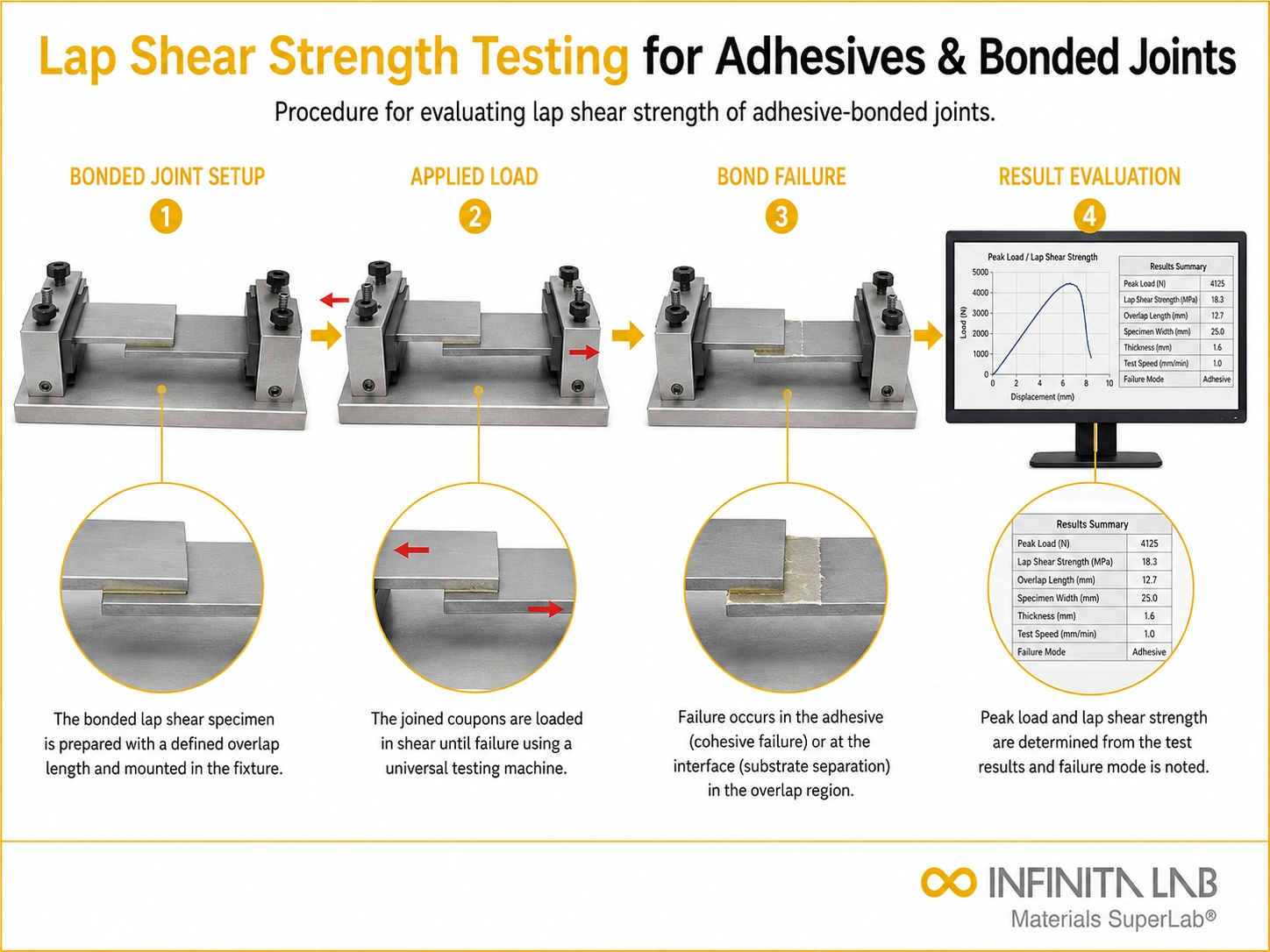
Overlapping materials are bonded using adhesive or joining method under controlled conditions.
1Conditioning
Specimens are cured and conditioned as per material requirements before testing.
2Load Application
Tensile force is applied to the lap joint until shear failure occurs.
3Data Analysis
Maximum load and failure mode are recorded to determine shear strength and bond quality.
4Test parameters and requirements
| Parameter | Details |
|---|---|
| Method | Tensile loading of overlapping bonded specimens |
| Measurement Type | Shear strength of adhesive or joint interface |
| Sample Type | Metal, polymer, or composite lap joint specimens |
| Loading Type | Axial tensile force causing shear stress |
| Measurement Basis | Maximum load at joint failure |
| Units | MPa, N, load at break |
| Bond Area | Defined overlapping surface area |
| Failure Mode | Cohesive, adhesive, or substrate failure |
| Test Condition | Controlled temperature and humidity as required |


- Universal Testing Machine (UTM)
- Lap shear fixture/jig
- Load cell for force measurement
- Extensometer or displacement sensor
- Data acquisition system
Equipment and Instrumentation Used for Testing
What You Receive: Test Report, Data, and Certification
- Maximum shear strength value
- Load-displacement curve
- Failure mode classification report
- Bond integrity assessment
- Detailed mechanical test report
Lap Shear Strength FAQs
The Lap Shear Test evaluates the strength and adhesion of bonded joints, measuring the force required to separate two materials joined by adhesives, coatings, or sealants.
The test can be conducted under various environmental conditions, such as different temperatures, humidity levels, and stress factors, to simulate the real-world performance of bonded materials.
Yes, the Lap Shear Test is widely used for quality control in industries to ensure that the bonding materials meet the required standards and, therefore, the reliability and durability of bonded joints.
The Lap Shear Test is commonly used to compare the performance of different adhesives or bonding agents to determine which provides the strongest bond for a specific application.
Humidity and stress conditions can alter the adhesion properties; thus, testing under such conditions can predict the performance of the bonded joint under real-world conditions, such as those found in automobile or aerospace applications.
Why Choose Infinita Lab for Lap Shear Strength Testing
At the core of this breadth is our network of 2,000+ accredited laboratories across the USA, offering access to over 10,000 testing methods and analytical services. From advanced materials characterization (SEM, TEM, RBS, XPS) to mechanical, chemical, environmental, biological, and standardized ASTM/ISO-compliant testing, we deliver unmatched flexibility, specialization, and scale. You are never limited by geography, facility, or methodology — Infinita Lab connects you to the right expertise and testing solution, every time.

Looking for an Accredited Partner for Lap Shear Strength Testing?
Send query us at hello@infinitalab.com or call us at (888) 878-3090 to learn more about our services and how we can support you.



Request a Quote
Submit your material details and receive testing procedures, pricing, and turnaround time within 24 hours.
 Quick Turnaround and Hasslefree process
 Confidentiality Guarantee
 Free, No-obligation Consultation
 100% Customer Satisfaction
