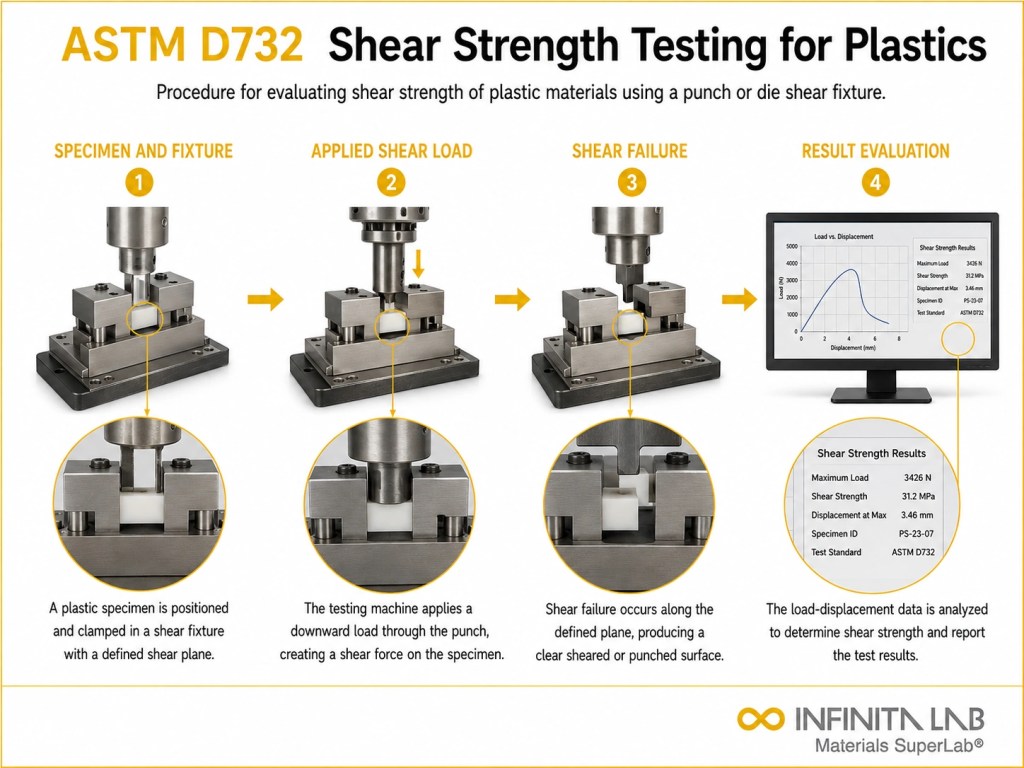


What Is ASTM D732 Shear Strength Plastics?
ASTM D732 describes a test method for determining the shear strength of plastic sheet materials using a punch-type shear test. A cylindrical punch forces a disk-shaped plug out of the test specimen, creating a shear failure along the punched circle perimeter. The maximum load at failure, divided by the shear area, gives the shear strength of the plastic.
This test is widely used for quality control of plastic sheet materials in automotive, electronics, and construction applications where resistance to punching, stamping, or cutting operations is important.
Applications and Benefits of ASTM D732 Shear Strength Plastics Testing
Scope
ASTM D732 applies to rigid plastic sheet materials of defined thickness and determines:
- Shear strength at failure (MPa or psi)
- Effect of temperature on shear behavior (ambient and elevated temperature testing)
- Comparison of shear strength across different plastic formulations
- Material suitability for punching, blanking, and stamping operations
Applications
- Quality control of plastic sheet for fabrication operations
- Die-cutting and punching process feasibility assessment
- Plastic sheet specification compliance verification
- Automotive interior component material selection
- Electronic housing and enclosure material characterization
Benefits
- Simple, rapid test suitable for production quality control
- Directly relevant to punching and stamping operations
- Applicable to a wide range of thermoplastic and thermoset materials
- Requires minimal specimen preparation
- Provides consistent results with low scatter for uniform sheet materials
Our ASTM D732 Testing Procedure
Specimen Preparation
Plastic sheet specimens of defined dimensions are cut; specimen thickness is measured at the test location.
1Fixture Setup
The specimen is clamped in the shear test fixture, and the cylindrical punch is aligned with the center hole.
2Punch Loading
The punch is driven through the specimen at a controlled crosshead rate until complete plug separation; maximum load is recorded.
3Shear Strength Calculation
Shear strength is calculated as maximum force divided by the cylindrical shear area (π × punch diameter × specimen thickness).
4ASTM D732 Test Parameters and Requirements
| Parameter | Details |
|---|---|
| Standard | ASTM D732 |
| Test Principle | Punch-type shear with cylindrical punch |
| Applicable Materials | Rigid plastic sheet (thermoset and thermoplastic) |
| Punch Diameter | 25.4 mm (1 in.) |
| Loading Rate | 1.3 mm/min (0.05 in./min) |
| Measured Output | Shear strength (MPa or psi) |


- Universal testing machine with appropriate load cell
- Punch-type shear test fixture with 25.4 mm diameter punch
- Precision micrometer for specimen thickness measurement
- Calipers for specimen dimension verification
- Data acquisition system for load recording
Equipment and Instrumentation Used for ASTM D732 Testing
What You Receive: Test Report, Data, and Certification
- Shear strength values (MPa) per specimen
- Statistical summary (mean, standard deviation, CV)
- Thickness data for each tested location
- Comparison to specification limits or reference material data
- Complete test report
ASTM D732 Shear Strength Plastics FAQs
D732 is designed for rigid plastic sheets; for thin flexible films, ASTM D1004 (tear resistance) or other film-specific methods are more appropriate.
Shear strength typically ranges from 50–75% of tensile strength for most plastics, though this ratio varies by material type and microstructure.
Yes — ASTM D732 specifies that testing can be conducted at temperatures other than ambient; an environmental chamber or heated platen is needed, and the specimen must be at temperature before testing begins.
Yes — fiber-reinforced plastics typically show higher shear strength than unfilled grades; fiber orientation relative to the punch may also influence results for anisotropic materials.
A minimum of five specimens per condition is typically recommended; more may be needed if material variability is high or statistical design allowables are required.
Shear testing of polymers evaluates a material’s resistance to forces that cause adjacent sections to slide past one another. A prepared polymer specimen is placed in a suitable test fixture, and a controlled load is applied until deformation or failure occurs. The maximum load and specimen dimensions are used to calculate shear strength. The results help compare polymer materials and assess their suitability for applications involving shear forces.
Punch shear testing applies a concentrated load through a punch to determine a material’s resistance to shearing. Under ASTM D732, a punch tool shears a plastic specimen, and the maximum load is used to calculate shear strength. Interlaminar shear testing, by contrast, evaluates the strength of bonding between layers in laminated or fiber-reinforced composites using a suitable method. The appropriate test depends on the material structure and the property being evaluated.
ASTM D732 determines the shear strength of plastics in sheet, plate, and molded forms using a punch tool. The specimen is secured in a fixture, and a punch is driven through it under controlled loading. The maximum force required to shear the specimen is recorded and divided by the sheared area, calculated from the punch circumference and specimen thickness. The result helps compare plastic materials and evaluate their resistance to shear loading.
Why Choose Infinita Lab for Shear Strength Plastics Testing
When your Shear Strength Plastics results have to hold up - for compliance, a customer audit, or an engineering decision ASTM D732 accuracy and an unbiased third-party report matter more than price. Infinita Lab routes your ASTM D732 shear strength plastics testing to ISO/IEC 17025-accredited U.S. partner labs with hands-on method experience, so you get defensible data, transparent reporting, and turnaround times built around your project deadline - not ours.

Looking for an Accredited Partner for ASTM D732 Shear Strength Plastics Testing?
Send query us at hello@infinitalab.com or call us at (888) 878-3090 to learn more about our services and how we can support you.



