


ASTM D2557: Adhesive Tensile Shear Subzero Temperature Testing Services
The ASTM D2557 test method is used to determine the tensile-shear strength of adhesives at subzero temperatures of -267.8°C (-450°F) to -55°C (-67°F). This test method is used to evaluate the strength qualities of adhesive joints at subzero temperatures as an accelerated screening test.
TRUSTED BY


Get ASTM D2557 compliant results — request your adhesive tensile shear subzero temperature testing quote
- Overview
- Scope, Applications, and Benefits
- Test Process
- Specifications
- Instrumentation
- Results and Deliverables
What Is ASTM D2557 Adhesive Tensile Shear Subzero Temperature?
ASTM D2557 specifies the standard method of testing the tensile-shear strength of adhesive bonds at subzero temperatures. This test method determines how well an adhesive retains its load-carrying capability under extremely low-temperature and mechanical-stress conditions. The technique is crucial for applications subjected to freezing or cryogenic conditions. Testing bonded specimens conditioned at subfreezing temperatures, ASTM D2557 aids in assessing mechanical integrity, durability, and resistance to brittle failure.
This standard supports adhesive qualification for industries such as aerospace, refrigeration, defense, and cold-climate structural bonding, where temperature fluctuations may significantly affect joint performance.

Applications and Benefits of ASTM D2557 Adhesive Tensile Shear Subzero Temperature Testing
Scope
ASTM D2557 outlines procedures for measuring tensile-shear strength of adhesive bonds at reduced temperatures.
It evaluates:
- Resistance to fracture in cold environments
- Effects of brittleness and thermal contraction
- Changes in mechanical performance at sub-zero temperatures
- Influence of adhesive chemistry
- Strength retention after cold exposure
The method applies to epoxies, acrylics, polyurethanes, and other structural adhesives used in bonded assemblies.
Applications
- Aerospace structural bonding
- Refrigeration equipment assembly
- Defence and military systems
- Cold storage facilities
- Cryogenic and polar applications
- Automotive components exposed to cold climates
Benefits
- Determines adhesive suitability for low-temperature service
- Identifies brittle behavior under freezing conditions
- Supports material selection for harsh environments
- Improves product reliability and safety
- Enables comparison between adhesive formulations
- Assists in quality control and product qualification
Our ASTM D2557 Testing Procedure
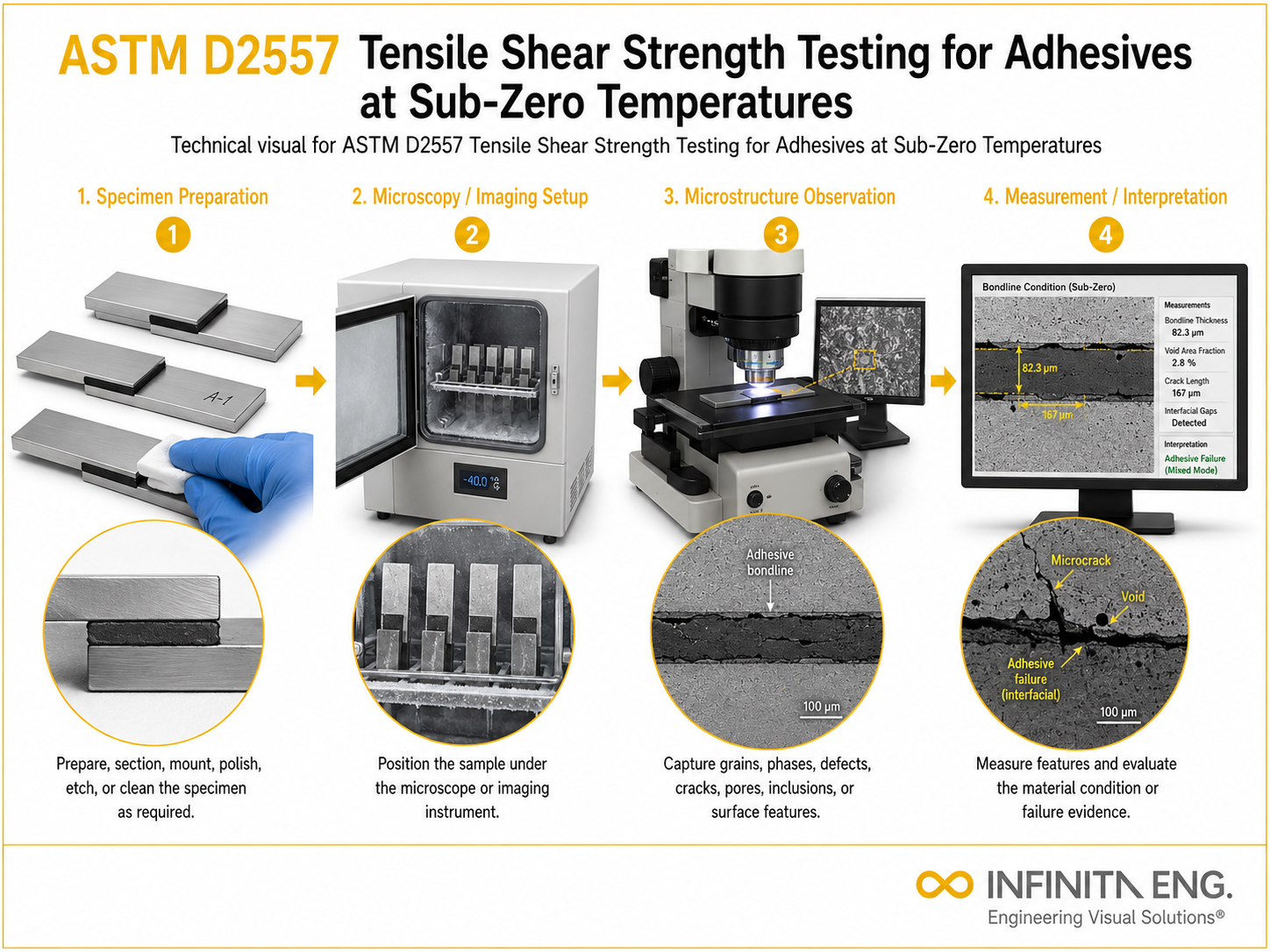
Specimen Preparation
Single-lap shear specimens are prepared using metallic or polymeric substrates. Bondline thickness is controlled using spacers or shims.
1Sub-zero Conditioning
Specimens are conditioned at specified subzero temperatures (typically −20°C or lower) for a defined period to reach thermal equilibrium.
2Low-Temperature Testing
Conditioned specimens are mounted in a low-temperature tensile testing machine, and a controlled tensile load is applied until bond failure occurs.
3Data Recording & Failure Analysis
Peak load is recorded, and the failure mode (adhesive, cohesive, or substrate) is visually examined.
4ASTM D2557 Test Parameters and Requirements
| Parameter | Details |
|---|---|
| Applicable Materials | Structural adhesives (epoxy, acrylic, polyurethane, etc.) |
| Specimen Type | Single-lap shear-bonded substrates |
| Test Temperature | Typically −20°C or lower |
| Bond Area | Standard overlap dimensions |
| Conditioning Time | As specified in the standard |
| Output Units | MPa or psi |


- Universal testing machine (UTM)
- Low-temperature environmental chamber
- Temperature monitoring sensors
- Specimen gripping fixtures
- Load cell and displacement sensors
- Data acquisition and analysis software
Equipment and Instrumentation Used for ASTM D2557 Testing
What You Receive: Test Report, Data, and Certification
- Tensile-shear strength values at subzero temperatures
- Comparative performance data among adhesives
- Failure mode classification
- Strength retention analysis
- Data supporting cold-service qualification
- Quality assurance documentation
ASTM D2557 Adhesive Tensile Shear Subzero Temperature FAQs
It indicates the lowest temperature at which a plastic material can withstand impact without cracking—critical for low-temperature applications like outdoor packaging or freezer environments.
Flexible plastic sheets and films that may become brittle at reduced temperatures.
Test specimens are conditioned at standard temperature and humidity before testing to ensure consistent results.
The specimen is clamped in an impact device, cooled to different temperatures, and hit by a falling dart to check if it ruptures or remains intact.
Why Choose Infinita Lab for Adhesive Tensile Shear Subzero Temperature Testing?
At the core of this breadth is our network of 2,000+ accredited laboratories across the USA, offering access to over 10,000 testing methods and analytical services. From advanced materials characterization (SEM, TEM, RBS, XPS) to mechanical, chemical, environmental, biological, and standardized ASTM/ISO-compliant testing, we deliver unmatched flexibility, specialization, and scale. You are never limited by geography, facility, or methodology — Infinita Lab connects you to the right expertise and testing solution, every time.

Need ASTM D2557 Adhesive Tensile Shear Subzero Temperature Testing You Can Rely On?
Send query us at hello@infinitalab.com or call us at (888) 878-3090 to learn more about our services and how we can support you.



Request a Quote
Submit your material details and receive testing procedures, pricing, and turnaround time within 24 hours.
 Quick Turnaround and Hasslefree process
 Confidentiality Guarantee
 Free, No-obligation Consultation
 100% Customer Satisfaction
