
Compression Testing and its Importance
Compression testing is a method used to evaluate the behavior of a product or material under a compressive load. Know more about compression testing.
TRUSTED BY


Precision-driven testing for dimensional accuracy and compliance
- Overview
- Scope, Applications, and Benefits
- Test Process
- Specifications
- Instrumentation
- Results and Deliverables
Compression Testing - Overview
Compression testing evaluates how materials behave under compressive loads, determining their ability to withstand forces that reduce size or volume. It is a fundamental mechanical test used to measure properties such as compressive strength, yield strength, modulus of elasticity, and deformation characteristics.
Accurate compression testing is essential for ensuring structural integrity, load-bearing capacity, and durability of materials used in construction, manufacturing, and engineering applications. This service supports quality control, product development, and compliance verification across industries by assessing how materials perform under real-world compressive conditions.

Scope, Applications, and Benefits
Scope
Compression testing is used to assess how materials behave under compressive loads, providing critical insights into their mechanical performance and structural reliability.
It evaluates:
- Compressive strength and overall load-bearing capacity
- Stress–strain behaviour during compression
- Elastic and plastic deformation characteristics
- Modulus of elasticity in compression
- Failure modes such as cracking, crushing, or buckling
Applications
- Concrete and cement material testing in construction
- Metals and alloys used in structural and load-bearing components
- Ceramics and brittle materials performance evaluation
- Polymer and foam compression behaviour analysis
- Packaging material strength and stacking performance testing
Benefits
- Ensures structural safety and reliability of materials
- Helps in selecting suitable materials for load-bearing applications
- Supports product design and engineering optimisation
- Identifies material weaknesses and failure risks
Compression Testing - Test Process
Sample Preparation & Setup
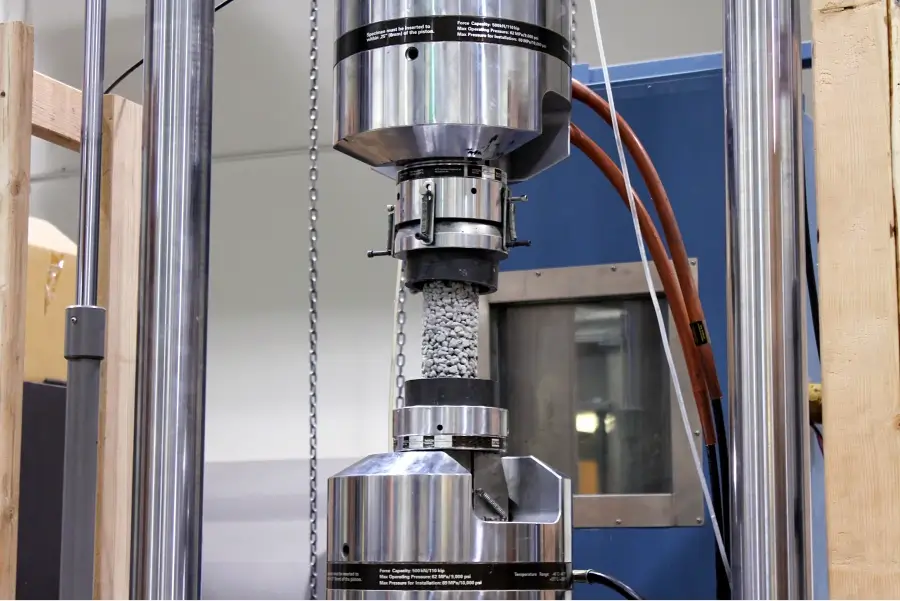
Specimens are prepared to standard dimensions and placed between compression platens with proper alignment.
1Load Application
A controlled compressive load is applied at a constant rate until deformation or failure.
2Data Recording
Load and displacement are continuously recorded to generate stress–strain behavior.
3Analysis & Reporting
Failure mode is evaluated, and compressive strength, modulus, and deformation results are reported.
4Compression Testing - Technical Specifications
| Parameter | Details |
|---|---|
| Methods | Uniaxial compression testing |
| Load Range | From a few Newtons to several MN (depending on material) |
| Specimen Types | Cylindrical, cubic, prismatic samples |
| Temperature Conditions | Ambient or controlled (if required) |
| Accuracy | ±1% of applied load |
Instrumentation Used for Testing
- Universal Testing Machine (UTM) with compression platens
- Extensometers or strain gauges for deformation measurement
- Digital data acquisition system for stress–strain analysis
- Alignment fixtures to ensure uniform load distribution
- Environmental chambers (for temperature-controlled testing)
Results and Deliverables
- Compressive strength (MPa or psi)
- Stress–strain curve and modulus of elasticity
- Yield point and deformation characteristics
- Failure mode analysis with observations
- Compliance comparison with applicable standards
- Detailed compression test report with traceability
Frequently Asked Questions
The test evaluates the shear strength of adhesive bonds under tension loading to assess their performance and reliability.
Any adhesive-bonded materials, including metals, composites, plastics, and ceramics, can be tested.
A tensile force perpendicular to the adhesive bond line is applied to generate shear stress.
Shear strength is calculated by dividing the maximum load applied during the test by the bond area.
Yes, it helps assess how materials deform and fail under load, providing insights into long-term performance and durability.
Why Choose Infinita Lab
for Electron Energy Loss
Spectroscopy (EELS)?
At the core of this breadth is our network of 2,000+ accredited labs in the USA, offering access to over 10,000 test types. From advanced metrology (SEM, TEM, RBS, XPS) to mechanical, dielectric, environmental, and standardized ASTM/ISO testing, we give clients unmatched flexibility, specialization, and scale. You are not limited by geography, facility, or methodology – Infinita connects you to the right testing, every time.

Looking for a trusted partner for Electron Energy Loss Spectroscopy (EELS) Testing?
Send query us at hello@infinitlab.com or call us at (888) 878-3090 to learn more about our services and how we can support you.




Request a Quote
Submit your material details and receive testing procedures, pricing, and turnaround time within 24 hours.
 Quick Turnaround and Hasslefree process
 Confidentiality Guarantee
 Free, No-obligation Consultation
 100% Customer Satisfaction
