

What Is ASTM C1198 Advanced Ceramic Dynamic Elastic Properties?
ASTM C1198, Standard Test Method for Dynamic Young’s Modulus, Shear Modulus, and Poisson’s Ratio for Advanced Ceramics by Sonic Resonance, is published by ASTM Committee C28 on Advanced Ceramics and developed by Subcommittee C28.01. The current edition is C1198-20(2026), reapproved in 2026 and listed as active. Earlier editions such as C1198-09(2013) are historical. No static load is involved. The method determines elastic constants from a specimen’s natural vibration. Resonant frequencies depend on a specimen’s modulus, mass, and geometry, so measuring them along with dimensions and mass lets you calculate the moduli. Dynamic Young’s modulus comes from the resonant frequency in the flexural mode of vibration; torsional resonance gives dynamic shear modulus. Poisson’s ratio? Computed from the two moduli.
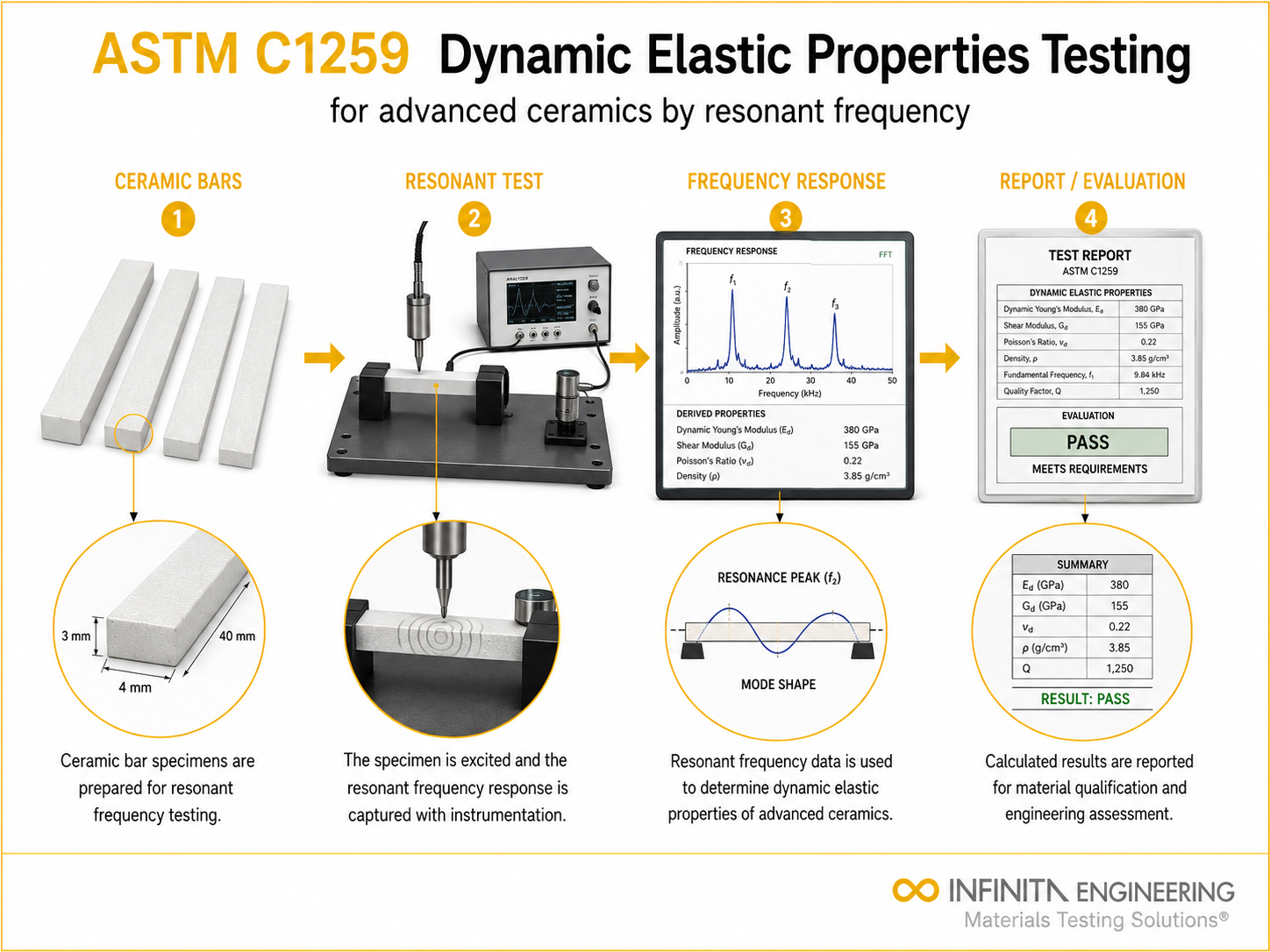
C1198 is a sonic resonance method in the strict sense. The specimen is suspended and excited mechanically: one transducer converts a cyclic electrical signal into a cyclic force on the specimen, and a second transducer senses the response. At the same time, the frequency is adjusted to locate resonance. That sets it apart from ASTM C1259, which covers the same properties by impulse excitation: a single tap excites the specimen, and a signal analyzer isolates the frequency. Specimens need a uniform rectangular or circular cross section, and the method is written for elastic, homogeneous, isotropic advanced ceramics. Particulate, whisker, or fiber-reinforced composites can be tested, but the reinforcement strongly affects results and has to be considered.
The test applies only minute stresses, so it’s nondestructive. The same specimen can then undergo other tests. The standard also describes a high-temperature furnace and a cryogenic cabinet, covering about -195 °C to 1200 °C.

Applications and Benefits of ASTM C1198 Advanced Ceramic Dynamic Elastic Properties Testing
Scope
ASTM C1198 determines the following dynamic elastic properties:
- The standard determines the dynamic elastic properties of advanced ceramics by measuring the mechanical resonant frequencies of a suitable specimen.
- In the flexural mode of vibration, the resonant frequency gives the dynamic Young’s modulus.
- Torsional resonant vibrations of the specimen yield the dynamic shear modulus.
- Poisson’s ratio is calculated from the dynamic Young’s modulus and the dynamic shear modulus.
- It is specifically appropriate for advanced ceramics that are elastic, homogeneous, and isotropic.
- Particulate, whisker, or fiber-reinforced ceramic composites may be tested, provided the strong influence of the reinforcement is taken into account.
- Specimens with major cracks or voids are outside the method’s scope because they distort the resonant response.
- Materials that cannot be made into a specimen with a uniform rectangular or circular cross section are also excluded.
- Resonances are excited mechanically while the specimen is suspended, using a drive transducer and a sensing transducer.
- Where material-specific standards such as C215, C623, C747, C848, C1259, E1875 and E1876 apply, follow them. They can differ in sample size, tolerances and calculations.
Applications
- Material development, where dynamic modulus tracks the effect of composition and processing changes in advanced ceramics.
- Characterizing materials and generating design data for ceramic components.
- Quality control, where acceptable resonant frequency ranges can be set for production lots.
- Screening for cracks, voids, porosity, or density variations that shift a specimen’s resonant frequencies.
- Measuring modulus at elevated and cryogenic temperatures, where static loading would be affected by delayed elastic and creep effects.
- Evaluating reinforced ceramic composites when the reinforcement’s influence is considered in the interpretation.
Benefits
- Nondestructive. Only minute stresses are applied, so the specimen isn’t broken and can be reused for other tests.
- One specimen yields Young’s modulus, shear modulus, and Poisson’s ratio from flexural and torsional resonance.
- Short measurement time makes high-temperature modulus testing practical without the creep effects of static loading.
- Resonant frequencies are sensitive to defects, so you get an indirect check on specimen integrity.
- Results rest on a recognized ASTM standard from the committee that governs advanced ceramics. That helps with reporting and comparison.
- Repeated measurements on the same bar allow modulus to be followed across thermal or processing steps.
Our ASTM C1198 Testing Procedure
Specimen Preparation
Ceramic specimens are machined to size, inspected, and conditioned at standard laboratory conditions.
1Impulse Excitation
A light impact induces mechanical vibrations in the specimen.
2Frequency Measurement
Resonant frequencies are recorded using a microphone or accelerometer.
3Data Analysis
Elastic moduli and Poisson’s ratio are calculated using ASTM equations.
4ASTM C1198 Test Parameters and Requirements
| Parameter | Details |
|---|---|
| Applicable Materials | Monolithic and composite ceramics |
| Specimen Shapes | Rectangular bars, rods, disks |
| Typical Dimensions | 100 mm × 10 mm × 5 mm (bars) |
| Conditioning | 23 ± 2°C, 50 ± 5% RH |
| Output Units | GPa (moduli), dimensionless (Poisson’s ratio) |


- Drive transducer – Converts a cyclic electrical signal into a cyclic mechanical force that excites the specimen.
- Sensing transducer – Picks up the specimen’s vibration and turns it back into an electrical signal.
- Signal source – The cyclic electrical signal comes from here, and its frequency is adjusted to find resonance.
- Oscilloscope or frequency readout – Shows signal amplitude and frequency, so the resonance in the desired mode can be identified.
- Specimen supports – Hold the specimen in suspension. It vibrates freely during measurement.
- Balance and dimensional gauges – Give the mass and dimensions used with the resonant frequencies in the calculations.
- High-temperature furnace and cryogenic cabinet – For measurement away from ambient temperature, across the range the standard describes.
Equipment and Instrumentation Used for ASTM C1198 Testing
What You Receive: Test Report, Data, and Certification
- Dynamic Young’s modulus is determined from the flexural resonant frequency.
- The torsional resonant frequency gives the dynamic shear modulus.
- Poisson’s ratio is calculated from the two measured moduli.
- Specimen dimensions and mass are recorded, along with the measured resonant frequencies and test temperature.
- A report referencing ASTM C1198 and the edition used, with notes on any specimen condition that affects interpretation.
- Any deviation from the standard procedure or specimen requirements is recorded too.
ASTM C1198 Advanced Ceramic Dynamic Elastic Properties FAQs
This test helps evaluate the elastic behavior and mechanical integrity of ceramics under dynamic or vibratory loading, which is crucial for predicting performance in structural, electronic, and high-temperature applications.
The test determines three key properties: Dynamic Young’s Modulus (E) – measures stiffness. Shear Modulus (G) – indicates resistance to shape deformation. Poisson’s Ratio (ν) – describes lateral strain relative to axial strain.
The specimen is lightly struck to generate vibrations, and its resonant frequencies are recorded using a sensor. These frequencies are then used to calculate elastic moduli through mathematical relationships.
This method is suitable for monolithic ceramics, ceramic composites, and sintered materials that are dense, homogeneous, and free from visible cracks or flaws.
Why Choose Infinita Lab for Advanced Ceramic Dynamic Elastic Properties Testing
When your Advanced Ceramic Dynamic Elastic Properties results have to hold up - for compliance, a customer audit, or an engineering decision - ASTM C1198 accuracy and an unbiased third-party report matter more than price. Infinita Lab routes your ASTM C1198 advanced ceramic dynamic elastic properties testing to ISO/IEC 17025-accredited U.S. partner labs with hands-on method experience, so you get defensible data, transparent reporting, and turnaround times built around your project deadline - not ours.

Need ASTM C1198 Advanced Ceramic Dynamic Elastic Properties Testing You Can Rely On?
Send query us at hello@infinitalab.com or call us at (888) 878-3090 to learn more about our services and how we can support you.





