


ASTM C1259: Advanced Ceramic Resonant Frequency Elastic Testing Services
Accredited ASTM C1259 advanced ceramic resonant frequency elastic testing from Infinita Lab, performed to the exact standard requirements - accurate, reproducible results with full documentation for compliance, R&D, and quality control programs.
TRUSTED BY


Get ASTM C1259 compliant results - request your advanced ceramic resonant frequency elastic testing quote
- Overview
- Scope, Applications, and Benefits
- Test Process
- Specifications
- Instrumentation
- Results and Deliverables
What Is ASTM C1259 Advanced Ceramic Resonant Frequency Elastic?
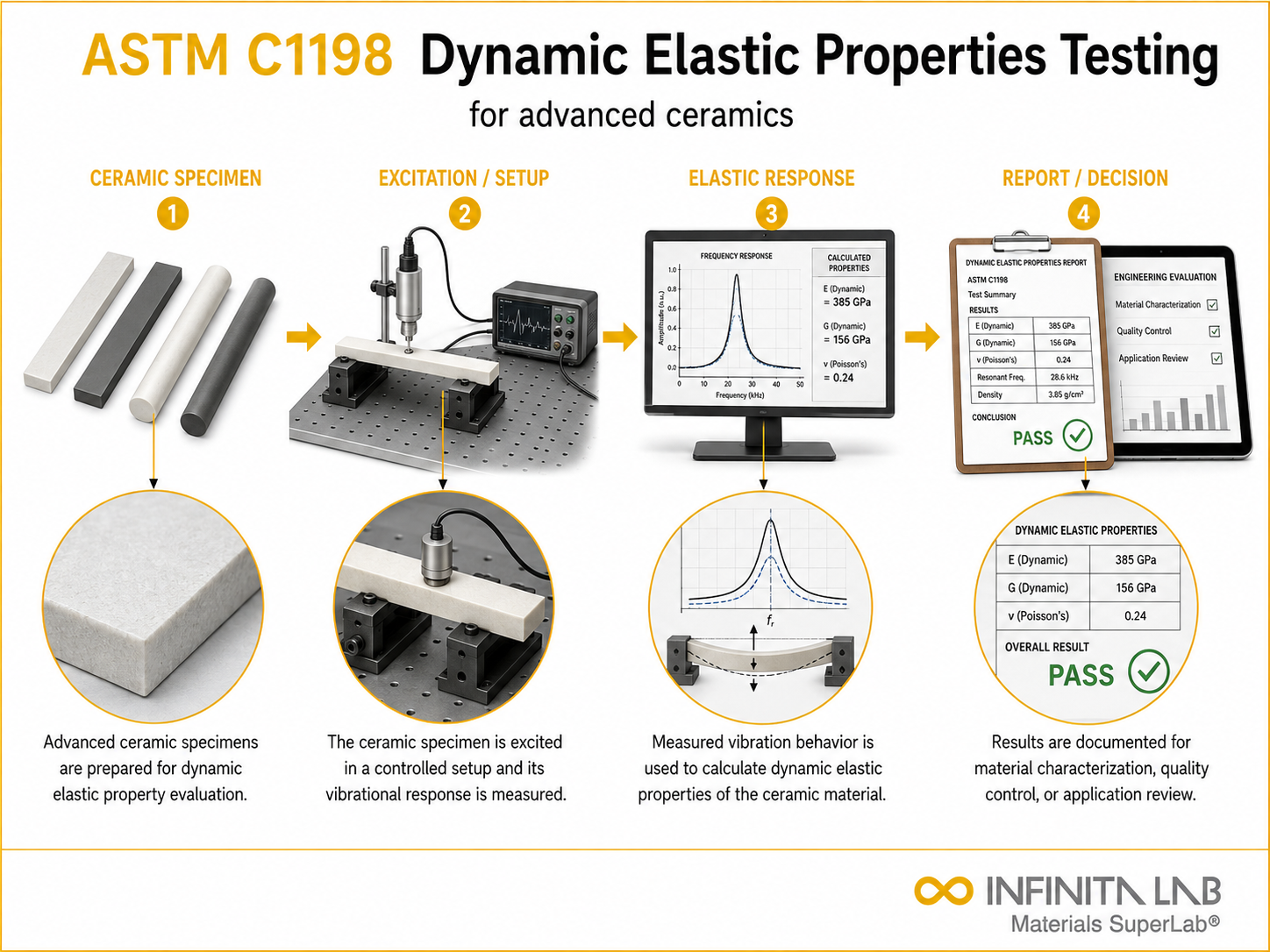
ASTM C1259, Standard Test Method for Dynamic Young’s Modulus, Shear Modulus, and Poisson’s Ratio for Advanced Ceramics by Impulse Excitation of Vibration, defines how to determine the dynamic elastic properties of advanced ceramics at ambient temperatures from a specimen’s geometry, mass, and measured resonant frequencies. ASTM Committee C28 on Advanced Ceramics maintains the method. It’s currently active as C1259-21 (2026), the 2021 edition reapproved in 2026. Excitation is simple: a single elastic strike from an impulse tool while the specimen rests on simple supports. Researchers choose support, impulse, and pick-up locations to favor a particular vibration mode, and a transducer, either a contact accelerometer or a non-contacting microphone, converts the response into a signal that an analyzer reduces to a fundamental resonant frequency. Flexural resonant frequency yields dynamic Young’s modulus. Torsional resonant frequency yields dynamic shear modulus. Poisson’s ratio then comes from those two moduli by calculation. The main body covers rectangular bars and cylindrical rods, while Annex A1 covers discs. The induced strains are minute, so the test is nondestructive and the moduli it measures sit near the origin of the stress-strain curve. The equations assume the ceramic is elastic, homogeneous, and isotropic. Ambient temperature is what the standard is written for. Work at cryogenic or high temperatures requires equipment changes and thermal-expansion corrections, following procedures in Test Method C1198. Resonant frequency alone can also screen specimens against an acceptable range, complex shapes included, because changes in geometry, mass, or internal flaws shift the frequency. C1259 sits within a family of related resonance standards. Its scope directs users to the material-specific method to apply.

Applications and Benefits of ASTM C1259 Advanced Ceramic Resonant Frequency Elastic Testing
Scope
ASTM C1259 covers determining the dynamic elastic properties of advanced ceramics using non-destructive, vibration-based techniques. It includes specimen preparation, excitation methods, and calculation procedures for accurate material characterization.
Includes:
- The standard covers the determination of the dynamic elastic properties of advanced ceramics at ambient temperatures.
- Dynamic Young’s modulus is determined from the resonant frequency in the flexural mode of vibration.
- The torsional mode of vibration gives the dynamic shear modulus, again from its resonant frequency.
- Poisson’s ratio is computed from the measured Young’s modulus and shear modulus rather than measured directly.
- A single elastic strike with an impulse tool excites the vibration, and the specimen is held on simple supports.
- Rectangular bars and cylindrical rods are described in the main body of the standard, and discs are addressed in Annex A1.
- Flat plates? They can be measured similarly, though the standard doesn’t present equations for them.
- Calculations are intended for materials that are elastic, homogeneous, and isotropic.
- Cryogenic and high-temperature measurements are possible with suitable equipment and thermal-expansion corrections, following the relevant procedures in Test Method C1198.
- Material-specific standards such as C215, C623, C747, C848, C1198, E1875, and E1876 may differ in sample size, tolerances, and calculations, and should be followed where they apply.
Applications
- Material development, where dynamic moduli guide formulation and processing changes in advanced ceramics.
- Characterization work, such as generating elastic constants for property databases.
- Design data for structural ceramic components that need modulus values near the origin of the stress-strain curve.
- Quality control, where resonant frequency alone is compared against an acceptable range to accept or reject parts.
- Screening of specimens with complex shapes, since frequency shifts reveal changes in geometry, mass, or internal flaws.
- Comparison of lots or processing routes, with thermal treatment or environmental exposure recorded in the specimen description.
Benefits
- The method is nondestructive, so the same specimen remains available for later strength or microstructural testing.
- Strains stay minute, so the moduli reflect behavior near the origin of the stress-strain curve.
- Simple apparatus: an impact tool and simple supports, with no complex alignment.
- A single strike yields frequency data from which flexural and torsional moduli can be derived.
- Either a contact accelerometer or a non-contacting microphone can serve as the transducer.
- Results are reported in SI units, supporting consistent comparison across suppliers and programs.
Our ASTM C1259 Testing Procedure
Specimen Preparation
Ceramic samples are prepared with precise geometry and smooth surfaces for accurate vibration response.
1Excitation
Specimen is lightly struck to induce natural vibrations at characteristic frequencies.
2Frequency Measurement
Vibration frequencies are recorded using sensors or microphones connected to analysis systems.
3Property Calculation
Elastic properties are calculated from measured frequencies, dimensions, and mass.
4ASTM C1259 Test Parameters and Requirements
| Parameter | Details |
|---|---|
| Material Type | Advanced ceramics |
| Properties Measured | Young’s modulus, shear modulus, Poisson’s ratio |
| Specimen Geometry | Rectangular bars or discs with defined dimensions |
| Measurement Principle | Natural frequency response analysis |
| Frequency Range | Depends on specimen size and material properties |
| Test Nature | Non-destructive dynamic testing |
| Output | Elastic constants and vibration characteristics |


- Impulse Tool – delivers the single elastic strike that sets the specimen vibrating at its natural frequencies.
- Specimen Supports – simple supports that hold the specimen while allowing the targeted vibration mode to develop.
- Microphone – non-contacting transducer that converts the acoustic response of the vibrating specimen into an electrical signal.
- Contact Accelerometer – the alternative pick-up, sensing vibration directly from the specimen surface.
- Signal Analyzer – pulls the fundamental resonant frequency out of the transducer signal.
- Precision Balance – for specimen mass, which feeds the modulus calculations.
- Micrometers and Calipers – specimen dimensions, to the accuracy the modulus calculations need.
Equipment and Instrumentation Used for ASTM C1259 Testing
What You Receive: Test Report, Data, and Certification
- Dynamic Young’s modulus is determined from the flexural resonant frequency of each specimen.
- The torsional resonant frequency of each specimen gives the dynamic shear modulus.
- Poisson’s ratio computed from the measured Young’s modulus and shear modulus.
- Measured resonant frequencies, specimen dimensions, and mass used in each calculation.
- Specimen description: material, geometry, and any thermal treatment or environmental exposure.
- A formal test report referencing ASTM C1259 and the edition used.
ASTM C1259 Advanced Ceramic Resonant Frequency Elastic FAQs
ASTM C1259 is used to determine dynamic elastic properties of advanced ceramics, including Young’s modulus, shear modulus, and Poisson’s ratio, using non-destructive vibration techniques for accurate material characterization and performance evaluation in engineering applications.
Impulse excitation involves striking a specimen lightly to induce vibrations, allowing measurement of natural frequencies used to calculate elastic properties accurately.
The method provides accurate, repeatable, and non-destructive measurement of multiple elastic properties, making it suitable for quality control and research.
The method requires precise specimen preparation and may be sensitive to environmental conditions, requiring controlled testing environments for accurate results.
Accuracy is ensured through standardized procedures, precise measurements, and controlled testing conditions, along with calibration of instruments.
ASTM C1259 is the Standard Test Method for Dynamic Young's Modulus, Shear Modulus, and Poisson's Ratio for Advanced Ceramics by Impulse Excitation of Vibration. It determines these elastic properties by measuring the resonant frequencies of a ceramic specimen after a mechanical impulse.
Why Choose Infinita Lab for Advanced Ceramic Resonant Frequency Elastic Testing
When your Advanced Ceramic Resonant Frequency Elastic results have to hold up - for compliance, a customer audit, or an engineering decision - ASTM C1259 accuracy and an unbiased third-party report matter more than price. Infinita Lab routes your ASTM C1259 advanced ceramic resonant frequency elastic testing to ISO/IEC 17025-accredited U.S. partner labs with hands-on method experience, so you get defensible data, transparent reporting, and turnaround times built around your project deadline - not ours.

Need ASTM C1259 Advanced Ceramic Resonant Frequency Elastic Testing You Can Rely On?
Send query us at hello@infinitalab.com or call us at (888) 878-3090 to learn more about our services and how we can support you.



Request a Quote
Submit your material details and receive testing procedures, pricing, and turnaround time within 24 hours.
 Quick Turnaround and Hasslefree process
 Confidentiality Guarantee
 Free, No-obligation Consultation
 100% Customer Satisfaction
