


V-Notched Shear Strength Testing Services for Composites & Metals
The V-Notched Shear Test is a simple and cost-effective way to determine the shear strength of brittle materials such as ceramics, glasses, and rocks. It involves cutting a V-shaped notch into a specimen and applying a load perpendicular to the notch until failure occurs. The results can help engineers design and develop new materials with improved performance and durability.
TRUSTED BY


Precision Testing Solutions for Accurate, Reliable, and Standards-Compliant Results
- Overview
- Scope, Applications, and Benefits
- Test Process
- Specifications
- Instrumentation
- Results and Deliverables
V-Notched Shear Test – Overview
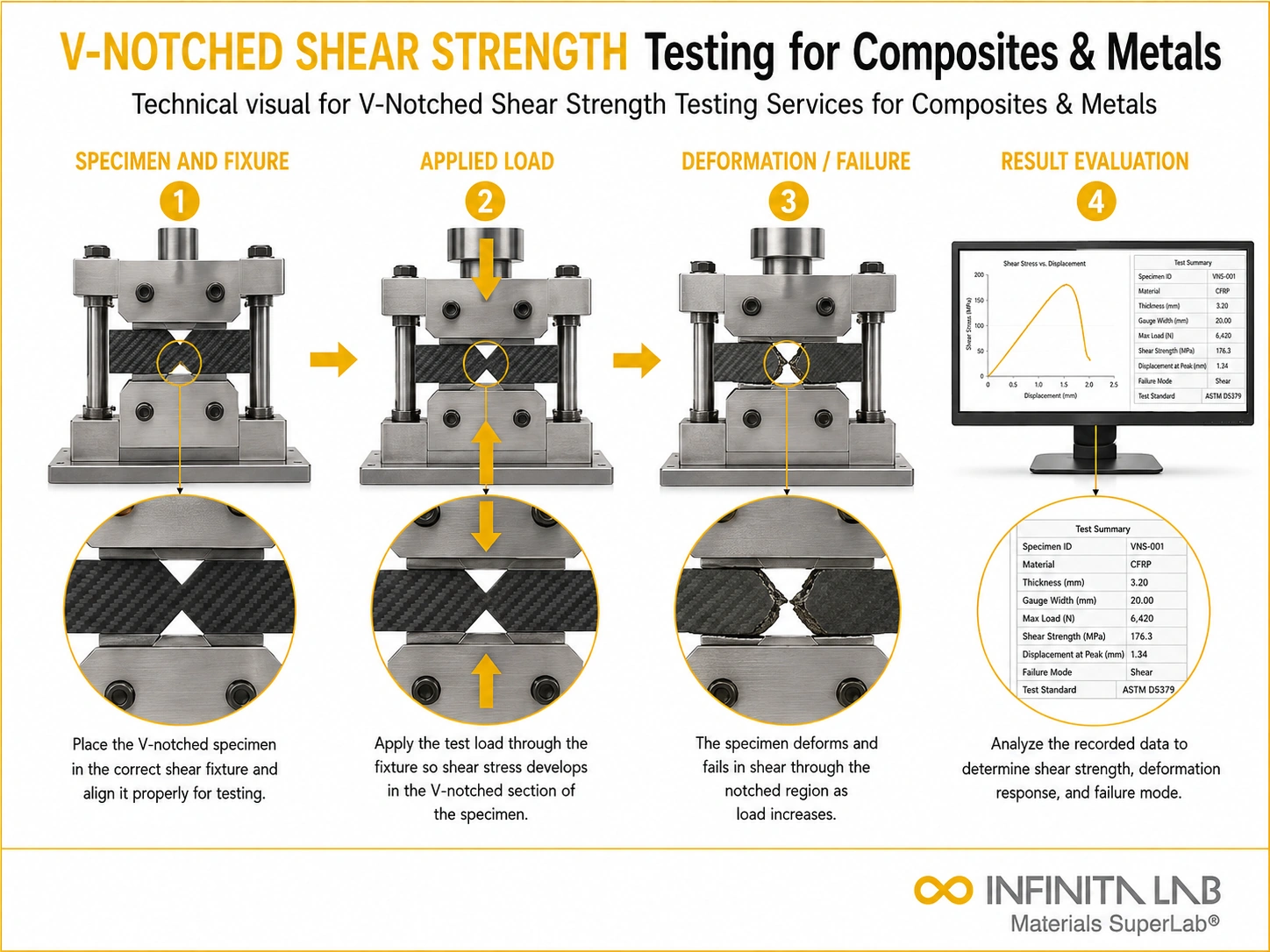
The V-Notched Shear Test is a standardized mechanical test method used to determine the shear properties of composite materials, including shear strength and shear modulus, under in-plane or interlaminar loading conditions. The test introduces a uniform shear stress field across the notched test section by applying opposing forces through a specialized fixture, enabling accurate measurement of shear response in fiber-reinforced polymer composites and other advanced materials.
Two primary configurations are used: the Iosipescu shear test (ASTM D5379) and the V-Notched Rail Shear test (ASTM D7078). Both methods use specimens with precision-machined V-notches that concentrate and uniformize shear stress in the test section. These methods are widely adopted in aerospace, defense, and advanced materials sectors for composite material qualification, design allowables generation, and process validation.

Scope, Applications, and Benefits
Scope
The V-Notched Shear Test measures shear strength and shear modulus of composite laminates and monolithic materials subjected to controlled shear loading through a notched specimen geometry. The test section between the two V-notches experiences a near-uniform shear stress state, making it suitable for accurate shear property characterization.
The scope includes:
- In-plane shear property determination (shear modulus G₁₂, shear strength F₁₂)
- Interlaminar shear characterization for specific laminate orientations
- Testing of unidirectional, woven, and multidirectional composite laminates
- Evaluation of fiber-reinforced polymers including CFRP, GFRP, and AFRP
- Characterization of sandwich core materials and monolithic isotropic materials
- Testing per ASTM D5379 (Iosipescu) and ASTM D7078 (V-Notched Rail Shear)
- Strain gauge and DIC-based shear strain measurement across the test section
- Compliance testing for aerospace, defense, and structural composite qualification programs
Applications
- Aerospace composite structures
- Automotive lightweight components
- Wind turbine blade materials
- Marine structural composites
- Defense and high-performance engineering systems
- Advanced polymer composite research
Benefits
- Accurate shear property evaluation
- Reliable data for composite design
- Improved structural failure prediction
- Enhanced simulation and FEA modeling
- Better material selection and optimization
- Increased safety in shear-critical applications
V-Notched Shear Test – Test Process
Specimen Preparation
Composite specimens are precisely machined with V-notches to ensure controlled shear stress concentration.
1Fixture Installation
The specimen is mounted in a dedicated shear fixture to ensure proper alignment and load transfer.
2Load Application
A controlled load is applied to induce shear deformation in the notched gauge region.
3Data Evaluation
Stress–strain data is recorded to determine shear strength, modulus, and failure mode.
4V-Notched Shear Test – Technical Specifications
| Parameter | Details |
|---|---|
| Measurement Principle | Shear stress induced via V-notched geometry |
| Sample Type | Fiber-reinforced polymer composites |
| Loading Mode | Quasi-static tensile-driven shear loading |
| Strain Measurement | Strain gauges or extensometer systems |
| Failure Mode | Matrix cracking or fiber-matrix debonding |
| Test Speed | Controlled displacement rate |
| Temperature Condition | Ambient or controlled environment |
| Output Data | Shear stress–strain curve |


Instrumentation Used for Testing
- Universal Testing Machine (UTM)
- V-notched shear fixture
- Strain measurement system
- Data acquisition system
- Specimen alignment tools
- Calibration accessories
Results and Deliverables
- Shear stress–strain curve
- In-plane shear strength value
- Shear modulus data
- Failure mode analysis report
- Material performance summary
- Test certification report
Frequently Asked Questions
It is used to determine the in-plane shear properties of composite materials by creating a controlled shear stress state in a V-notched specimen, enabling accurate measurement of shear strength and deformation behavior.
Even though the notch is designed to localize shear, small geometric imperfections, fixture compliance, and load eccentricity introduce secondary bending and normal stresses, making the stress state “shear-dominant” rather than perfectly pure shear.
Failure initiates when interlaminar shear stress exceeds matrix shear strength, leading to microcracking, followed by fiber–matrix debonding and eventual coalescence into shear bands that propagate rapidly across the gauge region.
Because matrix plasticization, microvoid growth, and interface slip begin at low stress levels, causing stiffness degradation before macroscopic cracks become visible.
Shear strain values are typically small, so even minor strain gauge misalignment or resolution errors significantly distort the calculated slope of the stress–strain curve.
Why Choose Infinita Lab for Advanced Materials Testing and Characterization?
At the core of this breadth is our network of 2,000+ accredited laboratories across the USA, offering access to over 10,000 testing methods and analytical services. From advanced materials characterization (SEM, TEM, RBS, XPS) to mechanical, chemical, environmental, biological, and standardized ASTM/ISO-compliant testing, we deliver unmatched flexibility, specialization, and scale. You are never limited by geography, facility, or methodology — Infinita Lab connects you to the right expertise and testing solution, every time.

Looking for a Trusted Partner for Accurate and Reliable Testing Services?
Send query us at hello@infinitlab.com or call us at (888) 878-3090 to learn more about our services and how we can support you.



Request a Quote
Submit your material details and receive testing procedures, pricing, and turnaround time within 24 hours.
 Quick Turnaround and Hasslefree process
 Confidentiality Guarantee
 Free, No-obligation Consultation
 100% Customer Satisfaction
