


ASTM A956: Leeb Hardness Steel Testing Services
Accredited ASTM A956 leeb hardness steel testing from Infinita Lab, performed to the exact standard requirements - accurate, reproducible results with full documentation for compliance, R&D, and quality control programs.
TRUSTED BY


Get ASTM A956 compliant results - request your leeb hardness steel testing quote
- Overview
- Scope, Applications, and Benefits
- Test Process
- Specifications
- Instrumentation
- Results and Deliverables
What Is ASTM A956 Leeb Hardness Steel?
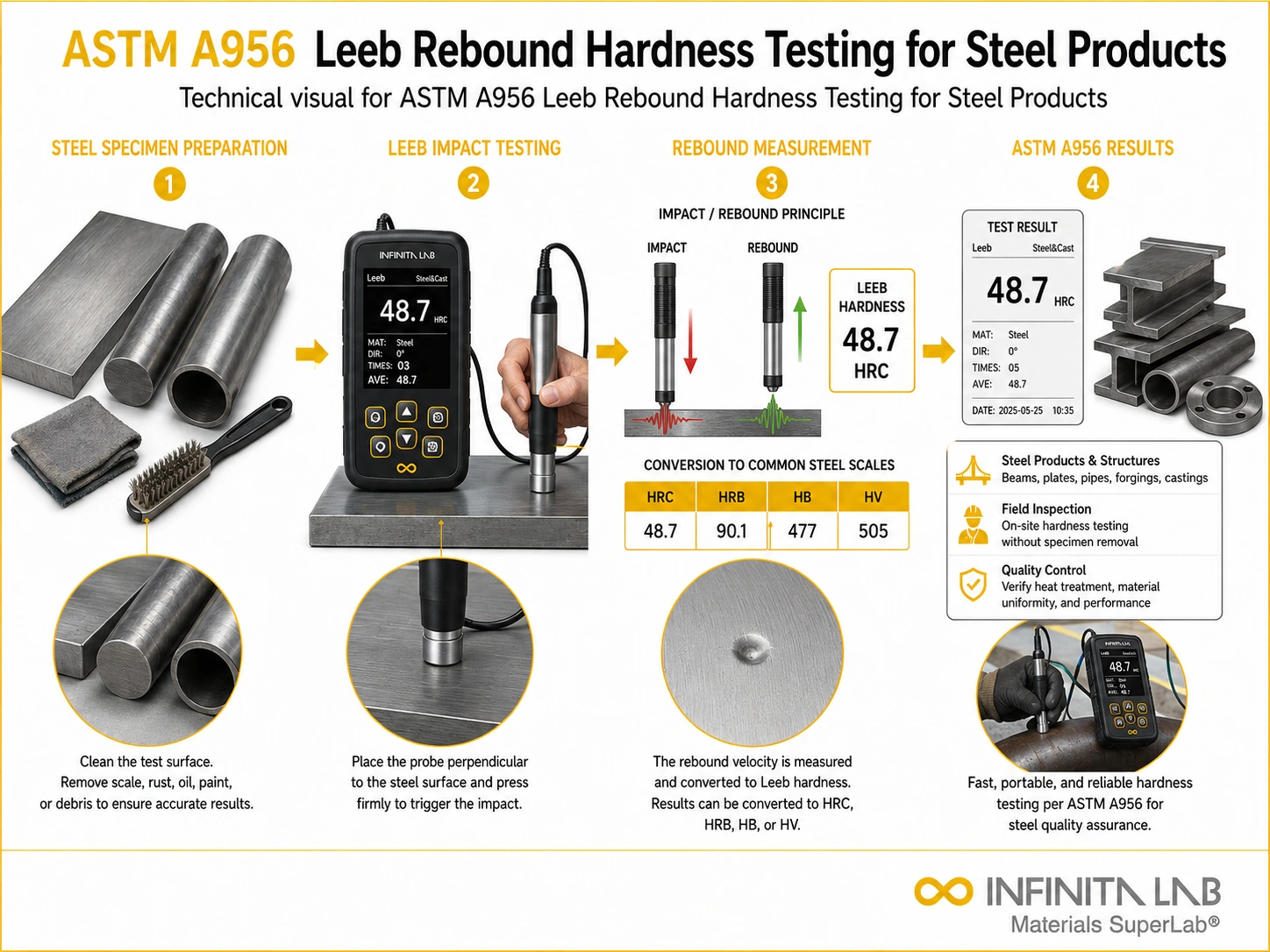
ASTM A956, officially titled Standard Test Method for Leeb Hardness Testing of Steel Products, sets out the procedure for determining hardness in steel, cast steel, and cast iron through the dynamic rebound principle, not static indentation. The method is simple in concept. A spring-loaded impact body, tipped with a tungsten carbide ball, gets fired at the test surface, and the instrument measures the ratio between its rebound velocity and its impact velocity. Multiply that ratio by 1000 to get the Leeb hardness value, expressed as HL, followed by a letter identifying the specific impact device used, such as HLD for the standard D-type probe. Velocity itself is captured electronically. As a permanent magnet inside the impact body passes through an induction coil, it generates a voltage signal, and the instrument converts that into a readable number within a second or two of contact.
The standard also covers the test apparatus itself – verification of impact devices against certified Leeb hardness reference test blocks, plus the conditions under which a reading counts as valid: minimum part mass, surface preparation, testing orientation. Because the test disturbs only a shallow surface layer, A956 is explicit about this limitation. Results reflect surface condition and heat treatment response, not bulk or subsurface properties, and a single reading isn’t enough; multiple readings at a given location are needed for a reliable average. There’s guidance on converting HL values to familiar scales too, like Rockwell C, Brinell, and Vickers, with a caution attached. These conversions are approximate, meant mainly for communication between supplier and customer, not as precise equivalents. D, DC, C, G, and E type impact devices are all covered, each suited to different surface geometries, hardness ranges, and part sizes found in production and field environments.

Applications and Benefits of ASTM A956 Leeb Hardness Steel Testing
Scope
ASTM A956 covers portable hardness testing of steel products using the Leeb rebound method to determine material hardness in various industrial applications.
- Covers Leeb hardness determination for steel, cast steel, and cast iron, using portable, rebound-type impact devices.
- It works by measuring the velocity ratio between a rebounding impact body and the impinging one, right as it strikes the surface.
- Hardness values come out in Leeb units (HL), tagged with a suffix for whichever impact device was used.
- Several impact device types are described, each fitted to a particular combination of surface finish, geometry, and hardness range.
- Verification and calibration procedures are spelled out too – instruments get checked against certified Leeb hardness reference blocks before and during use.
- Minimum specimen mass, surface roughness, coupling and support conditions, and how many readings a location needs – all addressed directly.
- Approximate conversion to other common scales, like Rockwell, Brinell, and Vickers, gets covered as well, with established conversion relationships cited.
- This is a surface measurement at its core. It doesn’t characterize hardness at subsurface depths within the part.
- There’s guidance on what can throw off reading accuracy: impact direction, surface curvature, surface preparation.
- Overall, it’s meant as a practical, field-ready alternative to stationary hardness equipment, for situations where pulling a sample just isn’t practical.
Applications
- Verifying hardness on large or heavy steel components – rolled plate, forgings, heavy fabrications – that can’t be hauled to a benchtop tester.
- Field inspection of installed or assembled structures, like pressure vessels, machinery frames, and welded steel assemblies, where portability isn’t optional.
- Checking cast steel and cast iron parts during production, particularly when heat treatment response needs a fast answer.
- Spot-checking finished or in-service components. No damage, no destructive sample extraction required.
- Backing up other hardness methods when the shop floor needs something quick and non-destructive.
- Confirming heat treatment consistency across large batches of steel product, checked at multiple surface locations.
- Receiving inspection and in-service maintenance checks, too, wherever the equipment has to travel to the part instead of the other way around.
Benefits
- Delivers a reading in seconds – far faster than static indentation for large-scale screening.
- Leaves only a minimal surface mark, so finished components can be tested without really affecting appearance or function.
- Portable instrumentation means the tester goes to the part, not the other way around, even when it’s heavy, fixed, or awkwardly shaped.
- Bridges to familiar hardness scales through established conversion relationships, which makes communicating with customers and suppliers a lot easier.
- Several impact device options are available, so testing adapts to curved, small, or rough surfaces.
- Cuts downtime and logistical headaches compared to methods that need the specimen removed or hauled to a lab instrument.
Our ASTM A956 Testing Procedure
Surface Preparation
The test surface is cleaned and smoothed to ensure accurate impact and rebound.
1Device Calibration
The Leeb hardness tester is calibrated using reference test blocks.
2Impact Testing
The impact device strikes the surface and measures rebound velocity.
3Result Conversion
The hardness value is calculated and converted into standard hardness scales if required.
4ASTM A956 Test Parameters and Requirements
| Parameter | Details |
|---|---|
| Method | Leeb rebound hardness test |
| Material | Steel products |
| Measurement | Leeb hardness value (HL) |
| Impact device | Spring-loaded impact body |
| Test direction | Test direction |
| Surface requirement | Smooth and clean surface |
| Output | Digital hardness readings |


- Portable Leeb hardness tester – The primary handheld unit. It houses the impact device and the electronics that capture and display HL readings.
- Impact device (D, DC, C, G, or E type) – An interchangeable probe containing the spring-loaded impact body, chosen to match surface finish and part geometry.
- Tungsten carbide impact ball – The hardened tip that contacts the test surface and generates the rebound response being measured.
- Induction coil and magnet assembly – The internal sensing system. It turns the impact body’s motion into a voltage signal for velocity calculation.
- Certified Leeb hardness reference test blocks – Known-hardness blocks, used to verify and calibrate the instrument before and during a test program.
- Support stands or fixtures – Accessories that steady smaller or irregularly shaped parts so impact energy couples properly into the material.
- Data logging software or printout accessories – Tools for capturing, organizing, and exporting readings – useful for reporting and traceability.
Equipment and Instrumentation Used for ASTM A956 Testing
What You Receive: Test Report, Data, and Certification
- Individual and averaged Leeb hardness (HL) values, recorded for each tested location on the component.
- The impact device type identified for each reading – HL values are device-specific, so this matters.
- Convert hardness equivalents when a client asks for them, such as approximate Rockwell C, Brinell, or Vickers values.
- A written test report covering instrument verification, test conditions, surface preparation, and reading locations.
- Photos of test locations on the component, where that’s relevant to traceability or client records.
- Recommendations for follow-up testing or additional verification, if readings point to inconsistent heat treatment.
ASTM A956 Leeb Hardness Steel FAQs
ASTM A956 is a standard method for measuring the hardness of steel using the Leeb rebound principle. It determines hardness based on the rebound velocity of an impact body striking the material surface.
Leeb hardness testing is a portable method that measures hardness by evaluating the rebound of an impact body. It is widely used for quick and non-destructive testing of large or installed components.
ASTM A956 is portable and easy to use, making it ideal for field applications. It allows hardness testing of large or fixed components without the need for sample removal or laboratory conditions.
Factors include surface roughness, material thickness, impact direction, and calibration. Proper control of these variables ensures consistent and accurate hardness measurements.
Different impact devices such as D, G, and C types are used depending on the material and application. Each device has specific energy levels and is suitable for different surface conditions and geometries.
ASTM A956/A956M determines Leeb hardness by impacting the steel surface with a controlled-force probe and measuring the ratio of rebound velocity to impact velocity. The measured response is converted to a Leeb hardness value.
Rebound hardness works by striking the material with a controlled impact and measuring how quickly the indenter rebounds. A harder surface generally produces a higher rebound response, which is converted into a hardness value.
The latest active edition listed by ASTM is ASTM A956/A956M-22, Standard Test Method for Leeb Hardness Testing of Steel Products. It covers Leeb hardness testing of steel, cast steel, and cast iron, including instrument verification and test-block calibration.
Why Choose Infinita Lab for Leeb Hardness Steel Testing
When your Leeb Hardness Steel results have to hold up - for compliance, a customer audit, or an engineering decision - ASTM A956 accuracy and an unbiased third-party report matter more than price. Infinita Lab routes your ASTM A956 leeb hardness steel testing to ISO/IEC 17025-accredited U.S. partner labs with hands-on method experience, so you get defensible data, transparent reporting, and turnaround times built around your project deadline - not ours.

Need ASTM A956 Leeb Hardness Steel Testing You Can Rely On?
Send query us at hello@infinitalab.com or call us at (888) 878-3090 to learn more about our services and how we can support you.



Request a Quote
Submit your material details and receive testing procedures, pricing, and turnaround time within 24 hours.
 Quick Turnaround and Hasslefree process
 Confidentiality Guarantee
 Free, No-obligation Consultation
 100% Customer Satisfaction
