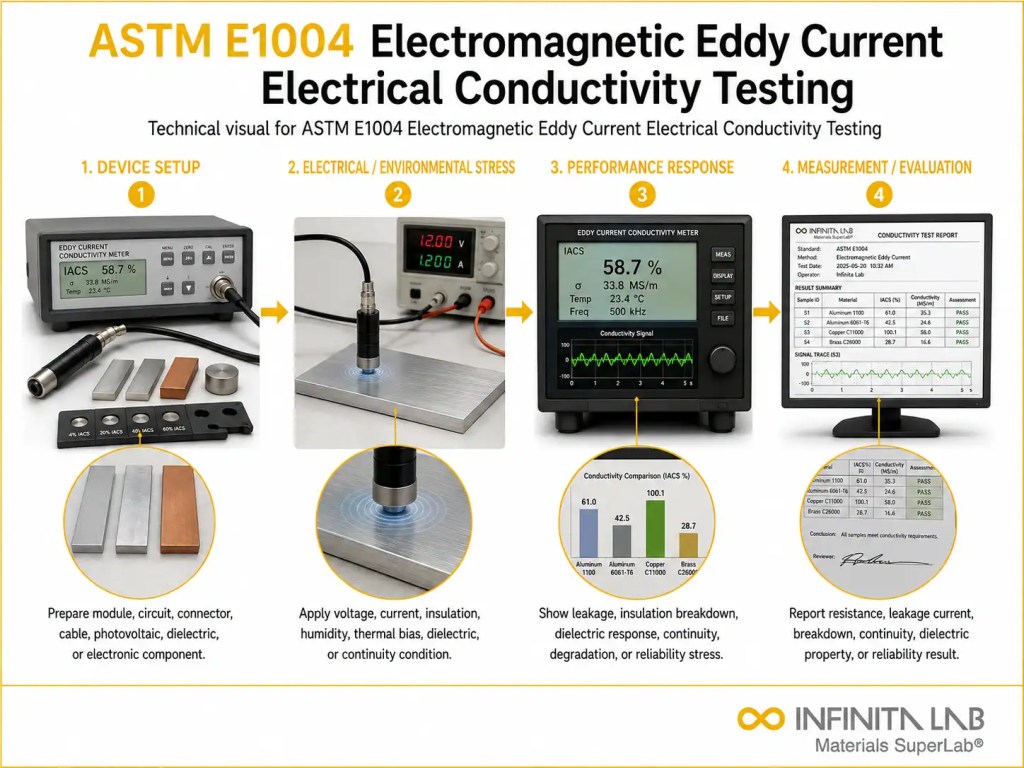


What Is ASTM E1004 Eddy Current Conductivity?
ASTM E1004 is a standardized test method that uses the electromagnetic (eddy-current) technique to measure the electrical conductivity of nonmagnetic metals. This non-destructive test method can measure conductivity in SI units.
The technique is based on measuring the eddy currents induced in the material and analyzing the results to infer its conductivity. When used with reference standards of known values, ASTM E1004 provides accurate and repeatable results. The technique applies to metals with flat or slightly curved surfaces, even when they have thin non-conductive coatings.
Applications and Benefits of ASTM E1004 Eddy Current Conductivity Testing
Scope
ASTM E1004 evaluates:
- Electrical conductivity of nonmagnetic metals
- Alloy classification
- Effects of heat treatment
- Alloy aging
- Corrosion impact
- Heat damage and temper
- Material hardness (when combined with hardness testing)
This method applies to coated and uncoated metallic surfaces with minimal curvature.
Applications
- Quality control in manufacturing
- Verification of electrical components
- Process monitoring during production
- Material selection for electrical applications
- Compliance with industry standards
- Electrical failure diagnostics
- Evaluation of material degradation
- Design optimization for electrical systems
Benefits
- Non-destructive testing method
- Rapid and repeatable results
- Assists in alloy identification
- Supports quality assurance programs
- Helps monitor heat treatment effects
- Ensures material performance reliability
- Improves product consistency
Our ASTM E1004 Testing Procedure
Instrument Setup & Warm-Up
Connect the probe, power on the instrument, and allow it to stabilize.
1Temperature Check & Calibration
Verify the temperature is stable and calibrate using reference standards.
2Measurement
Place the probe on the specimen surface and record conductivity readings.
3Verification & Data Recording
Check standards, restandardize if needed, and document results.
4ASTM E1004 Test Parameters and Requirements
| Parameter | Details |
|---|---|
| Applicable Materials | Nonmagnetic metals |
| Surface Condition | Flat or slightly curved |
| Coating Allowance | Thin non-conductive coatings permitted |
| Accuracy Requirement | ±0.5% IACS of reference value |
| Output Units | % IACS (International Annealed Copper Standard) |


- Eddy current conductivity meter
- Probe coil sensor
- Reference calibration standards
- Temperature monitoring device
- Data acquisition system
- Calibration software
Equipment and Instrumentation Used for ASTM E1004 Testing
What You Receive: Test Report, Data, and Certification
- Electrical conductivity values (% IACS)
- Calibration verification records
- Material classification reports
- Quality control documentation
- Trend analysis reports
ASTM E1004 Eddy Current Conductivity FAQs
ASTM E1004 test technique describes how to use the electromagnetic (eddy current) approach to determine the electrical conductivity of nonmagnetic metals.
A sample’s electrical conductivity helps determine: 1. Type of metal or alloy 2.Type of heat treatment (for aluminum, this evaluation should be used with a hardness examination). 3. Aging of the alloy. 4. Corrosion effects, and 5. Heat damage.
The method aids in material selection and quality control by providing accurate conductivity measurements, crucial for assessing material properties and processing conditions.
Temperature changes, probe coil-to-metal coupling (lift-off), surface condition, and instrument stability affect the accuracy of electrical conductivity.
Conductivity is determined using a probe and a meter. Voltage is applied across two electrodes inserted into an immersed probe in the sample water. The voltage loss due to the water resistance helps calculate the conductivity per cm.
ASTM E1004 is a test method for determining the electrical conductivity of nonmagnetic materials, particularly metals, using the electromagnetic eddy-current technique. The test involves placing an electrical conductivity probe against a prepared specimen surface. The instrument generates an electromagnetic field that induces eddy currents within the material and measures the resulting electromagnetic response. The measured response is converted into an electrical conductivity value, commonly expressed as a percentage of the International Annealed Copper Standard (% IACS) or Siemens per meter (S/m). The results help identify alloy variations, evaluate heat treatment conditions, detect aging effects, and support material quality control.
Quality control using electrical conductivity evaluates the consistency and electrical properties of metallic materials during manufacturing and inspection. A conductivity meter or suitable resistance measurement instrument is used to measure the electrical response of prepared material samples. The readings are compared with reference values, material specifications, or established production limits to identify variations in composition, heat treatment, aging, or material condition. Depending on the material and application, measurements may use eddy-current testing or direct electrical resistance methods. This approach helps manufacturers identify material inconsistencies, verify processing conditions, and maintain product quality.
ASTM B193 determines the electrical resistivity of metallic electrical conductor materials through direct resistance measurements. A prepared specimen is measured for its length, cross-sectional dimensions, weight, and density, as applicable. Its electrical resistance is then measured using an appropriate calibrated electrical measurement system. The measured resistance and specimen dimensions are used to calculate volume resistivity and, where required, weight resistivity. Temperature corrections are applied when measurements are performed at temperatures different from the specified reference temperature. The results help evaluate the electrical performance and consistency of conductive materials used in wires, cables, and electrical components.
Why Choose Infinita Lab for Eddy Current Conductivity Testing
When your Eddy Current Conductivity results have to hold up - for compliance, a customer audit, or an engineering decision - ASTM E1004 accuracy and an unbiased third-party report matter more than price. Infinita Lab routes your ASTM E1004 eddy current conductivity testing to ISO/IEC 17025-accredited U.S. partner labs with hands-on method experience, so you get defensible data, transparent reporting, and turnaround times built around your project deadline - not ours.

Need ASTM E1004 Eddy Current Conductivity Testing You Can Rely On?
Send query us at hello@infinitalab.com or call us at (888) 878-3090 to learn more about our services and how we can support you.