


ASTM E2141: Electrochromic Device Accelerated Aging Testing Services
Accredited ASTM E2141 electrochromic device accelerated aging testing from Infinita Lab, performed to the exact standard requirements - accurate, reproducible results with full documentation for compliance, R&D, and quality control programs.
TRUSTED BY


Get ASTM E2141 compliant results - request your electrochromic device accelerated aging testing quote
- Overview
- Scope, Applications, and Benefits
- Test Process
- Specifications
- Instrumentation
- Results and Deliverables
What Is ASTM E2141 Electrochromic Device Accelerated Aging?
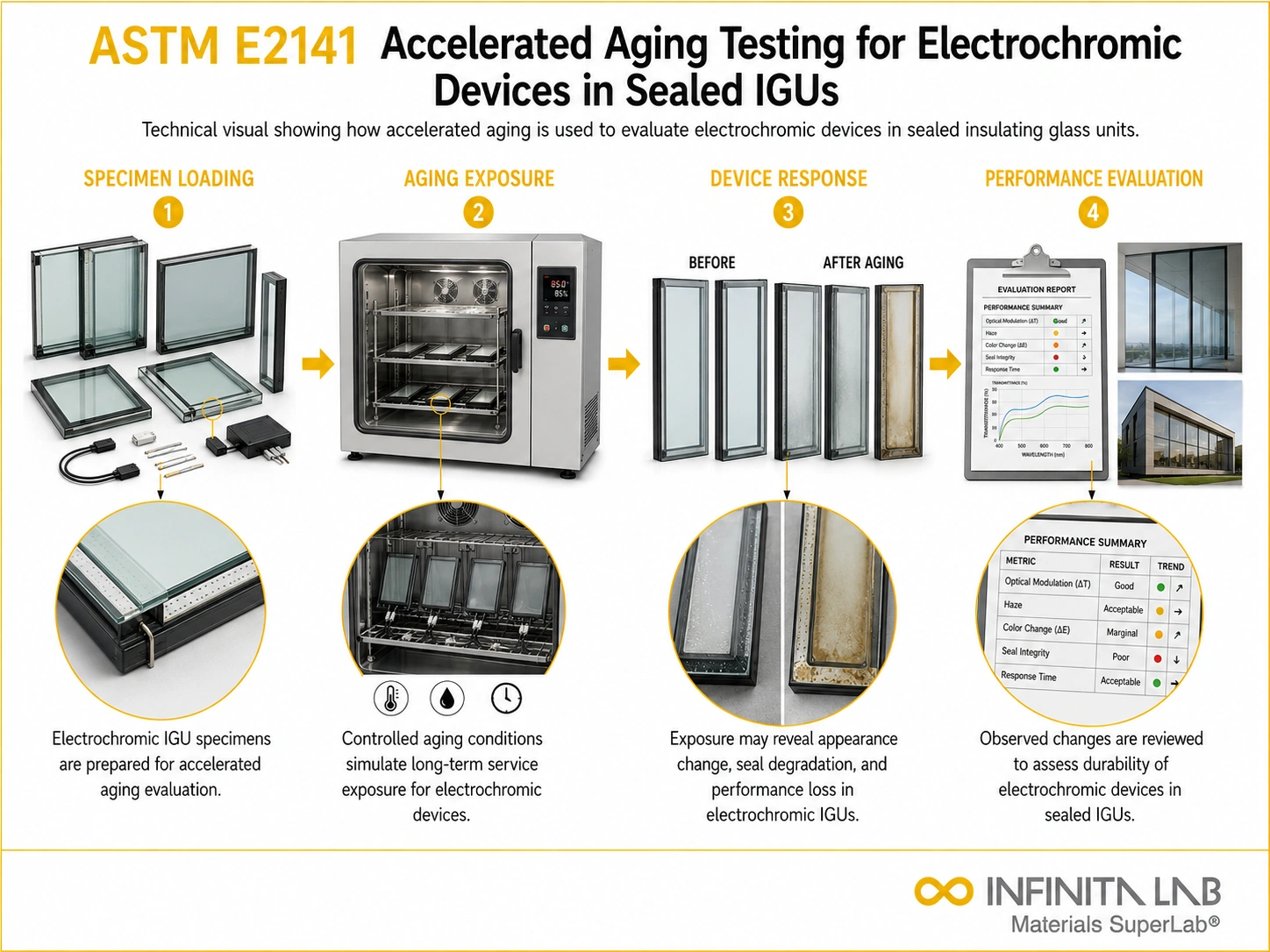
ASTM E2141, Standard Test Method for Accelerated Aging of Electrochromic Devices in Sealed Insulating Glass Units, defines a laboratory procedure for judging how well electrochromic (EC) glazing holds up over time. The current active edition is E2141-21, which supersedes E2141-14 and earlier versions; the 2001 original carried a different title referring to absorptive electrochromic coatings. It’s a single test method, not a family of lettered methods. It applies to EC devices built into sealed insulating glass units (IGUs) used as vision glass in windows, doors, skylights, and wall systems. Inorganic and organic EC materials are both covered, while photochromic devices, thermochromic devices, and EC glazings on non-glass substrates fall outside its scope. The method combines two ideas drawn from the standard’s own significance statement: rapid but realistic current-voltage cycling that stresses the electrical behavior of the device, and environmental exposure parameters of the kind used in weatherability standards, including simulated solar radiation. Together they compress years of in-service switching and weathering into a laboratory timeline. Different EC glazing designs can then be ranked by relative serviceability and durability. Specimens get characterized before and after aging, so changes in optical and electrical behavior can be quantified rather than judged by eye. One limit matters. E2141 is explicit that accelerated results cannot, by themselves, predict how long an installed unit will last, because that claim requires field data and a defensible analysis tying laboratory outcomes to real-world performance. Its best uses are comparison, qualification screening, and design feedback. A closely aligned international counterpart, ISO 18543, addresses the same product type, helping manufacturers selling in several markets plan one consistent durability program. The standard is published in Volume 04.11 of the ASTM Book of Standards.

Applications and Benefits of ASTM E2141 Electrochromic Device Accelerated Aging Testing
Scope
ASTM E2141 evaluates:
- The standard covers accelerated aging of electrochromic devices integrated into sealed insulating glass units.
- Written for EC glazing used as vision glass in building windows, doors, skylights, and wall systems.
- Both inorganic and organic electrochromic material systems fall within its scope.
- Photochromic and thermochromic devices are explicitly excluded from the method.
- Also out: electrochromic glazings built on non-glass substrates.
- The procedure pairs rapid current-voltage cycling with environmental exposure parameters typical of weatherability testing.
- The purpose is evaluating the relative serviceability and durability of EC glazings, not certifying a service life.
- Per the standard, accelerated results cannot predict in-service lifetime without corresponding field data and analysis.
- It’s a single test method; there are no separate lettered methods to choose between.
- ISO 18543 addresses the same product category and is closely aligned, which supports shared test planning across regions.
Applications
- Comparing the durability of competing electrochromic coating chemistries and device architectures.
- Qualification of electrochromic insulating glass units before release to architectural glazing markets.
- Screening design changes such as new seals, spacers, or electrode materials for their effect on aging.
- Feedback loops between glazing engineers and materials scientists during product development.
- Durability evidence for specifiers, building owners, and certification programs.
- Field-return investigations, where suspected degradation mechanisms are reproduced under controlled conditions.
Benefits
- Repeatable, standardized data that can be compared across products and laboratories.
- Weaknesses in electrical, optical, and sealing performance show up in less time.
- Reveals how switching behavior and appearance change after combined electrical and environmental stress.
- Early failure modes get caught before field deployment, which helps de-risk product launches.
- Manufacturers gain a recognized reference when documenting durability for customers and regulators.
Our ASTM E2141 Testing Procedure
Specimen Preparation
Select electrochromic sealed glass units free from visible defects and record initial properties
1Baseline Measurement
Measure initial optical and electrical performance parameters
2Final Measurement
Measure post-exposure optical and electrical properties
3Result Evaluation
Compare pre- and post-aging results to assess degradation and durability
4ASTM E2141 Test Parameters and Requirements
| Parameter | Details |
|---|---|
| Test Specimen | Electrochromic device in sealed, insulated glass unit |
| Environmental Conditions | Controlled temperature and relative humidity |
| Electrical Input | Defined voltage and cycling profile |
| Performance Metrics | Optical transmittance, switching behavior, visual defects |
| Test Equipment | Environmental chamber with electrical cycling capability |
| Evaluation Method | Pre- and post-aging performance comparison |


- Solar Simulator – Controlled simulated sunlight, commonly based on xenon-arc technology, reproduces solar loading on the glazing.
- Environmental Chamber – Holds the specified temperature and ambient conditions around the specimens during aging.
- Programmable Power Supply and Cycler – Applies and reverses voltage to switch the device between clear and tinted states, and records current response.
- Spectrophotometer – Visible and solar transmittance of the glazing, measured before, during, and after aging.
- Temperature Sensors and Data Logger – Specimen surface and chamber temperatures are monitored and logged for traceability.
- Visual Inspection Station – Supports documentation of coloration uniformity, edge effects, delamination, and seal condition.
Equipment and Instrumentation Used for ASTM E2141 Testing
What You Receive: Test Report, Data, and Certification
- Pre-aging and post-aging optical data for the clear and tinted states.
- Records of electrical cycling, showing current and voltage response over the test.
- Percent retention or change in key properties relative to baseline measurements.
- Photographic and written documentation of visible defects or uniformity changes.
- A final report identifying the standard edition, specimen details, test conditions, and observed degradation.
- Comparative summaries when multiple designs or coatings are evaluated side by side.
ASTM E2141 Electrochromic Device Accelerated Aging FAQs
An electrochromic device (ECD) changes optical transmittance (light and solar transmission) by applying a small voltage that drives ions (typically Li⁺ or H⁺) into and out of an electrochromic material (often WO₃). The reversible ion insertion/extraction changes the material's absorption, making the glass switch from clear to tinted.
The acceleration factors depend on exposure intensity and temperature. A typical ASTM E2141 protocol is designed to represent 10–25 years of service exposure in a temperate climate. The exact correlation requires climate-specific modeling and is stated in the product's durability .
Common failure modes include haze formation, non-uniform tinting (mottling), degraded switching speed, reduced optical range (minimum and maximum transmittance converge), delamination of functional layers, and seal failure in the IGU, which admits moisture and accelerates ECD degradation.
Yes. ASTM E2141 is designed to be applicable to both inorganic (transition metal oxide) and organic (conducting polymer, viologen-based) electrochromic systems, though specific protocol parameters (UV dose, voltage profile) may need to be adapted for each technology.
ASTM E2141 is commonly used with ASTM E2178 (air leakage), NFRC 100 (U-factor), NFRC 200 (SHGC), ASTM E2190 (IGU durability), and IEC 62368 (electrical safety) to form a complete qualification program for smart glazing products.
Why Choose Infinita Lab for Electrochromic Device Accelerated Aging Testing
When your Electrochromic Device Accelerated Aging results have to hold up - for compliance, a customer audit, or an engineering decision - ASTM E2141 accuracy and an unbiased third-party report matter more than price. Infinita Lab routes your ASTM E2141 electrochromic device accelerated aging testing to ISO/IEC 17025-accredited U.S. partner labs with hands-on method experience, so you get defensible data, transparent reporting, and turnaround times built around your project deadline - not ours.

Need ASTM E2141 Electrochromic Device Accelerated Aging Testing You Can Rely On?
Send query us at hello@infinitalab.com or call us at (888) 878-3090 to learn more about our services and how we can support you.



Request a Quote
Submit your material details and receive testing procedures, pricing, and turnaround time within 24 hours.
 Quick Turnaround and Hasslefree process
 Confidentiality Guarantee
 Free, No-obligation Consultation
 100% Customer Satisfaction
