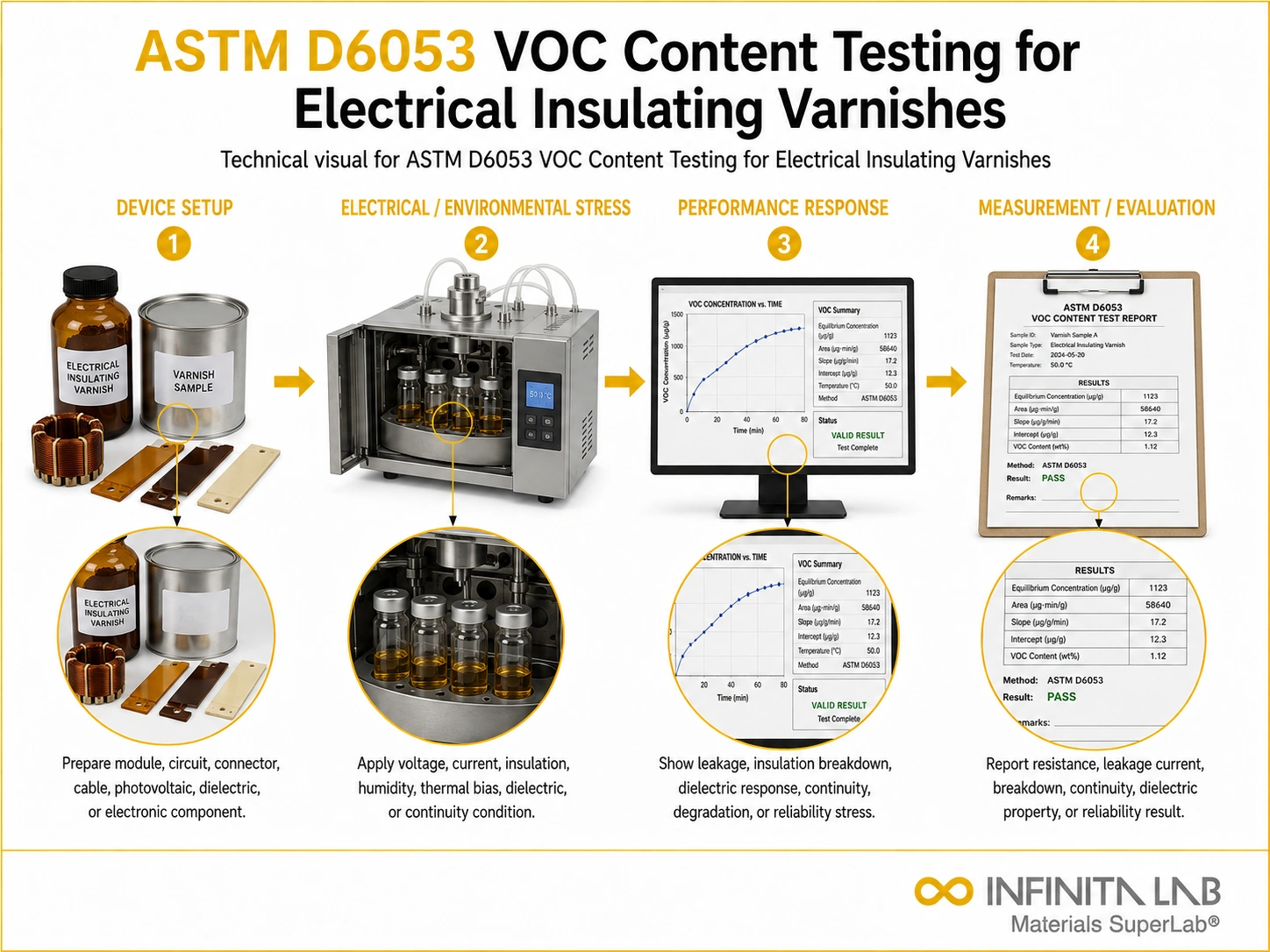


What Is ASTM D6053 VOC Electrical Insulating Varnish?
ASTM D6053, Standard Test Method for Determination of Volatile Organic Compound (VOC) Content of Electrical Insulating Varnishes, covers determining the amount of volatile organic compounds emitted during the cure of electrical insulating varnishes. The current active designation is D6053-14(2025), the 2014 edition reapproved in 2025, and Subcommittee D09.01 of ASTM Committee D09 on electrical and electrical insulating materials maintains the standard. It’s a short procedure, about three pages. The principle is simple: dishes containing a known amount of varnish are baked, and the volatile organic compound content is measured from what leaves the sample during that bake. Because the bake imitates the cure that varnish undergoes on an electrical unit, the result describes emissions under cure conditions, not a simple inventory of the solvents in the liquid. Results are calculated and expressed in grams per liter or pounds per gallon. The standard applies to all varnish types. Waterborne varnishes need one extra step, though: water content is determined in accordance with Practice D3960, so water isn’t counted as an organic volatile. The method states two purposes. One is to estimate the amount of cured varnish deposited on electrical units; the other is to measure volatile organic emissions from the manufacturing operations that apply the varnish. Earlier editions, including D6053-00, D6053-03 and D6053-08, are now historical, and only the current edition should be cited for new work. D6053 sits alongside ASTM D115, which covers broader testing of solvent-containing varnishes used for electrical insulation. Its own focus is narrower: VOC release during cure and the unit-based figures that environmental reporting depends on.

Applications and Benefits of ASTM D6053 VOC Electrical Insulating Varnish Testing
Scope
ASTM D6053 determines the volatile organic content of electrical insulating varnishes by:
- ASTM D6053 covers the determination of the amount of volatile organic compounds emitted during the cure of electrical insulating varnishes.
- It applies to all types of electrical insulating varnish, not only solvent-based products.
- Waterborne varnishes are included, provided water content is determined according to Practice D3960 and accounted for in the calculation.
- Baking dishes that hold a known amount of varnish, then quantifying the volatile organic compounds lost during the bake, is the basis of the measurement.
- Results are expressed as a mass of VOC per unit volume, in grams per liter or pounds per gallon.
- Estimating the quantity of cured varnish that ends up on an electrical unit is one use.
- Another: measuring volatile organic emissions from manufacturing operations that apply varnish.
- Three pages long, the test method falls under the jurisdiction of ASTM Subcommittee D09.01 and is published in Volume 10.02 of the Book of Standards.
- It doesn’t purport to address every safety concern, so users must establish their own safety and health practices before running it.
Applications
- Determining the VOC content of varnishes used to impregnate motor stator and rotor windings.
- Varnishes used on transformer and coil windings and other wound electrical components can be characterized too.
- Incoming material and batch quality control for varnish suppliers and end users alike.
- Plants that apply and cure varnish can generate VOC data for emissions inventories and permit reporting.
- Product development: comparing candidate varnish formulations, including solvent-borne and waterborne options.
- Estimating the mass of cured varnish retained on a finished electrical unit.
Benefits
- A standardized, repeatable way to report VOC content of insulating varnishes, so results are comparable between suppliers and sites.
- It supplies the numbers needed to document environmental compliance and air-emission reporting.
- Because the test reflects the actual cure bake, the result relates to what is released during real processing.
- Solvent-borne and waterborne chemistries both fit under one method.
- Straightforward laboratory equipment is all it requires, which keeps testing efficient and cost-effective.
- Formulation decisions aimed at lowering emissions without losing insulating performance get support as well.
Our ASTM D6053 Testing Procedure
Dish Preparation & Sample Addition
Aluminium dishes are weighed, and 2–10 g of varnish is added to each dish.
1Film Formation & Oven Curing
Dishes are rolled to form uniform coatings and cured in a forced-convection oven.
2Cooling & Final Weighing
Samples are cooled in a desiccator and reweighed to nearest 0.01 g.
3Calculation
Weight loss is used to calculate VOC content.
4ASTM D6053 Test Parameters and Requirements
| Parameter | Details |
|---|---|
| Applicable Materials | Electrical insulating varnishes |
| Sample Mass | 2–10 g |
| Number of Samples | Minimum three |
| Oven Type | Forced-convection |
| Cooling Method | Desiccator |


- Analytical Balance – Weighs the dishes and varnish specimens before and after baking to establish the volatile mass loss.
- Forced-Draft Laboratory Oven – Holds the baking conditions called for in the procedure and heats the specimens uniformly.
- Specimen Dishes – These hold the known amount of varnish during baking and are weighed with the sample.
- Desiccator – Baked dishes cool here in a dry atmosphere before the final weighing.
- Density Measurement Equipment – Establishes the density of the varnish so results can be expressed on a per-volume basis.
- Water Content Analyzer (Karl Fischer or gas chromatograph) – Determines water in waterborne varnishes, following the approach in Practice D3960.
Equipment and Instrumentation Used for ASTM D6053 Testing
What You Receive: Test Report, Data, and Certification
- A report of VOC content in grams per liter or pounds per gallon, as requested.
- Sample identification, lot, and condition at receipt, all documented.
- Water content data for waterborne varnishes, with the correction applied to the VOC result.
- A statement of the standard edition used, plus a record of any deviations from the method.
- Raw weighing data and calculations, available for audit and quality review.
- Test documentation prepared to support environmental compliance files and supplier qualification records.
ASTM D6053 VOC Electrical Insulating Varnish FAQs
Varnishtraditionally combines a drying oil, a resin, a thinner or solvent, and a metal drier to accelerate drying. However, different types of varnish have different components.
Electrical Insulating varnishes are resins like epoxies that protect high-voltage machines such as transformers, motors, and generators from electrical failure. They are applied over electrical conductors to provide a layer of electrical isolation and prevent shorting.
Insulating varnish is a moisture barrier, preventing water or humidity from damaging sensitive electronic components. Dual electric strength - It has high dielectric strength and can withstand high voltages without breaking down.
VOC content affects both environmental compliance and occupational safety. High VOC levels contribute to air pollution and pose health risks to workers and end-users.
The method applies to liquid electrical insulating varnishes, including impregnating, coating, and overcoat varnishes.
Insulation samples are placed in controlled environmental chambers, where VOC and SVOC emissions are collected from the material and analyzed to determine emission levels. The results are compared with applicable VOC limits or certification requirements to assess compliance. ASTM D7859 covers preparation of spray polyurethane foam insulation samples for VOC/SVOC emission testing.
Why Choose Infinita Lab for VOC Electrical Insulating Varnish Testing
When your VOC Electrical Insulating Varnish results have to hold up - for compliance, a customer audit, or an engineering decision - ASTM D6053 accuracy and an unbiased third-party report matter more than price. Infinita Lab routes your ASTM D6053 VOC electrical insulating varnish testing to ISO/IEC 17025-accredited U.S. partner labs with hands-on method experience, so you get defensible data, transparent reporting, and turnaround times built around your project deadline - not ours.

Need ASTM D6053 VOC Electrical Insulating Varnish Testing You Can Rely On?
Send query us at hello@infinitalab.com or call us at (888) 878-3090 to learn more about our services and how we can support you.