


VDA VOC FOG Emissions Testing Services
VDA 278 is a process for testing the resistance of painted surfaces to chemicals. In the automotive industry, coatings play a vital role in the durability and longevity of vehicles. It is a widely recognized standard in the automotive industry and is used to evaluate the resistance of automotive coatings to various chemical substances, including solvents, acids, and alkalis.
TRUSTED BY


Get compliant results — request your VDA VOC FOG emissions testing quote
- Overview
- Scope, Applications, and Benefits
- Test Process
- Specifications
- Instrumentation
- Results and Deliverables
What Is VDA VOC FOG Emissions?
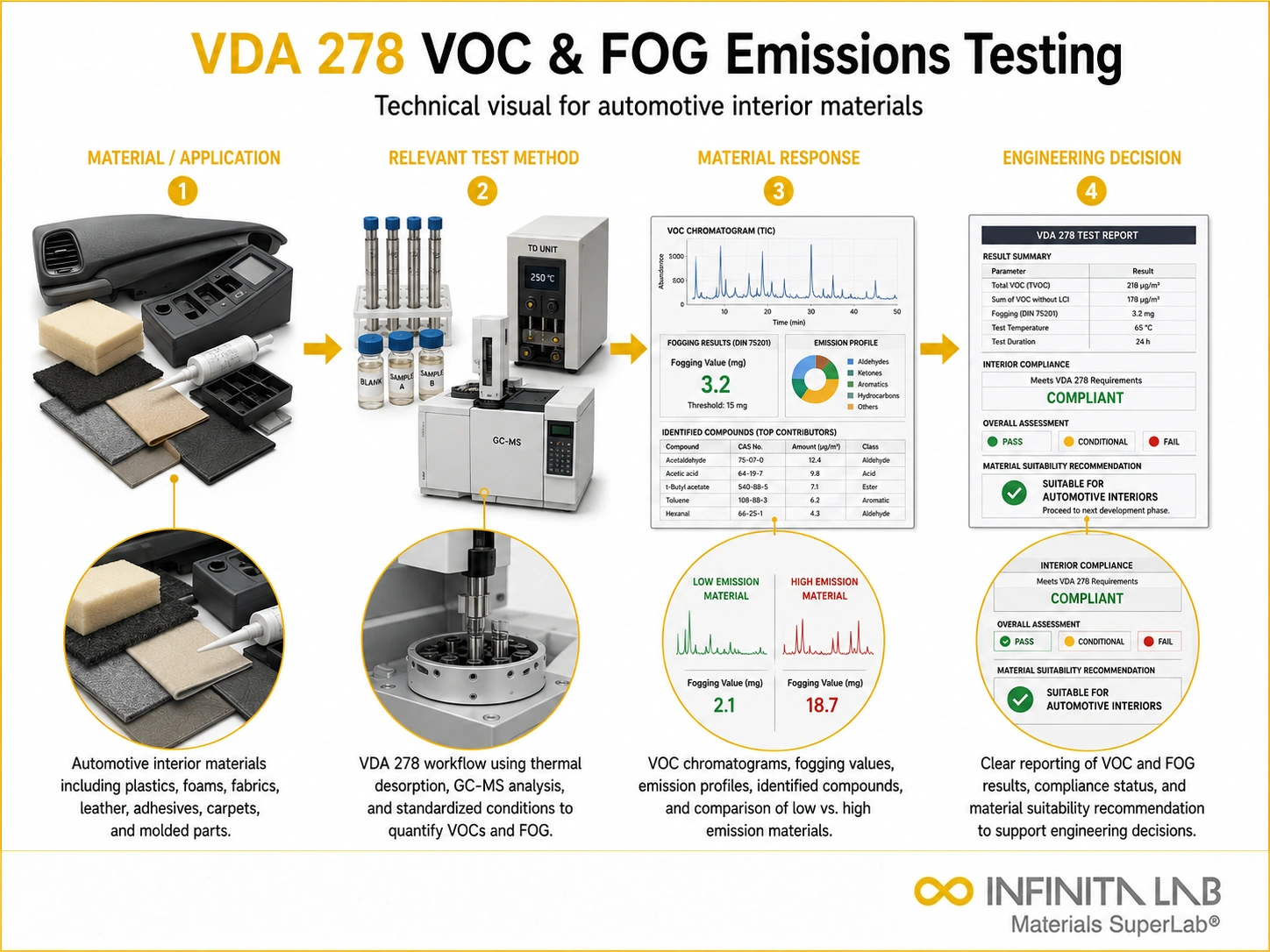
VDA 278 is a standardised procedure for testing automotive interior materials for volatile organic compounds (VOC) and condensable emissions (FOG) that might be emitted by these materials. The test evaluates how non-metallic automotive interior materials react in terms of emitted compounds to ensure that they meet indoor air quality requirements.
This standardised procedure uses thermal desorption, followed by gas chromatography/mass spectrometry (TD-GC/MS), to detect organic emissions from materials at raised temperature levels. VOCs, however, are tested at lower temperature levels, similar to those found inside a car, while FOGs contain compounds that might condense on surfaces like windshields at raised temperature levels.

Applications and Benefits of VDA VOC FOG Emissions Testing
Scope
VDA 278 is a testing standard used to determine the amount of volatile matter that is released by automotive interior materials. It focuses on the chemicals that are released by these materials during heating, as controlled by thermal desorption. This is an important standard in the automotive industry, used to ensure that the air inside an automotive cabin is clean and that the materials used inside the automotive cabin meet high standards.
VDA 278 is used to detect the chemicals that are released by automotive interior materials. It is used to detect:
– Volatile Organic Compounds (VOC)
– Condensable Organic Compounds (FOG)
Applications
- Automotive interior material qualification
- Vehicle cabin air quality evaluation
- Material selection for interior components
- Supplier material validation
- Quality control of automotive parts
- Development of low-emission materials
- Research and development of automotive materials
Benefits
- Ensures low-emission interior materials
- Improves vehicle cabin air quality
- Reduces windshield fogging risks
- Supports compliance with OEM emission requirements
- Detects volatile and semi-volatile compounds
- Standardised emission measurement method
- Enhances passenger comfort and safety
- Supports supplier material qualification
Our Testing Procedure
Sample Preparation
Automotive material specimens are cut to size and placed in thermal desorption tubes.
1VOC Measurement
The sample is heated to about 90°C to release volatile organic compounds for analysis.
2FOG Measurement
The sample is further heated to about 120°C to release condensable organic compounds (FOG).
3GC-MS Analysis & Interpretation
Released compounds are analyzed using GC-MS and VOC/FOG emission levels are calculated.
4Test parameters and requirements
| Parameter | Details |
|---|---|
| Emission Categories | VOC (Volatile Organic Compounds), FOG (Condensable compounds) |
| VOC Test Temperature | Approximately 90°C |
| FOG Test Temperature | Approximately 120°C |
| Applicable Materials | Automotive interior plastics, foams, textiles, rubbers, adhesives, coatings |
| Sample Form | Solid materials or components used in vehicle interiors |
| Output Units | µg/g (micrograms per gram of material) |


- Thermal desorption unit
- Gas chromatography system (GC)
- Mass spectrometer (MS) detector
- Sample desorption tubes
- Temperature-controlled furnace
- Analytical balance
- Chromatography data analysis software
Equipment and Instrumentation Used for Testing
What You Receive: Test Report, Data, and Certification
- Total VOC emission values
- Total FOG emission values
- Individual compound identification
- Chromatographic emission profiles
- Compliance evaluation against OEM specifications
- Material emission comparison reports
VDA VOC FOG Emissions FAQs
VDA 278 is a standardized automotive test method used to measure volatile organic compounds (VOC) and condensable organic compounds (FOG) emitted from interior vehicle materials. It evaluates emissions that may affect cabin air quality and cause windshield fogging.
VOC refers to low-boiling volatile organic compounds that evaporate easily and contribute to cabin air contamination. FOG refers to higher boiling organic compounds that can condense on cooler surfaces such as windshields, potentially causing fogging.
The test is suitable for automotive interior materials such as plastics, rubbers, foams, textiles, adhesives, coatings, sealants, and interior trim components.
The test uses thermal desorption followed by gas chromatography–mass spectrometry (TD-GC/MS) to separate, identify, and quantify emitted organic compounds.
VOC emissions are typically measured at around 90°C, while FOG emissions are measured at a higher temperature of around 120°C.
Why Choose Infinita Lab for VDA VOC FOG Emissions Testing?
At the core of this breadth is our network of 2,000+ accredited laboratories across the USA, offering access to over 10,000 testing methods and analytical services. From advanced materials characterization (SEM, TEM, RBS, XPS) to mechanical, chemical, environmental, biological, and standardized ASTM/ISO-compliant testing, we deliver unmatched flexibility, specialization, and scale. You are never limited by geography, facility, or methodology — Infinita Lab connects you to the right expertise and testing solution, every time.

Looking for an Accredited Partner for VDA VOC FOG Emissions Testing?
Send query us at hello@infinitalab.com or call us at (888) 878-3090 to learn more about our services and how we can support you.



Request a Quote
Submit your material details and receive testing procedures, pricing, and turnaround time within 24 hours.
 Quick Turnaround and Hasslefree process
 Confidentiality Guarantee
 Free, No-obligation Consultation
 100% Customer Satisfaction
