


VOC Guide Testing Services
Volatile Organic Compounds (VOCs) are a class of organic compounds that easily evaporate into the air at room temperature. They are found in various household and industrial products, as well as in nature, and can have both beneficial and detrimental effects on human health and the environment.
TRUSTED BY


Get compliant results — request your VOC guide testing quote
- Overview
- Scope, Applications, and Benefits
- Test Process
- Specifications
- Instrumentation
- Results and Deliverables
What Is VOC Guide?
Volatile Organic Compounds (VOCs) are a class of carbon-based chemicals that readily evaporate at ambient or moderately elevated temperatures due to their high vapor pressure and low boiling points. They are commonly present in coatings, solvents, adhesives, fuels, and polymer-based materials, where they contribute to emissions during application, curing, or thermal exposure. VOCs play a significant role in atmospheric chemistry and material performance.
In industrial and environmental contexts, VOCs are critical due to their impact on air quality, human health, and regulatory compliance. Their behavior depends on molecular structure, volatility, and interaction with surrounding media, influencing evaporation rate, odor generation, and secondary chemical reactions such as photochemical smog formation.

Applications and Benefits of VOC Guide Testing
Scope
VOC analysis focuses on identifying, quantifying, and understanding the emission behavior of volatile organic compounds from materials and environments.
- Covers volatile emissions from liquids, solids, and coatings
- Applicable to solvents, paints, adhesives, fuels, and polymers
- Evaluates evaporation, diffusion, and emission characteristics
- Supports environmental and regulatory compliance assessment
- Includes total VOC and compound-specific analysis
- Used in air quality monitoring and material qualification
Applications
- Indoor and outdoor air quality assessment
- Automotive interior material evaluation
- Paints, coatings, and adhesive formulation control
- Industrial emission monitoring
- Environmental impact studies
- Chemical and material research
Benefits
- Improves air quality and safety assessment
- Supports regulatory compliance with emission limits
- Helps optimize low-emission material formulations
- Reduces environmental and health risks
- Enables better process and product control
- Assists in odor and contamination management
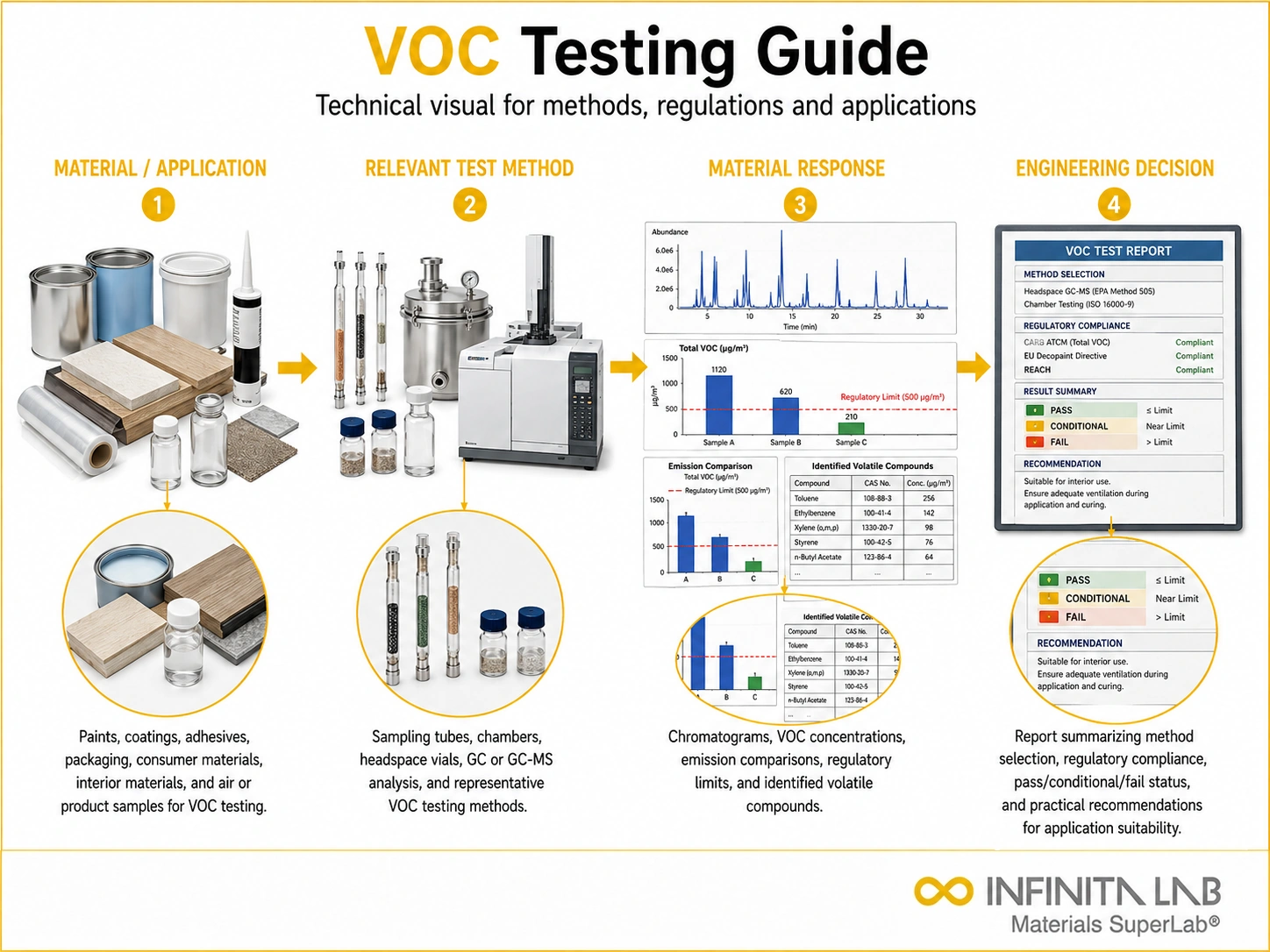
Our Testing Procedure
Sample Collection
Air, material, or emission samples are collected using controlled sampling techniques to capture representative VOC content.
1Extraction or Release
VOCs are released from the sample through thermal desorption, solvent extraction, or direct sampling methods.
2Separation and Detection
Analytical instruments such as gas chromatography separate and detect individual VOC compounds.
3Quantification and Analysis
VOC concentration is calculated and reported based on calibration standards and analytical data.
4Test parameters and requirements
| Parameter | Details |
|---|---|
| Measurement Principle | Volatilization and analytical detection of organic compounds |
| Sample Type | Air, coatings, polymers, solvents, and environmental samples |
| Detection Method | GC, GC-MS, or gravimetric techniques |
| Volatility Range | Low to high boiling organic compounds |
| Output Units | ppm, mg/m³, g/L depending on application |
| Detection Limit | ppb to ppm levels (method dependent) |
| Temperature Range | Ambient to elevated (method-specific) |


- Gas Chromatograph (GC)
- Gas Chromatography–Mass Spectrometry (GC-MS)
- Thermal desorption units
- Sampling pumps and tubes
- Flame ionization detectors (FID)
- Environmental monitoring systems
Equipment and Instrumentation Used for Testing
What You Receive: Test Report, Data, and Certification
- Total VOC concentration report
- Individual compound identification (if applicable)
- Emission profile analysis
- Air quality or material compliance report
- Regulatory classification data
- Analytical certification documentation
VOC Guide FAQs
VOCs are chemicals that can vaporize into the air. They are used in thousands of products daily, including paint, varnish, wax, and various cleaning, degreasing, and cosmetic products. Exposure to VOC vapors can cause a variety of health effects.
Different regulatory bodies define VOCs based on reactivity, environmental impact, or boiling range, leading to variations in which compounds are included or excluded in different standards.
Higher temperature increases molecular kinetic energy, overcoming intermolecular forces and accelerating evaporation rate, resulting in higher VOC release.
VOC content refers to the amount present in a material, while VOC emissions describe the rate and quantity released into the environment over time.
TVOC aggregates all compounds into a single value, masking the presence of highly toxic or reactive species that may be present at low concentrations but have significant impact.
Why Choose Infinita Lab for VOC Guide Testing
At the core of this breadth is our network of 2,000+ accredited laboratories across the USA, offering access to over 10,000 testing methods and analytical services. From advanced materials characterization (SEM, TEM, RBS, XPS) to mechanical, chemical, environmental, biological, and standardized ASTM/ISO-compliant testing, we deliver unmatched flexibility, specialization, and scale. You are never limited by geography, facility, or methodology — Infinita Lab connects you to the right expertise and testing solution, every time.

Looking for an Accredited Partner for VOC Guide Testing?
Send query us at hello@infinitalab.com or call us at (888) 878-3090 to learn more about our services and how we can support you.



Request a Quote
Submit your material details and receive testing procedures, pricing, and turnaround time within 24 hours.
 Quick Turnaround and Hasslefree process
 Confidentiality Guarantee
 Free, No-obligation Consultation
 100% Customer Satisfaction
