


ASTM D6266: Waterborne Automotive Coating VOC Testing Services
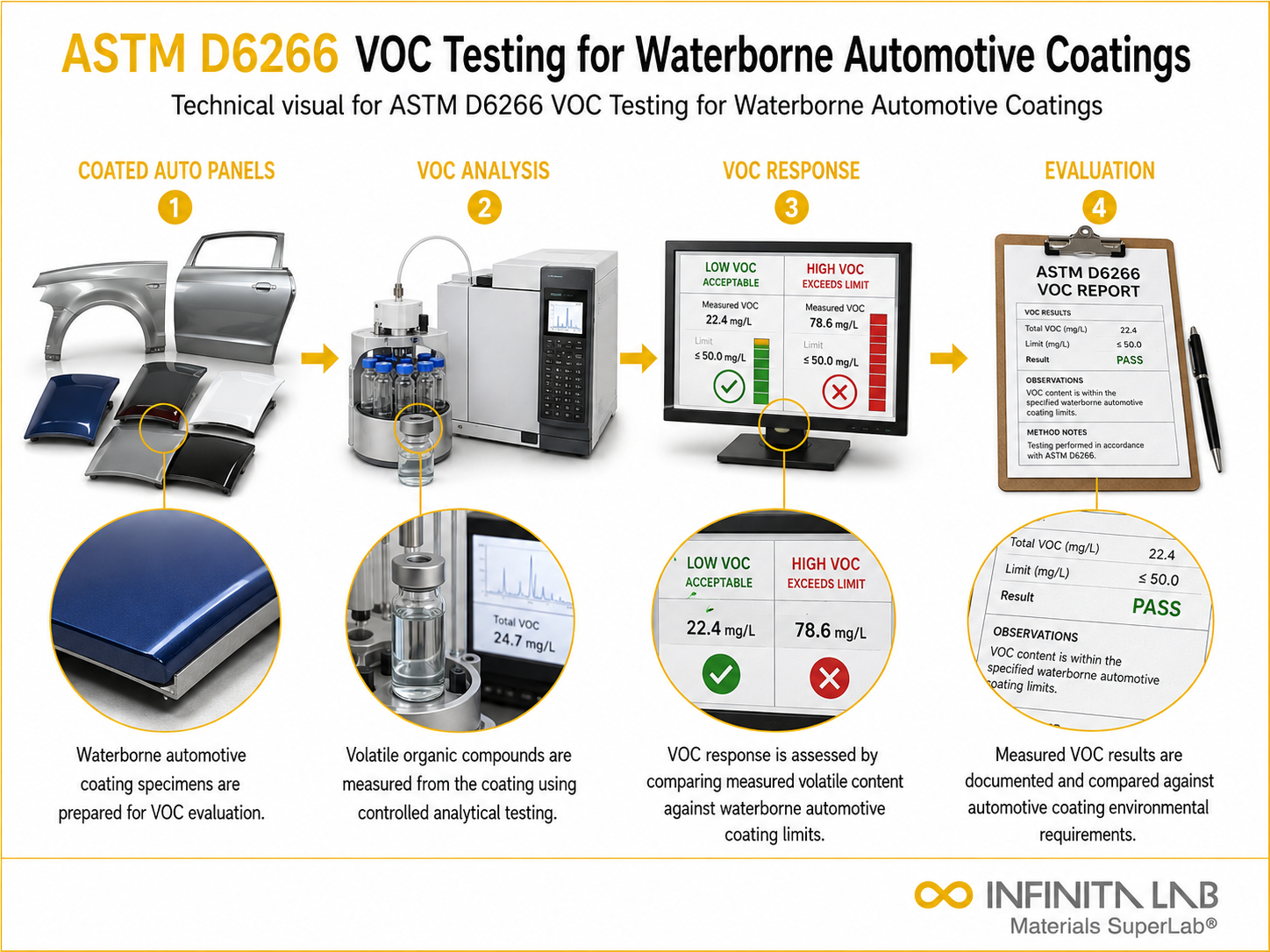
ASTM D6266-00 is used to determine the amount of volatile organic compound (VOC) released from waterborne automotive coatings. The information obtained is used to determine the amount of VOC available for removal by a VOC control device.
TRUSTED BY


Get ASTM D6266 compliant results — request your waterborne automotive coating VOC testing quote
- Overview
- Scope, Applications, and Benefits
- Test Process
- Specifications
- Instrumentation
- Results and Deliverables
What Is ASTM D6266 Waterborne Automotive Coating VOC?
ASTM D6266 is an internationally recognized standardized test method for determining the VOC emissions from waterborne coatings. Waterborne coatings are environmentally preferable to solvent-based coatings because they use water as the dispersion medium for resin components. However, waterborne coatings do emit VOCs during their application and curing.
This method quantifies the VOC available for treatment by control devices and is critical data for environmental compliance, equipment design, and pollution control strategies. The results help manufacturers evaluate the total VOC load entering abatement systems and determine the overall efficiency of emission reduction.

Applications and Benefits of ASTM D6266 Waterborne Automotive Coating VOC Testing
Scope
ASTM D6266 evaluates:
- VOC emissions from freshly applied waterborne coatings
- Weight loss during coating application and curing
- VOC content using gas chromatography (GC)
- Water content correction for accurate VOC calculation
- VOC mass available for abatement systems
This method supports regulatory compliance and environmental monitoring.
Applications
- Design of VOC control devices
- Environmental compliance testing
- Coating formulation development
- Manufacturing process optimization
- Air pollution control system validation
- Industrial quality control
- Regulatory reporting
Benefits
- Accurate VOC emission quantification
- Supports pollution control system design
- Improves environmental compliance
- Enables coating formulation optimization
- Standardized and repeatable methodology
- Enhances process efficiency
- Supports sustainability initiatives
Our ASTM D6266 Testing Procedure
Initial Weighing & Coating Application
The clean panel is weighed, and the waterborne coating is applied uniformly.
1Post-Coating Weighing & Curing
The panel is weighed after coating and then cured under controlled conditions.
2Final Weighing & GC Analysis
Final weight is measured, and GC analysis is performed to quantify VOCs and water content.
3VOC Calculation
VOC mass is calculated directly or by subtracting water content.
4ASTM D6266 Test Parameters and Requirements
| Parameter | Details |
|---|---|
| Applicable Materials | Waterborne coatings |
| Measurement Output | VOC weight |
| Analysis Method | Weight loss & gas chromatography |
| Environmental Focus | Air emission control |
| Reported Units | Grams or pounds of VOC |


- Analytical balance
- Coated test panels
- Drying/curing chamber
- Gas chromatograph (GC)
- Sample containers
- Environmental control system
- Data analysis software
Equipment and Instrumentation Used for ASTM D6266 Testing
What You Receive: Test Report, Data, and Certification
- Total VOC weight available for abatement
- GC analytical reports
- Weight loss calculations
- Compliance documentation
- Environmental impact assessment
- Control device design data
- Quality control records
ASTM D6266 Waterborne Automotive Coating VOC FAQs
ASTM D6266 determines the amount of volatile organic compound (VOC) released from waterborne automotive coatings and available for removal by a VOC control or abatement system. The method provides engineering data on VOC emissions generated during coating application and baking.
The method is specifically intended for waterborne automotive coatings after they have been applied to a test panel. It can be used to evaluate coatings under laboratory simulations of production processes or in an actual production facility.
The test involves measuring the weight loss of a freshly coated test panel during evaporation or drying, together with analysis of the VOC or water content in the coating. These measurements are used to calculate the amount of VOC released during the process.
The test provides basic engineering data that can help determine the VOC load delivered to a control device, including VOC evolved in flash zones or bake ovens. This information can support evaluation and design of VOC abatement systems and comparison of coating processes.
No. ASTM D6266 determines the amount of VOC available for delivery to the control device, not the device's removal efficiency itself. Total VOC removal depends on both the amount of VOC available and the removal efficiency of the abatement system.
Why Choose Infinita Lab for Waterborne Automotive Coating VOC Testing
At the core of this breadth is our network of 2,000+ accredited laboratories across the USA, offering access to over 10,000 testing methods and analytical services. From advanced materials characterization (SEM, TEM, RBS, XPS) to mechanical, chemical, environmental, biological, and standardized ASTM/ISO-compliant testing, we deliver unmatched flexibility, specialization, and scale. You are never limited by geography, facility, or methodology — Infinita Lab connects you to the right expertise and testing solution, every time.

Need ASTM D6266 Waterborne Automotive Coating VOC Testing You Can Rely On?
Send query us at hello@infinitalab.com or call us at (888) 878-3090 to learn more about our services and how we can support you.



Request a Quote
Submit your material details and receive testing procedures, pricing, and turnaround time within 24 hours.
 Quick Turnaround and Hasslefree process
 Confidentiality Guarantee
 Free, No-obligation Consultation
 100% Customer Satisfaction
