
ASTM D4027 Modified Rail Shear Testing for Structural Adhesives
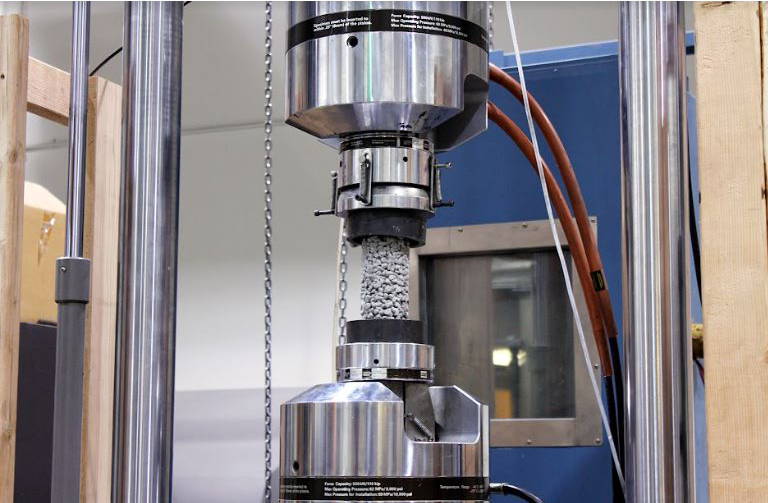
ASTM D4027 describes the test for tensile shear modulus and shear strength of adhesive layers between rigid adherends. The wooden test specimen is clamped within a modified rail fixture loaded from a testing machine. The ASTM D4027 adhesive strength and shear modulus is expressed in megapascals (Mpa).
TRUSTED BY


Precision-driven testing for dimensional accuracy and compliance
- Overview
- Scope, Applications, and Benefits
- Test Process
- Specifications
- Instrumentation
- Results and Deliverables
Overview
ASTM D4027 describes a test method for determining the shear strength of structural adhesives by a modified rail test. It provides an accurate indication of the adhesive shear strength for bonding rigid substrates such as metals, composites, and ceramics.
The load is applied parallel to the adhesive layer, resulting in a uniform shear stress, minimizing bending and peel effects. The test method is widely used for strong structural adhesives in load-carrying joints where predictable stress distribution and reliable performance under service conditions are paramount.

Scope, Applications, and Benefits
Scope
ASTM D4027 determines the apparent shear strength, stiffness, and failure characteristics of structural adhesive bonds under controlled laboratory conditions.
It evaluates:
- Shear strength of bonded joints
- Shear modulus and stiffness
- Strain to failure
- Failure modes (cohesive, adhesive, substrate)
- Stress–strain behaviour of adhesives
The method applies to:
- Rigid and semi-rigid structural adhesives
- Single-lap and double-lap joint configurations
- Metal, composite, and thermoset plastic adherends
Applications
- Aerospace structural bonding
- Automotive body and chassis assembly
- Construction and civil engineering joints
- Marine structural components
- Industrial equipment assembly
- Adhesive product development
- Quality control testing
Benefits
- Provides accurate pure shear data
- Minimizes bending and peel stresses
- Supports adhesive material selection
- Enables performance comparison between adhesives
- Improves joint reliability and safety
- Assists in design validation
Test Process
Surface Preparation & Bonding
Adherend surfaces are prepared, adhesive is applied with controlled thickness, and specimens are cured as specified.
1Specimen Setup
Cured specimens are mounted in a modified rail fixture for testing.
2Tensile Loading
Load is applied parallel to the adhesive layer until failure occurs.
3Data & Calculation
Maximum load and displacement are recorded, and shear strength is calculated from the failure load and bonded area.
4Technical Specifications
| Parameter | Details |
|---|---|
| Applicable Materials | Structural adhesives with rigid adherends |
| Joint Type | Single-lap and double-lap |
| Typical Bonded Area | 25 mm × 25 mm |
| Adhesive Thickness | 0.25 – 0.5 mm |
| Test Temperature | Room temperature or specified conditions |
| Loading Mode | Tension |
Instrumentation Used for Testing
- Universal testing machine
- Modified rail shear fixture
- Precision alignment grips
- Load cell
- Extensometer or displacement sensor
- Temperature chamber (if required)
- Data acquisition system
Results and Deliverables
- Shear strength values (MPa)
- Failure load data
- Stress–strain curves
- Failure mode classification
- Comparative adhesive performance reports
- Documentation for quality control and certification
Frequently Asked Questions
The ASTM D4027 test is designed to measure the shear properties of structural adhesives using a modified rail test setup. It determines the adhesive’s strength, stiffness, and failure behavior under shear loading.
This method applies to rigid and semi-rigid structural adhesives used for bonding metals, composites, ceramics, and thermosetting plastics, especially in load-bearing or high-performance applications.
Unlike lap shear tests, the modified rail test minimizes bending and peel stresses, ensuring that the applied load generates nearly pure shear stress across the adhesive layer, resulting in more accurate shear strength data.
The test provides key parameters such as apparent shear strength, shear modulus, strain at failure, and the mode of failure (cohesive, adhesive, or substrate).
Why Choose Infinita Lab
for Electron Energy Loss
Spectroscopy (EELS)?
At the core of this breadth is our network of 2,000+ accredited labs in the USA, offering access to over 10,000 test types. From advanced metrology (SEM, TEM, RBS, XPS) to mechanical, dielectric, environmental, and standardized ASTM/ISO testing, we give clients unmatched flexibility, specialization, and scale. You are not limited by geography, facility, or methodology – Infinita connects you to the right testing, every time.

Looking for a trusted partner for Electron Energy Loss Spectroscopy (EELS) Testing?
Send query us at hello@infinitlab.com or call us at (888) 878-3090 to learn more about our services and how we can support you.




Request a Quote
Submit your material details and receive testing procedures, pricing, and turnaround time within 24 hours.
 Quick Turnaround and Hasslefree process
 Confidentiality Guarantee
 Free, No-obligation Consultation
 100% Customer Satisfaction
