
ASTM E111 Young’s Modulus, Tangent Modulus & Chord Modulus Testing
ASTM E111 is used to determine Young's modulus, tangent modulus, and chord modulus of structural materials. This test method is limited to materials in which creep deformation is negligible compared to the strain (deformation) produced immediately upon loading. The values stated in SI units are to be regarded as standard.
TRUSTED BY


Precision-driven testing for dimensional accuracy and compliance
- Overview
- Scope, Applications, and Benefits
- Test Process
- Specifications
- Instrumentation
- Results and Deliverables
Overview
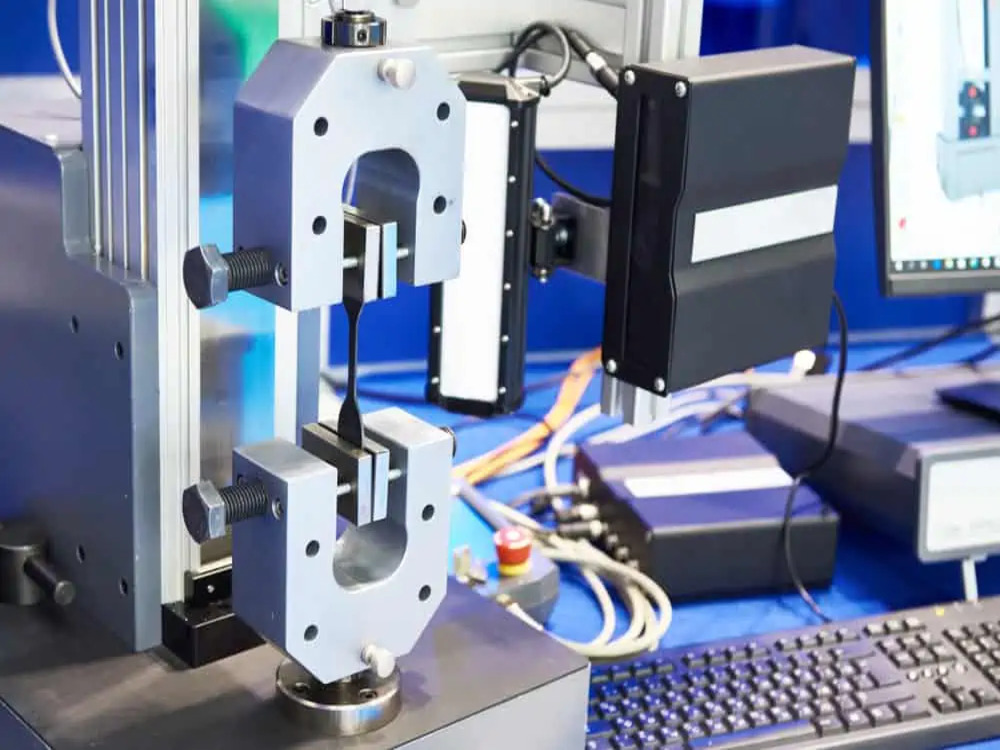
ASTM E111 is the standard test method for ascertaining Young’s Modulus (stiffness), tangent modulus, and chord modulus of structural materials subjected to uniaxial loading. It measures the slope of the stress-strain curve, particularly beneficial for materials exhibiting linear or mildly non-linear elastic behavior, where creep is minimal. The method uses universal testing machines with extensometers to quantify elastic deformation.
This test method is limited to materials in which creep deformation is negligible compared to the strain (deformation) produced immediately upon loading. The values are in SI units.

Scope, Applications, and Benefits
Scope
ASTM E111 establishes methods for calculating elastic moduli using stress–strain data obtained during mechanical testing. It ensures accurate evaluation of stiffness by defining calculation techniques for different modulus types under controlled loading conditions.
- Covers determination of Young’s modulus, tangent modulus, and chord modulus
- Applicable to metallic and structural materials
- Uses stress–strain data from tensile or compressive testing
- Defines calculation methods for linear and non-linear regions
- Ensures repeatable and standardized modulus evaluation
Applications
- Structural material design and analysis
- Mechanical property characterization of metals
- Finite element modeling and simulation input
- Quality control in manufacturing processes
- Aerospace and automotive material validation
- Research and development of new materials
Benefits
- Provides accurate measurement of material stiffness
- Enables differentiation between linear and non-linear elastic behavior
- Supports reliable engineering design and analysis
- Ensures consistency in modulus determination
- Enhances material selection and performance prediction
- Reduces errors in stress–strain interpretation
Testing Process
Specimen Preparation
A standardized test specimen is prepared with defined dimensions and surface quality.
1Load Application
Controlled tensile or compressive load is applied while measuring corresponding deformation.
2Data Acquisition
Stress and strain values are continuously recorded during loading.
3Modulus Calculation
Elastic moduli are calculated from the stress–strain curve using defined methods.
4Technical Specifications
| Parameter | Details |
|---|---|
| Test Type | Tensile / Compressive |
| Measured Properties | Young’s, Tangent & Chord Modulus |
| Materials Tested | Metals, plastics, composites, ceramics |
| Strain Measurement | Extensometer / Strain gauge |
| Result Output | Stress–strain curve & modulus values |
| Test Environment | Ambient laboratory conditions |
Instrumentation Used
- Universal Testing Machine (UTM)
- Load cell with appropriate capacity
- Extensometer (contact or non-contact)
- Constant-rate crosshead drive
- Data acquisition and analysis system
- Measuring tools (vernier calipers or micrometer)
Results and Deliverables
- Young’s modulus values
- Tangent modulus values at specified stress or strain points
- Chord modulus values between defined strain limits
- Stress–strain curve plots
- Test report with calculation methodology
- Measurement uncertainty and repeatability data
Frequently Asked Questions
ASTM E111 determines Young's modulus, tangent modulus, and chord modulus of structural materials.
Young’s modulus represents material stiffness in the linear elastic region, indicating resistance to deformation under load. It is essential for design calculations, structural analysis, and predicting how materials behave under mechanical stress in engineering applications.
Tangent modulus is the slope of the stress–strain curve at a specific point, reflecting instantaneous stiffness. Unlike Young’s modulus, it accounts for non-linear behavior, making it useful for analyzing materials beyond the initial linear elastic region.
Chord modulus is calculated between two defined points on the stress–strain curve. It provides an average stiffness over a strain range, useful for materials with non-linear elastic behavior where a single slope does not represent the response accurately.
Factors include strain measurement precision, load accuracy, specimen alignment, and data resolution. Errors in any of these can distort the stress–strain curve and lead to incorrect modulus values.
Why Choose Infinita Lab
for Electron Energy Loss
Spectroscopy (EELS)?
At the core of this breadth is our network of 2,000+ accredited labs in the USA, offering access to over 10,000 test types. From advanced metrology (SEM, TEM, RBS, XPS) to mechanical, dielectric, environmental, and standardized ASTM/ISO testing, we give clients unmatched flexibility, specialization, and scale. You are not limited by geography, facility, or methodology – Infinita connects you to the right testing, every time.

Looking for a trusted partner for Electron Energy Loss Spectroscopy (EELS) Testing?
Send query us at hello@infinitlab.com or call us at (888) 878-3090 to learn more about our services and how we can support you.




Request a Quote
Submit your material details and receive testing procedures, pricing, and turnaround time within 24 hours.
 Quick Turnaround and Hasslefree process
 Confidentiality Guarantee
 Free, No-obligation Consultation
 100% Customer Satisfaction
