


MIL-STD-810: Method Shock Testing Services
Military Standard 810, Method 516, also called MIL-STD 810 shock testing, are methods to test the durability, functionality, and resilience of any material when exposed to impulse shock. These shocks resemble shocks experienced during operation, transit, handling, or crash.
TRUSTED BY


Get MIL-STD-810 compliant results — request your method shock testing quote
- Overview
- Scope, Applications, and Benefits
- Test Process
- Specifications
- Instrumentation
- Results and Deliverables
What Is MIL-STD-810 Method Shock?
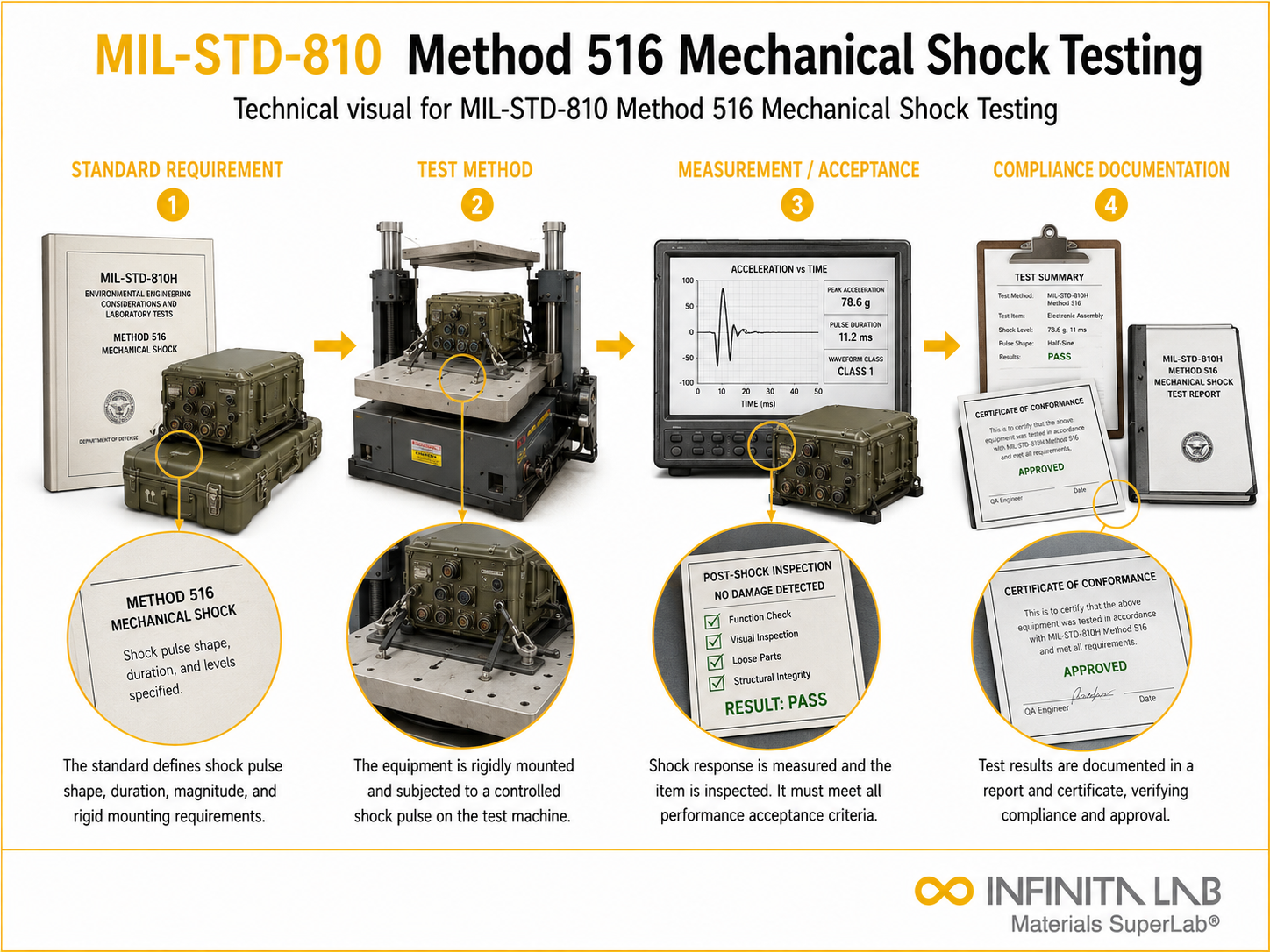
MIL-STD-810 Method 516 is a standardized test used to evaluate the ability of equipment and materials to withstand mechanical shock events encountered during handling, transportation, and operational use. These shocks may result from drops, impacts, collisions, or sudden accelerations.
The method applies controlled shock pulses to test items, simulating real-world conditions such as transit drops, crash impacts, or bench handling. It helps identify structural weaknesses, functional failures, and levels of fragility, ensuring that products maintain integrity and performance under sudden mechanical stress.

Applications and Benefits of MIL-STD-810 Method Shock Testing
Scope
MIL-STD-810 Method 516 evaluates:
- Resistance to mechanical shock and impact
- Structural integrity under sudden loads
- Functional performance after shock exposure
- Fragility and packaging requirements
- Mounting and attachment strength
Applications
- Military and defense equipment
- Aerospace and avionics systems
- Electronic devices and rugged equipment
- Automotive and transport systems
- Industrial and telecom hardware
Benefits
- Simulates real-world shock conditions
- Identifies design and material weaknesses
- Improves durability and reliability
- Supports packaging and transport design
- Reduces the risk of failure during handling or operation
Our MIL-STD-810 Testing Procedure
Sample Preparation
Test items are configured based on operational or transport conditions.
1Shock Application
Controlled shock pulses (e.g., half-sine, sawtooth) are applied using drop tables or shock machines.
2Multi-Condition Testing
Samples undergo shocks such as drops, impacts, or crash simulations depending on procedure.
3Data Analysis
Physical damage, displacement, and functional performance are evaluated against criteria.
4MIL-STD-810 Test Parameters and Requirements
| Parameter | Details |
|---|---|
| Test Principle | Mechanical shock / transient vibration testing |
| Shock Pulse Types | Half-sine, sawtooth, trapezoidal |
| Typical Shock Levels | ~20 g to 40 g, ~11 ms duration (application dependent) |
| Test Methods | 8 procedures (I–VIII) |
| Drop Height (Transit) | ~1.22 m typical (Procedure IV) |
| Axes | Multi-axis (X, Y, Z) testing |
| Measured Outputs | Physical damage, displacement, functional performance |


- Shock test machines (mechanical or hydraulic)
- Drop test systems
- Electrodynamic shakers
- Accelerometers and sensors
- Data acquisition systems
- High-speed recording systems
Equipment and Instrumentation Used for MIL-STD-810 Testing
What You Receive: Test Report, Data, and Certification
- Shock resistance performance data
- Functional performance before and after shock
- Fragility and packaging recommendations
- Failure mode identification (cracks, displacement, malfunction)
- Pass/fail evaluation as per test criteria
- Test report
MIL-STD-810 Method Shock FAQs
It is used to evaluate how equipment withstands mechanical shocks such as drops, impacts, and collisions, ensuring durability during handling, transport, and operation.
Method 516, Procedure IV, is for testing products that could be accidentally dropped, such as when they are removed from a shelf or dropped during handling.
MIL-STD 810 low temperature evaluates the effects of low temperatures on the integrity, safety, and performance of material during storage and use. This method is best for assessing material that will likely be exposed to a low temperature environment during its life cycle.
While MIL-STD-810 is primarily a military standard, its methods are also widely used in commercial industries to ensure product reliability and durability.
Fragility testing determines how sensitive a product is to shock, helping design protective packaging and mounting systems to prevent damage during transport.
Why Choose Infinita Lab for Method Shock Testing
At the core of this breadth is our network of 2,000+ accredited laboratories across the USA, offering access to over 10,000 testing methods and analytical services. From advanced materials characterization (SEM, TEM, RBS, XPS) to mechanical, chemical, environmental, biological, and standardized ASTM/ISO-compliant testing, we deliver unmatched flexibility, specialization, and scale. You are never limited by geography, facility, or methodology — Infinita Lab connects you to the right expertise and testing solution, every time.

Looking for an Accredited Partner for MIL-STD-810 Method Shock Testing?
Send query us at hello@infinitalab.com or call us at (888) 878-3090 to learn more about our services and how we can support you.



Request a Quote
Submit your material details and receive testing procedures, pricing, and turnaround time within 24 hours.
 Quick Turnaround and Hasslefree process
 Confidentiality Guarantee
 Free, No-obligation Consultation
 100% Customer Satisfaction
