


ASTM E1461: Thermal Diffusivity Flash Method Testing Services
Accredited ASTM E1461 thermal diffusivity flash method testing from Infinita Lab, performed to the exact standard requirements - accurate, reproducible results with full documentation for compliance, R&D, and quality control programs.
TRUSTED BY


Get ASTM E1461 compliant results - request your thermal diffusivity flash method testing quote
- Overview
- Scope, Applications, and Benefits
- Test Process
- Specifications
- Instrumentation
- Results and Deliverables
What Is ASTM E1461 Thermal Diffusivity Flash Method?
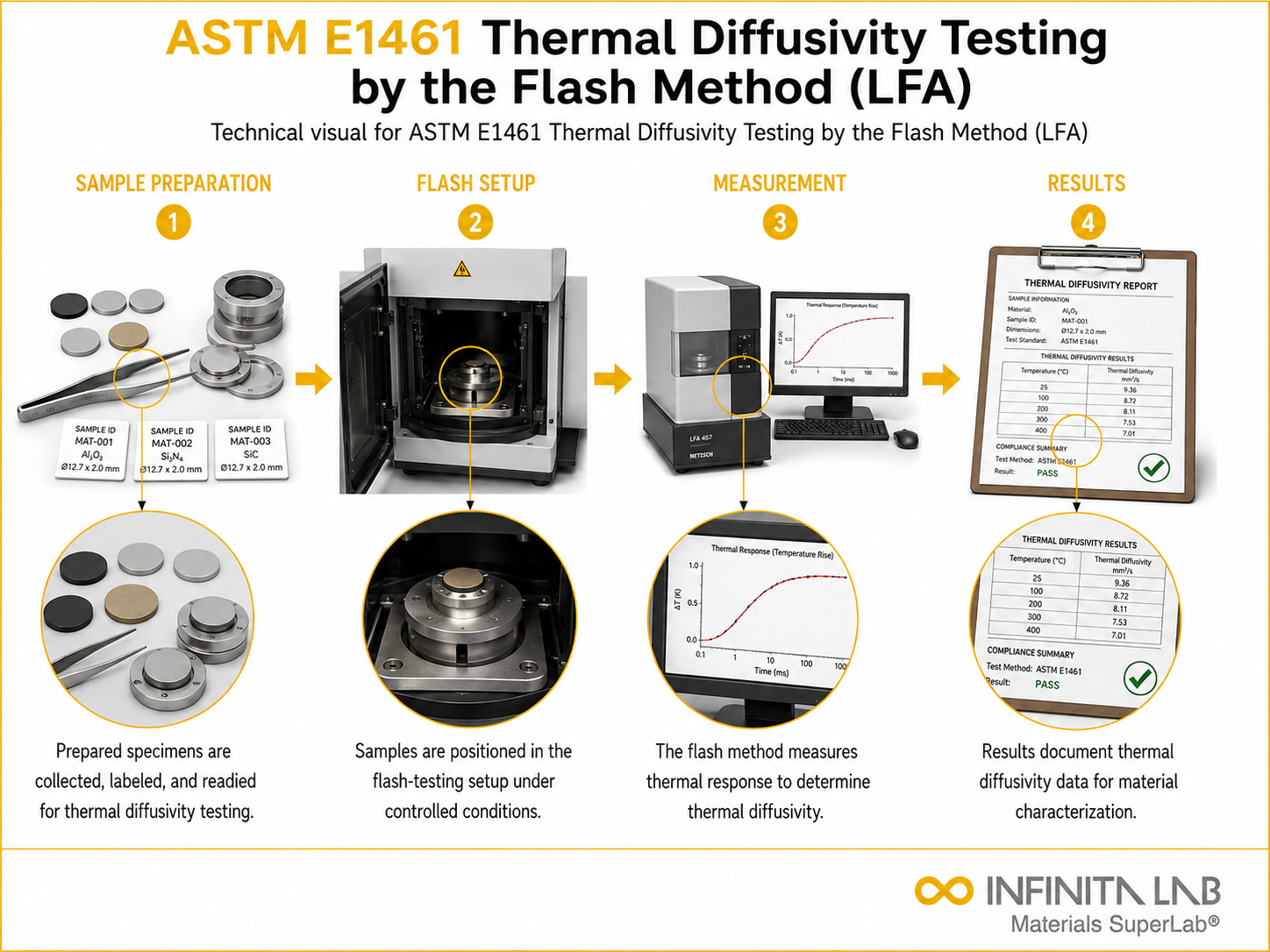
ASTM E1461 is the standard test method for determining the thermal diffusivity of essentially homogeneous, isotropic solid materials using the flash method, a widely accepted technique for characterising how quickly heat moves through a material. In this approach, a thin disc or square specimen is exposed on its front face to a short, high-intensity energy pulse from a laser or xenon flash source. As the resulting heat travels through the specimen thickness, an infrared detector positioned at the rear face records the temperature rise over time, producing a temperature-versus-time curve. Thermal diffusivity is then calculated from the specimen thickness and the time required for the rear face to reach a defined fraction, typically half, of its maximum temperature rise, using established mathematical models that may include corrections for heat loss and finite pulse effects. Because the method requires only a small specimen, a short test duration, and no direct contact instrumentation beyond the detector, it has become the reference technique for measuring thermal diffusivity across a broad temperature range. Thermal diffusivity testing under ASTM E1461 matters because it underpins thermal management design, material qualification, and quality control across industries where heat transfer behaviour determines product performance and safety. Engineers rely on accurate diffusivity data, combined with density and specific heat, to derive thermal conductivity and to validate simulation models used in high-temperature components, electronic packaging, and insulation systems. For manufacturers and material developers, ASTM E1461 testing provides objective, standardised, and repeatable data that supports specification compliance, process optimisation, and confidence in how a material will perform under real operating thermal loads.

Applications and Benefits of ASTM E1461 Thermal Diffusivity Flash Method Testing
Scope
- Measures the thermal diffusivity of essentially homogeneous, isotropic solid materials as a function of temperature using the flash method.
- Applies to a broad range of material classes, including metals, alloys, ceramics, composites, coatings, and semi-transparent or translucent materials prepared with an appropriate opaque, high-emissivity coating.
- Uses small, thin specimens, typically discs or squares only a few millimetres thick, making the method suitable for limited-quantity or precious material samples.
- Supports testing across a wide temperature range, from sub-ambient and room-temperature conditions to very high temperatures, depending on the furnace and instrument configuration used.
- Provides diffusivity values that, together with independently determined density and specific heat, allow thermal conductivity to be calculated rather than measured directly.
- Serves as the underlying methodology referenced by thermal characterisation programs in aerospace, automotive, energy, nuclear, electronics, and materials research sectors.
- Enables non-contact, rapid measurement of a temperature-dependent property that steady-state conduction methods cannot reliably obtain.
- Supports material qualification, design validation, and quality assurance activities where heat transfer behaviour is a critical performance parameter.
- Applies to isotropic and, with appropriate specimen orientation, certain anisotropic or layered materials to characterise through-thickness heat transport.
- Provides data used to compare candidate materials, verify manufacturing consistency, and validate thermal models used in engineering simulations.
Applications
- Aerospace thermal protection systems and high-temperature structural components exposed to extreme re-entry or engine environments.
- Nuclear fuel, cladding, and reactor structural materials where accurate thermal transport data supports safety analysis.
- Electronics and semiconductor thermal management, including heat sinks, substrates, and packaging materials.
- Automotive components such as brake materials, engine parts, and thermal barrier coatings subject to rapid heating cycles.
- Refractories and industrial furnace linings that must maintain predictable thermal behaviour at elevated temperatures.
- Thermal insulation materials and building products where diffusivity data informs energy performance modelling.
- Advanced composites and coatings developed for thermal barrier, ablative, or protective applications.
Benefits
- Delivers standardised, accredited data that supports regulatory, contractual, and specification compliance requirements.
- Provides a fast, non-contact measurement approach that minimises specimen handling and reduces test turnaround time.
- Requires only small specimens, preserving limited or costly material for other characterisation needs.
- Generates temperature-dependent data that better reflects real-world operating conditions than single-point measurements.
- Enables derivation of thermal conductivity when paired with density and specific heat data, avoiding separate steady-state testing.
- Supports informed material selection, design validation, and quality control decisions across the product development lifecycle.
Our ASTM E1461 Testing Procedure
Specimen Preparation
A flat, uniform specimen is prepared with defined dimensions and surface coatings if required.
1Energy Pulse Application
A short laser or light pulse is applied to one surface of the specimen.
2Temperature Detection
The temperature rise on the opposite surface is recorded using an infrared detector.
3Data Analysis
The temperature response curve is analyzed to calculate thermal diffusivity based on heat transfer models.
4ASTM E1461 Test Parameters and Requirements
| Parameter | Details |
|---|---|
| Standard | ASTM E1461 |
| Test Principle | Measurement of rear surface temperature rise after a heat pulse application |
| Applicable Materials | Metals, ceramics, polymers, and composite solids |
| Heat Source | Laser or xenon flash lamp providing short energy pulse |
| Specimen Geometry | Flat, homogeneous, and parallel-faced samples |
| Temperature Range | Ambient to high temperatures depending on system capability |
| Measurement Output | Thermal diffusivity expressed in mm²/s or m²/s |


- Laser or Xenon Flash Source – Delivers a short, high-energy pulse to uniformly heat the front face of the specimen and initiate the thermal transient.
- Infrared Detector – Continuously measures the temperature rise on the specimen’s rear face to generate the time-temperature response curve.
- Furnace or Temperature-Controlled Chamber – Maintains and steps through the desired test temperature or temperature program during measurement.
- Specimen Holder – Secures the disc or square specimen in a fixed, repeatable position between the energy source and the detector.
- Data Acquisition System – Captures, digitises, and processes the detector signal to determine the half-rise time and calculate thermal diffusivity.
- Graphite Coating Apparatus – Applies a thin, uniform high-emissivity coating to specimen surfaces to improve energy absorption and infrared detection accuracy.
- Environmental Control System – Manages inert or controlled atmosphere conditions within the test chamber to prevent specimen oxidation at elevated temperatures.
Equipment and Instrumentation Used for ASTM E1461 Testing
What You Receive: Test Report, Data, and Certification
- Thermal diffusivity values reported as a function of temperature across the tested range.
- Derived thermal conductivity values calculated from diffusivity, density, and specific heat data when those inputs are provided or independently determined.
- Graphical plots illustrating diffusivity and conductivity, where applicable, versus temperature.
- Documentation of specimen dimensions, coating method, and test conditions used during the measurement.
- A summary of the calculation method applied, including any corrections made for heat loss or pulse duration effects.
- A formal, accredited test report suitable for engineering records, specification compliance, and customer submission.
Frequently Asked Question
ASTM E1461 is based on the principle of transient heat transfer. A short energy pulse is applied to one surface of a specimen, and the resulting temperature rise on the opposite surface is measured. The time-dependent response is used to calculate thermal diffusivity using established mathematical models.
Thermal diffusivity indicates how quickly heat spreads through a material. It is critical for understanding heat transfer behavior, which affects thermal stability, insulation performance, and heat management in engineering applications, electronics, and high-temperature environments.
The flash method measures transient heat flow, allowing rapid testing without requiring steady-state conditions. In contrast, steady-state methods require stable temperature gradients, which can take longer and may introduce errors due to heat losses and environmental influences.
Surface coatings such as graphite improve emissivity and absorption of the energy pulse. This ensures uniform heat distribution and accurate temperature detection, particularly for reflective or semi-transparent materials.
The flash method is fast, accurate, non-destructive, and applicable over a wide temperature range. It provides reliable thermal diffusivity data essential for material development, thermal analysis, and engineering design.
ASTM E1461 is the Standard Test Method for Thermal Diffusivity by the Flash Method. It provides a standardized approach for determining thermal diffusivity of primarily homogeneous, isotropic solid materials.
Why Choose Infinita Lab for Thermal Diffusivity Flash Method Testing
At the core of this breadth is our network of 2,000+ accredited laboratories across the USA, offering access to over 10,000 testing methods and analytical services. From advanced materials characterization (SEM, TEM, RBS, XPS) to mechanical, chemical, environmental, biological, and standardized ASTM/ISO-compliant testing, we deliver unmatched flexibility, specialization, and scale. You are never limited by geography, facility, or methodology — Infinita Lab connects you to the right expertise and testing solution, every time.

Need ASTM E1461 Thermal Diffusivity Flash Method Testing You Can Rely On?
Send query us at hello@infinitalab.com or call us at (888) 878-3090 to learn more about our services and how we can support you.



Request a Quote
Submit your material details and receive testing procedures, pricing, and turnaround time within 24 hours.
 Quick Turnaround and Hasslefree process
 Confidentiality Guarantee
 Free, No-obligation Consultation
 100% Customer Satisfaction
