


ASTM D6866: Biobased Carbon Content Testing Services
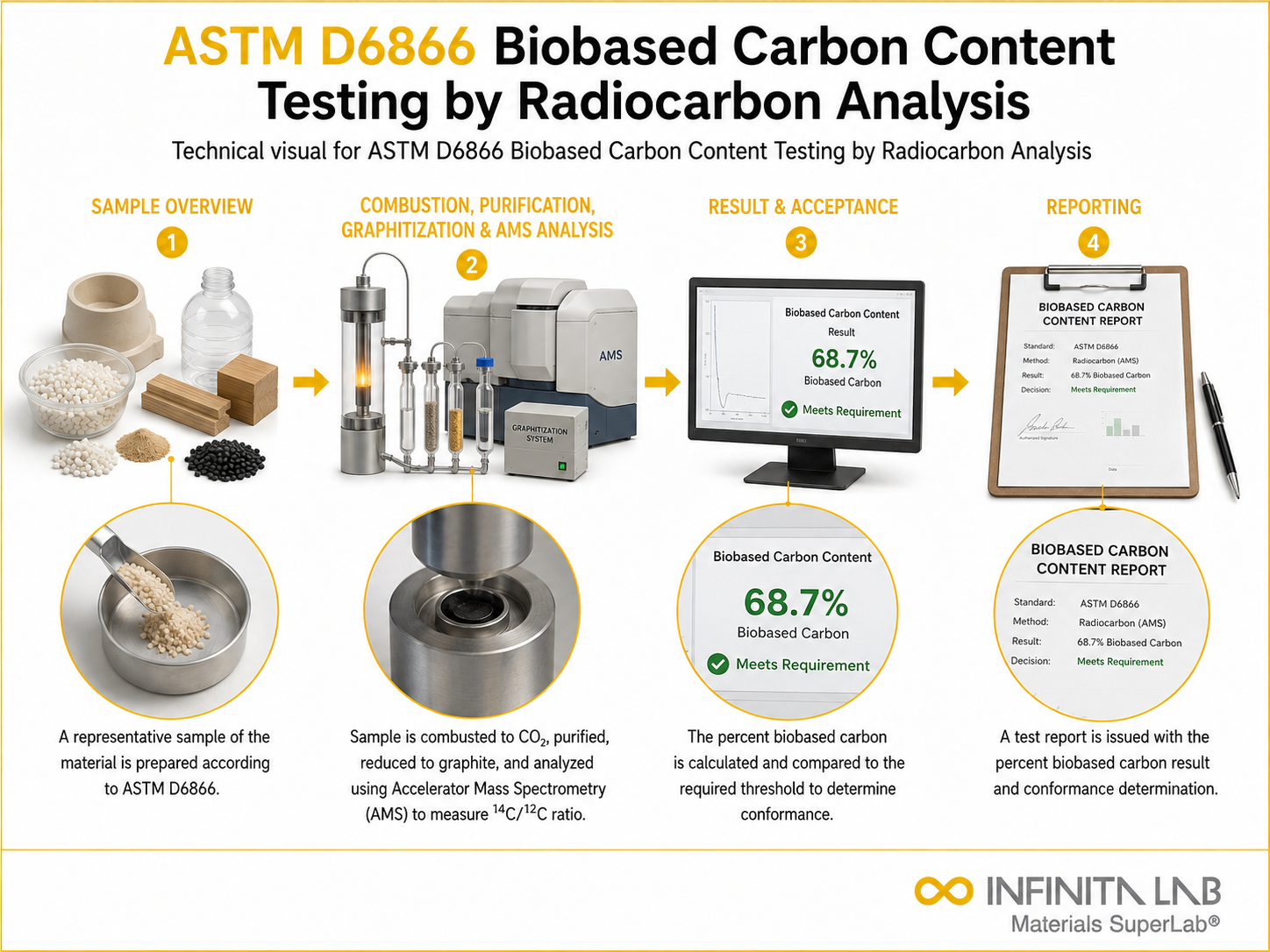
ASTM D6866-12 method measures the biobased carbon content of solids, liquids, and gaseous samples using radiocarbon analysis. Specimens containing carbon-based components are tested using this method. This test method is carried out in the presence of oxygen to produce carbon dioxide (CO2) gas after combustion.
TRUSTED BY


Get ASTM D6866 compliant results — request your biobased carbon content testing quote
- Overview
- Scope, Applications, and Benefits
- Test Process
- Specifications
- Instrumentation
- Results and Deliverables
What Is ASTM D6866 Biobased Carbon Content?
ASTM D6866-12 provides test methods for determining the biobased content of solid, liquid, and gaseous samples using radiocarbon (14C) analysis. This is based on the principle that biobased (plant- or animal-derived) carbon contains 14C, while fossil-derived carbon contains none. By measuring the ratio of 14C to total carbon, the biobased fraction of a material can be accurately determined.
This standard is widely used in sustainability certification, product labeling, and regulatory compliance for bioplastics, biofuels, packaging, and other bio-derived materials.

Applications and Benefits of ASTM D6866 Biobased Carbon Content Testing
Scope
ASTM D6866-12 applies to any material containing carbon and covers three measurement methods:
- Method A: Liquid scintillation counting (LSC)
- Method B: Accelerator mass spectrometry (AMS)
- Method C: LSC with ratio measurement. The standard evaluates biobased carbon content as a percentage of total organic carbon.
Applications
- Certification of bioplastics and bio-based packaging
- Biofuel carbon content verification
- Sustainability reporting and labeling compliance
- Research on renewable material content
- Quality assurance for USDA BioPreferred® program participants
Benefits
- Provides definitive, scientifically validated biobased content data
- Supports credible environmental and sustainability claims
- Enables compliance with international biobased labeling standards
- Applicable to a wide range of solid, liquid, and gaseous materials
- Recognized by USDA, ISO, and international certification bodies
Our ASTM D6866 Testing Procedure
Sample Combustion
The sample is combusted to convert all carbon to CO2, which is collected for isotopic analysis.
1Isotope Measurement
The 14C/12C ratio is measured by AMS or liquid scintillation counting depending on the method selected.
2Ratio Calculation
The measured 14C activity is compared to a modern carbon reference standard (oxalic acid) to calculate the percent modern carbon (pMC).
3Biobased Content Reporting
pMC is converted to biobased content percentage and reported with uncertainty.
4ASTM D6866 Test Parameters and Requirements
| Parameter | Details |
|---|---|
| Test Principle | Radiocarbon (14C) isotope ratio measurement |
| Methods Available | Method A (LSC), Method B (AMS), Method C (LSC ratio) |
| Reference Standard | NIST oxalic acid (modern carbon reference) |
| Measured Output | Biobased carbon content (%) |
| Applicable Matrices | Solids, liquids, gases |


- Combustion system for sample-to-CO2 conversion
- Accelerator mass spectrometer (AMS) for Method B
- Liquid scintillation counter for Method A and C
- Graphitization system (for AMS sample preparation)
- Vacuum line and manometric CO2 quantification system
Equipment and Instrumentation Used for ASTM D6866 Testing
What You Receive: Test Report, Data, and Certification
- Biobased carbon content (% of total organic carbon)
- Percent modern carbon (pMC) value
- Method used and measurement uncertainty
- Comparison to biobased content threshold (e.g., USDA BioPreferred)
- Full test report for certification or labeling support
ASTM D6866 Biobased Carbon Content FAQs
Biobased content measures the proportion of carbon derived from renewable biological sources; biodegradability measures how quickly a material decomposes. They are independent properties.
Method B (AMS) offers the highest sensitivity and is preferred for materials with very low biobased content; Methods A and C are suitable for higher biobased fractions.
ASTM D6866 measures the ratio of radiocarbon isotope carbon-14 to total carbon, comparing it with modern reference standards to calculate the percentage of biobased carbon in a material.
ASTM D6866 requires advanced instruments such as accelerator mass spectrometry, liquid scintillation counters, or beta-ionization detectors to accurately measure radiocarbon content in samples.
Results are reported as percentage of biobased carbon content, indicating the proportion of renewable material present, helping industries validate sustainability and environmental claims for products.
Why Choose Infinita Lab for Biobased Carbon Content Testing
At the core of this breadth is our network of 2,000+ accredited laboratories across the USA, offering access to over 10,000 testing methods and analytical services. From advanced materials characterization (SEM, TEM, RBS, XPS) to mechanical, chemical, environmental, biological, and standardized ASTM/ISO-compliant testing, we deliver unmatched flexibility, specialization, and scale. You are never limited by geography, facility, or methodology — Infinita Lab connects you to the right expertise and testing solution, every time.

Need ASTM D6866 Biobased Carbon Content Testing You Can Rely On?
Send query us at hello@infinitalab.com or call us at (888) 878-3090 to learn more about our services and how we can support you.



Request a Quote
Submit your material details and receive testing procedures, pricing, and turnaround time within 24 hours.
 Quick Turnaround and Hasslefree process
 Confidentiality Guarantee
 Free, No-obligation Consultation
 100% Customer Satisfaction
