
ASTM D2293 Creep Properties of Adhesives in Shear by Compression Loading
The ASTM D2293 test method covers the determination of the creep properties of adhesives for bonding metals when tested on a standard specimen. The performance of specimens assessed by this method is quantified in terms of the SI units.
TRUSTED BY


Precision-driven testing for dimensional accuracy and compliance
- Overview
- Scope, Applications, and Benefits
- Test Process
- Specifications
- Instrumentation
- Results and Deliverables
Overview
ASTM D2293 is the standard test method for the creep of structural adhesives under a constant compressive shear force. Testing adhesive joints under continuous stress to assess long-term deformation provides key information on performance and durability over extended periods.
This test applies to many adhesives used to bond metals, plastics, and composites, especially in load-bearing roles where long-term reliability is crucial. By watching deformation unfold over extended periods, ASTM D2293 helps predict service life under real-world operating conditions.

Scope, Applications, and Benefits
Scope
ASTM D2293 outlines procedures for measuring shear creep deformation in adhesives subjected to constant compressive loading.
It evaluates:
- Time-dependent shear deformation
- Creep compliance and strain rate
- Long-term load-bearing capability
- Dimensional stability of bonded joints
- Effects of temperature and humidity
- Retention of bond integrity over time
The method applies primarily to structural adhesives used in critical engineering applications.
Applications
- Aerospace structural bonding
- Automotive body and component assembly
- Construction and infrastructure bonding
- Electronics and device assembly
- Composite material joining
- Reliability testing for load-bearing joints
Benefits
- Predicts long-term adhesive performance
- Supports service life estimation
- Identifies creep susceptibility
- Improves structural design reliability
- Enables quality control across adhesive batches
- Assists in material selection for demanding environments
Test Process
Specimen Preparation
Bonded specimens are prepared in overlapped or butt-joint configurations with cleaned, treated surfaces and controlled curing.
1Alignment & Setup
Specimens are carefully aligned to ensure uniform shear stress development during loading.
2Compression Loading & Deformation Measurement
A constant compressive load is applied, and shear deformation is measured at defined time intervals.
3Environmental Conditioning
Testing may be performed at ambient or elevated temperature and humidity to simulate service conditions.
4Technical Specifications
| Parameter | Details |
|---|---|
| Applicable Materials | Structural adhesives |
| Substrate Types | Metals, plastics, composites |
| Specimen Configuration | Overlap or butt-joint |
| Loading Mode | Sustained compressive shear |
| Test Duration | Hours to months |
| Environment | Ambient or accelerated conditions |
Instrumentation Used for Testing
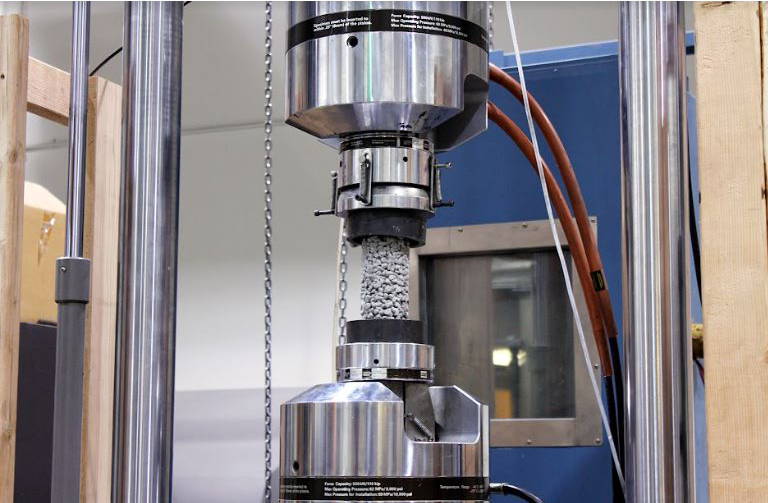
- Universal testing machine or creep testing frame
- Constant load application system
- Precision displacement gauges or extensometers
- Environmental chamber (optional)
- Specimen alignment fixtures
- Data logging and analysis software
Results and Deliverables
- Creep deformation vs. time curves
- Shear creep compliance data
- Long-term strength retention assessment
- Environmental effect analysis
- Material qualification data
- Documentation for quality assurance and certification
Frequently Asked Questions
ASTM D2293 is used to measure the time-dependent deformation (creep) of adhesives when subjected to constant shear stress under compression loading.
Creep behavior determines whether an adhesive can maintain joint integrity over long periods, especially in structural and load-bearing applications.
Mainly structural adhesives, including epoxies, acrylics, and polyurethane systems used in aerospace, automotive, and construction industries.
Case Studies
In-depth examination of genuine material testing solutions
Dopant and Ultra-Low Concentration Elemental Analysis Using STEM…

Dopant and Ultra-Low Concentration Elemental Analysis Using STEM…
Introduction to STEM-EELS for Elemental Analysis Scanning Transmission Electron Microscopy (STEM) combined with Electron Energy Loss...
Read Case StudyAnalysis of PVC Pipe Degradation Using FTIR Spectroscopy

Analysis of PVC Pipe Degradation Using FTIR Spectroscopy
PVC Pipe in Infrastructure — and Why Degradation Matters Polyvinyl chloride (PVC) pressure pipe is one...
Read Case StudyNano-scale roughness measurement of Si-wafers by Atomic Force…

Nano-scale roughness measurement of Si-wafers by Atomic Force…
Nano-scale surface roughness is a critical parameter in fabricated thin-films that are used in optics, solar...
Read Case Study
Request a Quote
Submit your material details and receive testing procedures, pricing, and turnaround time within 24 hours.
 Quick Turnaround and Hasslefree process
 Confidentiality Guarantee
 Free, No-obligation Consultation
 100% Customer Satisfaction
