


ASTM D6370: Rubber Compositional Analysis TGA Testing Services
ASTM D6370-99 test method is used to determine the composition of rubber using the thermogravimetric (TGA) technique. It is used to determine the amounts of organics (oil, polymer), carbon black, and ash (filler) present in a rubber compound.
TRUSTED BY


Get ASTM D6370 compliant results — request your rubber compositional analysis TGA testing quote
- Overview
- Scope, Applications, and Benefits
- Test Process
- Specifications
- Instrumentation
- Results and Deliverables
What Is ASTM D6370 Rubber Compositional Analysis TGA?
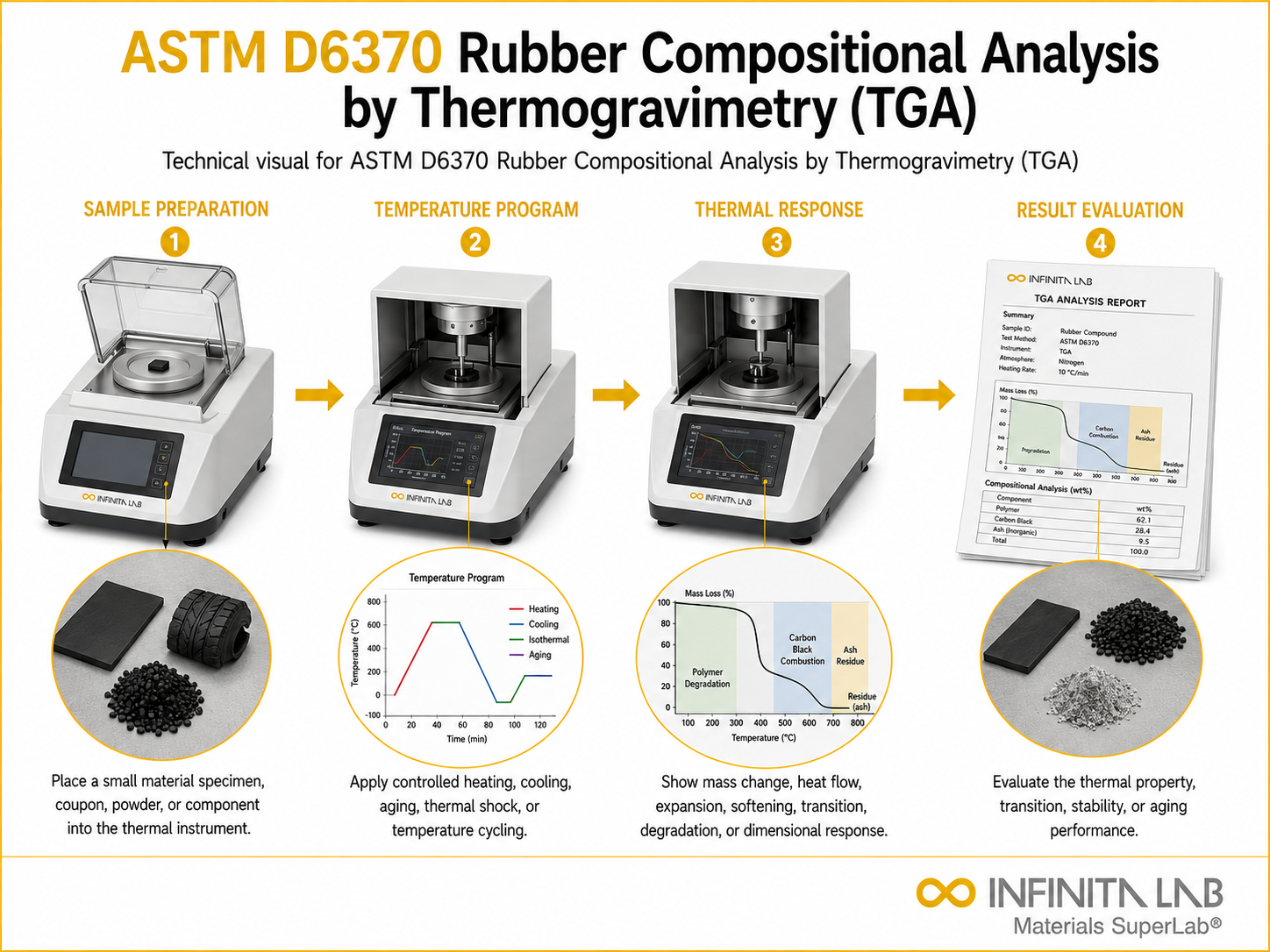
ASTM D6370 evaluates the compositional analysis of rubber materials using thermogravimetric analysis (TGA), determining mass changes as a function of temperature. It helps quantify components such as moisture, volatile content, polymer fraction, carbon black, and inorganic ash, providing a detailed material breakdown.
This standard is widely used in rubber compounding, quality control, and failure analysis. It enables manufacturers to verify formulation accuracy, detect contamination or inconsistencies, and ensure compliance with performance specifications for rubber products used in automotive, industrial, and consumer applications.

Applications and Benefits of ASTM D6370 Rubber Compositional Analysis TGA Testing
Scope
This standard is used to determine the compositional breakdown of rubber using controlled thermal degradation.
- Quantification of moisture and volatile content
- Measurement of polymer, filler, and ash content
- Applicable to natural and synthetic rubber materials
- Analysis through controlled heating and mass loss monitoring
- Used for quality control and material characterization
- Helps in formulation verification and failure analysis
Applications
- Rubber formulation validation
- Quality control in rubber manufacturing
- Failure analysis of rubber components
- Material characterization for research and development
- Inspection of incoming raw rubber materials
- Process optimization in compounding
Benefits
- Provides precise compositional analysis
- Detects formulation inconsistencies
- Improves product quality and reliability
- Supports material development and optimization
- Enables rapid and accurate testing
- Assists in regulatory and specification compliance
Our ASTM D6370 Testing Procedure
Sample Preparation
A small, representative rubber sample is prepared and weighed to ensure accurate baseline measurement.
1Controlled Heating
The sample is heated at a programmed rate under controlled atmosphere to initiate decomposition.
2Mass Loss Monitoring
Continuous measurement of weight loss is recorded as different components volatilize or decompose.
3Data Analysis
The mass loss data is analyzed to determine the percentage composition of each rubber component.
4ASTM D6370 Test Parameters and Requirements
| Parameter | Details |
|---|---|
| Sample mass | Small, representative quantity for precise measurement |
| Temperature range | Controlled heating up to decomposition temperature |
| Heating rate | Defined and programmable rate for consistency |
| Atmosphere | Inert or oxidative environment depending on analysis |
| Mass resolution | High-precision balance for accurate detection |
| Data acquisition | Continuous real-time recording system |
| Residue analysis | Determination of ash and inorganic content |
| Volatile detection | Identification of moisture and low-boiling compounds |
| Polymer degradation | Monitored via thermal breakdown stages |


- Thermogravimetric analyzer (TGA)
- High-precision analytical balance
- Controlled heating furnace
- Gas supply system (inert/oxidative)
- Data acquisition and analysis software
- Temperature control unit
- Sample crucibles
Equipment and Instrumentation Used for ASTM D6370 Testing
What You Receive: Test Report, Data, and Certification
- Moisture and volatile content percentage
- Polymer fraction determination
- Carbon black or filler content analysis
- Ash and inorganic residue report
- Thermal decomposition curve (TGA curve)
- Complete compositional breakdown report
ASTM D6370 Rubber Compositional Analysis TGA FAQs
ASTM D6370-99 is a thermogravimetric analysis (TGA) method dedicated to evaluating rubber compound composition. It evaluates the contents of organics, carbon black, and ash, which contribute to the quality of materials. Therefore, it is helpful in QA/QC, material screening, and troubleshooting.
ASTM D6370 uses controlled heating to measure mass loss at different temperature stages. Each component—moisture, polymers, fillers—decomposes or volatilizes at specific ranges, allowing precise quantification of each constituent in the rubber sample.
The initial purging of the test is performed using an inert gas such as nitrogen or argon of high purity (99.99%), and during the final heating stage, reactive gases such as Air or oxygen are used. The inert purge gas should contain oxygen of not more than ten µg/g level.
TGA provides continuous, real-time mass loss data with high precision. Unlike chemical extraction methods, it requires minimal sample preparation and delivers rapid, accurate compositional insights, making it highly efficient for industrial and research applications.
By comparing expected and actual compositional data, deviations in filler or polymer content can be identified. This helps detect errors in compounding, raw material variation, or processing inconsistencies.
Why Choose Infinita Lab for Rubber Compositional Analysis TGA Testing
At the core of this breadth is our network of 2,000+ accredited laboratories across the USA, offering access to over 10,000 testing methods and analytical services. From advanced materials characterization (SEM, TEM, RBS, XPS) to mechanical, chemical, environmental, biological, and standardized ASTM/ISO-compliant testing, we deliver unmatched flexibility, specialization, and scale. You are never limited by geography, facility, or methodology — Infinita Lab connects you to the right expertise and testing solution, every time.

Need ASTM D6370 Rubber Compositional Analysis TGA Testing You Can Rely On?
Send query us at hello@infinitalab.com or call us at (888) 878-3090 to learn more about our services and how we can support you.



Request a Quote
Submit your material details and receive testing procedures, pricing, and turnaround time within 24 hours.
 Quick Turnaround and Hasslefree process
 Confidentiality Guarantee
 Free, No-obligation Consultation
 100% Customer Satisfaction
