
ASTM D3931 Strength Test of Gap-Filling Adhesive Bonds in Shear by Compression Loading
The ASTM D3931 standard method covers the procedure to test the shear strength of gap-filling adhesives in wood-to-wood joints under a compressive load, for structural design, research, and quality control. In ASTM D3931, the adhesive shear strength is expressed in pounds per square inch.
TRUSTED BY


Precision-driven testing for dimensional accuracy and compliance
- Overview
- Scope, Applications, and Benefits
- Test Process
- Specifications
- Instrumentation
- Results and Deliverables
Overview
ASTM D3931 defines a standardized method for determining the shear strength of gap-filling adhesive bonds under compression. Gap-filling adhesives are formulated to maintain adequate strength when applied at bondline thicknesses greater than those typically used in precision fit-up applications. These adhesives are critical in assembly operations where substrate surfaces are not perfectly mated, and a thick bondline is unavoidable.
The test uses a cylindrical plug-in-socket specimen geometry, in which a cylindrical rod is bonded inside a close-fitting sleeve with the gap-filling adhesive. The bonded assembly is loaded in compression, inducing shear stress at the adhesive interface. The compressive shear strength is calculated from the failure load and bonded area. This geometry effectively simulates many practical assembly joints where a gap-filling adhesive is used to bond pins, bushings, or cylindrical inserts.

Scope, Applications, and Benefits
Scope
ASTM D3931 evaluates:
- Compressive shear strength of gap-filling adhesive bonds
- Effect of bondline thickness on shear strength
- Performance of adhesives at controlled gap thicknesses
- Substrate material effects on gap-filling bond strength
- Environmental conditioning effects on gap-filling performance
- Comparative ranking of gap-filling adhesive systems
Applications
- Cylindrical assembly bonding (pins, bushings, shafts)
- Machinery component assembly
- Automotive powertrain component bonding
- Retaining compound applications
- Industrial maintenance and repair bonding
- Structural gap-filling in manufacturing assembly
- Research and development in gap-filling adhesive technology
Benefits
- Provides data specifically relevant to gap-filling applications
- Enables selection of adhesives for variable-fit assemblies
- Detects bondline thickness sensitivity in adhesive performance
- Supports process development for gap-fill bonding
- Reduces assembly failures from inadequate gap-filling strength
- Provides data for adhesive specification in cylindrical joint designs
Test Process
Specimen Fabrication
Cylindrical rod and sleeve are machined to the specified dimensions; adhesive is applied to fill the annular gap.
1Curing
Bonded specimens are cured per the adhesive supplier's specifications.
2Compression Loading
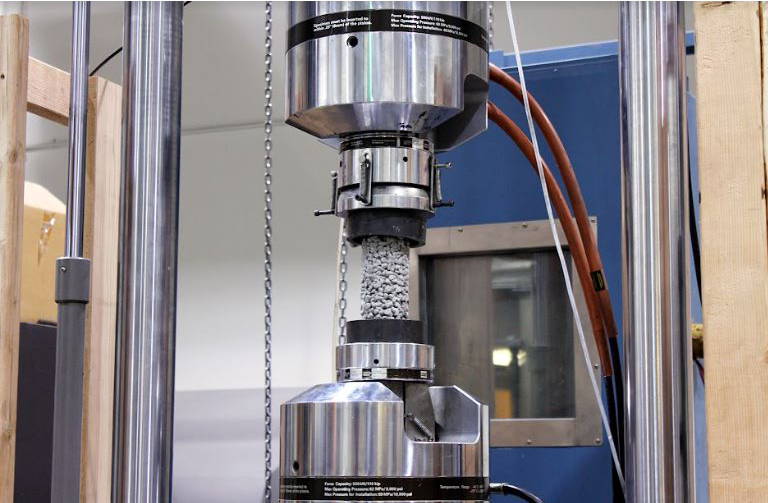
Specimen is loaded axially in compression on a universal testing machine until bond failure.
3Shear Strength Calculation
Compressive shear strength is calculated from peak load divided by bonded surface area.
4Technical Specifications
| Parameter | Details |
|---|---|
| Test Principle | Compressive shear loading of cylindrical plug-in-socket joint |
| Specimen Type | Cylindrical rod-in-sleeve |
| Applicable Materials | Gap-filling structural adhesives |
| Output Units | MPa (psi) |
| Measured Outputs | Compressive shear strength, failure mode |
Instrumentation Used for Testing
- Universal testing machine (UTM) with compression platens
- Machined cylindrical rod and sleeve fixtures
- Micrometer and calipers for gap measurement
- Load cell calibrated to test range
- Data acquisition software
- Failure surface examination tools
Results and Deliverables
- Compressive shear strength values (MPa or psi)
- Bondline thickness measurements
- Failure mode classification
- Load-displacement curves
- Compliance documentation
- Quality assurance reports
Partnering with Infinita Lab for Optimal Results
Infinita Lab addresses the most frustrating pain points in the ASTM D3931 testing process: complexity, coordination, and confidentiality. Our platform is built for secure, simplified support, allowing engineering and R&D teams to focus on what matters most: innovation. From kickoff to final report, we orchestrate every detail—fast, seamlessly, and behind the scenes.
Looking for a trusted partner to achieve your research goals? Schedule a meeting with us, send us a request, or call us at (888) 878-3090 to learn more about our services and how we can support you. Request a Quote
Frequently Asked Questions
ASTM D3931 measures shear strength of gap-filling adhesive bonds using compression loading. It evaluates performance of adhesives in joints with gaps, helping assess structural integrity and load-bearing capability in bonded assemblies.
Key parameters include specimen geometry, adhesive thickness, curing conditions, loading rate, and alignment. Controlled conditions ensure accurate measurement of shear strength in gap-filling adhesive joints.
The test measures shear strength of adhesive bonds under compression loading. Results indicate ability of adhesives to maintain structural integrity in joints with varying gap thicknesses.
ASTM D3931 applies to adhesive materials used in structural bonding applications such as construction, automotive, aerospace, and industrial assemblies requiring gap-filling capabilities.
ASTM D3931 results depend on specimen preparation and curing conditions. It may not fully represent real-world loading scenarios, requiring additional testing for fatigue, environmental exposure, or long-term performance evaluation.
Case Studies
In-depth examination of genuine material testing solutions
Case Study: Dopant & Ultra-Low Concentration Analysis via…

Case Study: Dopant & Ultra-Low Concentration Analysis via…
Introduction to STEM-EELS for Elemental Analysis Scanning Transmission Electron Microscopy (STEM) combined with Electron Energy Loss...
Read Case StudyAnalysis of PVC Pipe Degradation Using FTIR Spectroscopy

Analysis of PVC Pipe Degradation Using FTIR Spectroscopy
PVC Pipe in Infrastructure — and Why Degradation Matters Polyvinyl chloride (PVC) pressure pipe is one...
Read Case StudyNano-scale roughness measurement of Si-wafers by Atomic Force…

Nano-scale roughness measurement of Si-wafers by Atomic Force…
Nano-scale surface roughness is a critical parameter in fabricated thin-films that are used in optics, solar...
Read Case Study
Request a Quote
Submit your material details and receive testing procedures, pricing, and turnaround time within 24 hours.
 Quick Turnaround and Hasslefree process
 Confidentiality Guarantee
 Free, No-obligation Consultation
 100% Customer Satisfaction
