
Effects of Material Interfaces on Thermal Transmission
Material interfaces play a significant role in heat transfer and carry heat across or into materials. It depends on the thermal conductivity, surface roughness, and bonding characteristics, such as whether the interface between two materials is conducive to delivering heat or resisting its flow. Therefore, the phenomenon is commonly governed by thermal boundary resistance and is crucial in applications

TRUSTED BY


Precision-driven testing for dimensional accuracy and compliance
- Overview
- Scope, Applications, and Benefits
- Test Process
- Specifications
- Instrumentation
- Results and Deliverables
Overview
Material interfaces play a significant role in heat transfer and carry heat across or into materials. It depends on the thermal conductivity, surface roughness, and bonding characteristics, such as whether the interface between two materials is conducive to delivering heat or resisting its flow. Therefore, the phenomenon is commonly governed by thermal boundary resistance and is crucial in applications, including electronic cooling and insulation systems.
Thus, these interfaces must be investigated to the fullest extent to appreciate the effects these interfaces have on heat transfer, optimize thermal management, and enhance the performance and efficiency of various industrial systems.

Scope, Applications, and Benefits
Scope
Material interfaces are a critical and significant source of thermal transmission resistance. Material interfaces lead to the introduction of thermal boundary resistances that slow down the flow of heat across material boundaries. This is caused by differences in the material properties involved, such as conductivity and density, as well as the atomic structure. This could lead to scattering and reflection of phonons or electrons.
- Conduction: Heat transfer within or between solids through molecular vibration or electron movement.
- Convection: Heat transfer in fluids caused by the movement of the fluid itself.
- Radiation: Heat transfer through electromagnetic waves, requiring no medium.
Applications
- Conduction: Heat transfer within or between solids through molecular vibration or electron movement.
- Convection: Heat transfer in fluids caused by the movement of the fluid itself.
- Radiation: Heat transfer through electromagnetic waves, requiring no medium.
Benefits
- Conduction: Heat transfer within or between solids through molecular vibration or electron movement.
- Convection: Heat transfer in fluids caused by the movement of the fluid itself.
- Radiation: Heat transfer through electromagnetic waves, requiring no medium.
Effects of Material Interfaces on Thermal Transmission Testing Process
Sample Preparation
Standard specimens are machined and conditioned before testing.
1Load Application
A fixed bending stress (commonly 0.455 MPa or 1.82 MPa) is applied to the sample.
2Controlled Heating
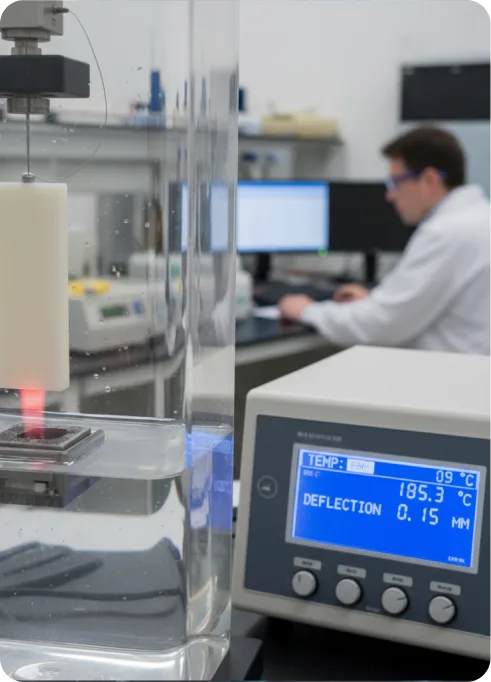
The specimen is immersed in a temperature-controlled oil bath, heated at 2°C/min.
3Deflection Measurement
The temperature at which the specimen deflects by 0.25 mm is recorded as the HDT.
4Technical Specifications
| Parameter | Details |
|---|---|
| Parameter | Typical Condition |
| Test Temperature | 23°C ± 2°C |
| Relative Humidity | 50 ± 5% |
| Droplet Volume | 2–5 μL |
| Liquid Used | Deionized Water |
| Surface Cleanliness | Free from contaminants |
| Number of Measurements | Minimum of 5 readings per sample |
Instrumentation Used for Testing
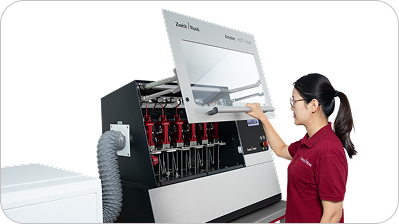
- Automated HDT/Vicat Testing Apparatus with digital displacement measurement
- High-precision oil baths with PID temperature control
- Deflection gauge sensors (0.001 mm resolution)
- Calibrated thermocouples traceable to NABL standards

Results and Deliverables
- HDT result value (°C) under specified load
- Deflection vs Temperature curve
- Observation summary and remarks
- Traceable, NABL-compliant PDF report
Case Studies
In-depth examination of genuine material testing solutions
Dopant and ultra-low concentration elemental analysis using Scanning…

Dopant and ultra-low concentration elemental analysis using Scanning…
EELS analysis of gate and channel is performed on fin field-effect transistors (finFETs). Scanning transmission electron...
Read Case StudyAnalysis of degradation of PVC pipe using Fourier…

Analysis of degradation of PVC pipe using Fourier…
Introduction PVC is the polymer primarily used to make pipes for plumbing, drainage, and electrical conduits....
Read Case StudyNano-scale roughness measurement of Si-wafers by Atomic Force…

Nano-scale roughness measurement of Si-wafers by Atomic Force…
Nano-scale surface roughness is a critical parameter in fabricated thin-films that are used in optics, solar...
Read Case StudyExplore Related Material Testing Services
-
 10 Things to Look for in a Quality Metallography Belt Grinder
 -
8 Design Considerations for Manufacturable Plastic Parts
-
Adhesion Strength and Mechanical Failure
-
AS9100 Quality Management System
-
ASTM A487 Steel Castings Suitable for Pressure Service
-
ASTM C241/C241M Test for Abrasion Resistance of Stone Subjected to Foot Traffic


Frequently Asked Questions
Thermal interface materials, such as greases or pads, fill gaps and voids at the interface between materials, reducing resistance and enhancing thermal conductivity by improving surface contact.
Surface roughness creates air gaps and reduces the effective contact area at the interface, increasing thermal resistance and limiting efficient heat transfer.
Thermal conductivity and boundary resistance often vary with temperature. For instance, reduced phonon activity can increase interfacial resistance at very low temperatures.
Request a Quote for HDT Testing
Submit your material details and receive testing procedures, pricing, and turnaround time within 24 hours.
 Quick Turnaround and Hasslefree process
 Confidentiality Guarantee
 Free, No-obligation Consultation
 100% Customer Satisfaction
