
Bridge impact testing is a procedure used to check if a package can withstand impacts near its center when only supported at its ends. The goal is to deliver the same level of kinetic energy at the point of impact and reduce the potential for damage. It is essential for companies to conduct this test in order to avoid costly transportation damage and benefit from other advantages such as cost-effective distribution, improved client satisfaction, and increased market share.



Bridge Impact Testing
Bridge impact testing is a procedure used to evaluate the capability of a package to withstand impact near its center when only supported at its ends. The aim is to deliver the same kinetic energy at the point of impact and consequently reduce the potential for damage.
This type of testing is essential as packages containing mixed sizes are sometimes shipped and their cross-section needs to be tested to ensure it can withstand impacts. Without this, companies can suffer an annual loss of up to $1 billion due to transportation damage.
Testing and certifying packages decrease these costs, as well as shorten the time from product to market, increase assurance in product launch, reduce product loss and damage, improve client satisfaction, and increase market share.
Read more: What Exactly Is A Bridge Impact Test?
ASTM D5265-compliant bridge impact testing can be done using a free-fall drop tester or equipment for simulating mechanical impact testing. Samples from a lot should be selected and the package can be loaded with either real or fake materials. Then, the package must be conditioned using ASTM Method D4332.
Video 01: Bridge Impact Test
For Process A, the package is positioned on the drop test apparatus’ test floor and the impactor is dropped from a predetermined height onto the small cross-section of the package. In Process B, the package is placed on the S.M.I.T.E. (Simulated Mechanical Impact Testing Equipment) table and the impactor is dropped from a machine height to produce a specified impact velocity.
The report usually includes information such as the impactor’s weight, the technique used for preparing the container, the fall height, description of the contents under test, the size of the package being tested, and the results of each specimen’s tests, date, and time of the test, and the name of the test engineer.

Liquid Chromatography-Mass Spectroscopy Liquid Chromatography-Mass Spectroscopy (LC-MS) is an analytical technique that allows the separation, identification, and quantification of the...
Read Article ➙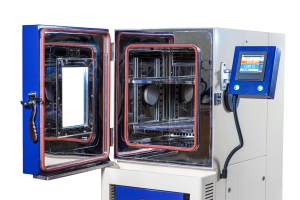
Highly Accelerated Stress Test - HAST Testing Services A highly accelerated stress test (HAST) is an essential part of environmental...
Read Article ➙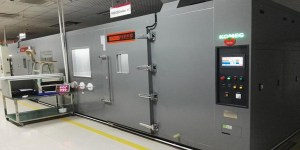
Introduction Accelerated aging in product testing is a methodology that simulates the long-term effects of environmental factors on a product...
Read Article ➙In-depth examination of genuine material testing solutions

EELS analysis of gate and channel is performed on fin field-effect transistors (finFETs). Scanning transmission electron...
Read Case Study
Introduction PVC is the polymer primarily used to make pipes for plumbing, drainage, and electrical conduits....
Read Case Study
Nano-scale surface roughness is a critical parameter in fabricated thin-films that are used in optics, solar...
Read Case StudySubmit your contact info and we’ll get back to you within 24 hours


