
XRF, X-Ray Fluorescence Spectroscopy
XRF is useful for inspection and quick nondestructive analysis of large objects such as automotive parts, archaeological samples, art objects, or forensic samples.


XRF Testing, X-Ray Fluorescence Spectroscopy Testing Facility
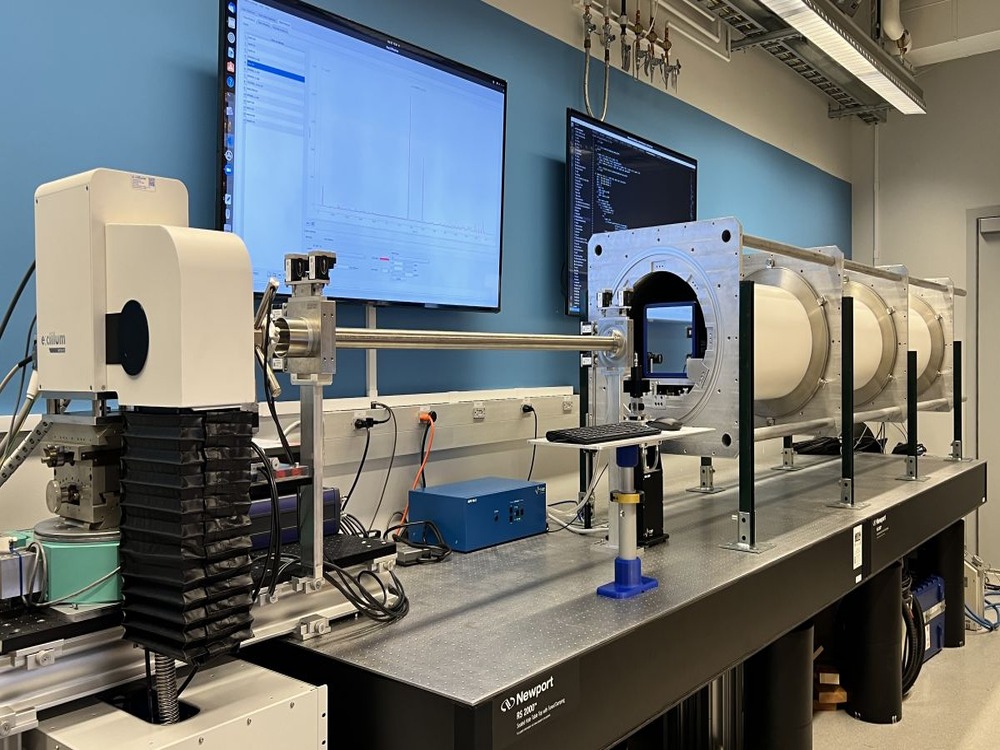
XRF, X-Ray Fluorescence Spectroscopy (XRF) is an elemental and chemical analysis tool. Handheld XRF is particularly useful for inspection and quick nondestructive analysis of large objects such as automotive parts, archaeological samples, art objects, or forensic samples. In this test, the sample is excited by an incident X-ray beam interacting with the sample’s atoms. The sample emits X-rays, which are characteristic of its chemical and elemental makeup. Analysis of the emitted X-ray radiation provides the chemical composition of the material.
Common Uses
- Atomic layer deposited thin film thickness measurement for semiconductor memory applications
- Inspections of parts and corrosion detection in automotive
- Impurities and contaminants in trace amounts in materials
- Elemental analysis of large area wafers or large samples
- Nondestructive paint analysis in art objects
- Mineral chemical composition analysis in the field
- Archaeological sample chemical analysis
- Impurities in pharmaceutical drugs and food products
XRF Advantages:
- XRF works on both, conductive and nonconductive samples
- Detection of elements in very low concentrations – trace amounts
- Quick analysis – almost instant results
- No sample preparation required
- Angstrom level thin film thickness measurement
XRF Limitations:
- Quantification of results requires a more complicated procedure using reference standards
- Useful only for elements from B to U
- Handheld XRF cannot detect elements below Mg
Industries:
- Oil and Gas
- Food Products
- Chemical
- Pharmaceutical
- Organic Semiconductors
- Nanotechnology
- Additive Manufacturing
- Advanced Materials
- Automotive
- Energy Storage and Batteries
- LED and Display
- Mining and Minerals
More Details
- Wikipedia Tutorial
- XRF geochemical applications
- Handheld XRF
- More about XRF
- Trace Element Analysis by XRF
 Metrology Testing Service

- What is Johansson Mikrokator?
- Atom Probe Tomography (APT)
- Field Emission SEM: High-Resolution Imaging for Precise Surface Analysis
- Hydrogen Forward Scattering Spectrometry (HFS)
- Micro-Raman Spectroscopy
- High-Resolution Mass Spectrometry (HRMS) for Industrial Advancement
- How can thermomechanical Analysis (TMA) identify the dimensional changes of a material?
- Thermal Analysis and Calorimetry Testing and Measurement Services
- View All


3 Easy Steps to Start Testing


Case Studies
In-depth examination of genuine material testing solutions
Dopant and Ultra-Low Concentration Elemental Analysis Using STEM…

Dopant and Ultra-Low Concentration Elemental Analysis Using STEM…
Introduction to STEM-EELS for Elemental Analysis Scanning Transmission Electron Microscopy (STEM) combined with Electron Energy Loss...
Read Case StudyAnalysis of PVC Pipe Degradation Using FTIR Spectroscopy

Analysis of PVC Pipe Degradation Using FTIR Spectroscopy
PVC Pipe in Infrastructure — and Why Degradation Matters Polyvinyl chloride (PVC) pressure pipe is one...
Read Case StudyNano-scale roughness measurement of Si-wafers by Atomic Force…

Nano-scale roughness measurement of Si-wafers by Atomic Force…
Nano-scale surface roughness is a critical parameter in fabricated thin-films that are used in optics, solar...
Read Case StudyTalk to Our Experts Today!
Submit your contact info and we’ll get back to you within 24 hours


