Compression tests are used to characterize the strength and stiffness of a material or product when subjected to crushing loads. Learn more about compression testing


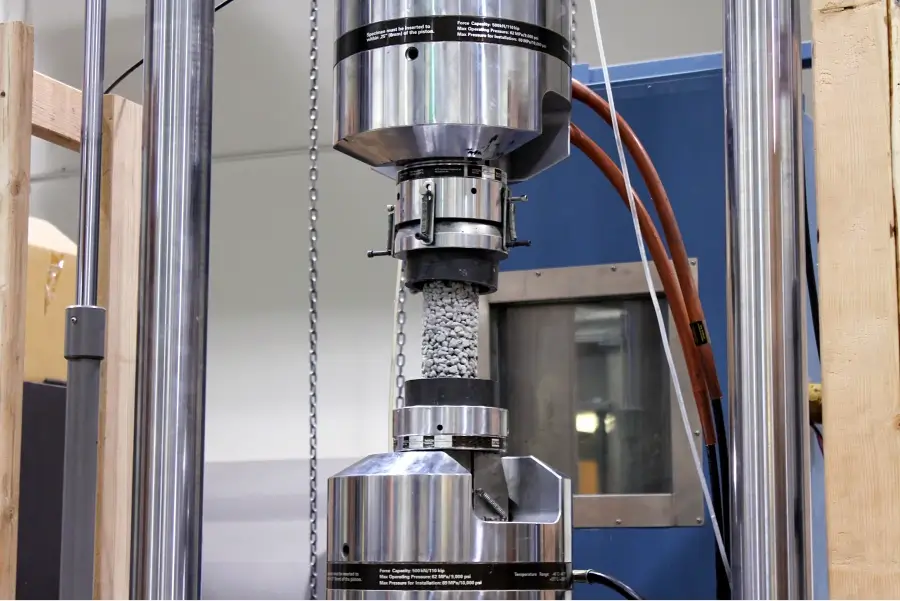
The mechanical properties of a substance or an item are evaluated by subjecting them to compressive forces, such as pushing, compressing, squashing, crushing, and flattening. Compression testing, like tensile and bending tests, is a fundamental mechanical test. Compression tests are used to characterize the strength and stiffness of a material or product when subjected to crushing loads. Compressive tests are performed by placing a specimen under pressure with platens or specialized fixtures on a testing machine designed to generate compressive stresses.
Sample stress and strain, among other material parameters, are measured, and numerous computations are performed during a compression test. The information is displayed as a stress-strain chart. Compressive strength, elastic limit, proportional limit, yield point, yield strength, and the modulus of elasticity can all be calculated from the available data.
Multiple samples are loaded between two plates or platens to evenly stress both sides of the object being tested. In order to flatten the sample, a compression-capable testing machine presses the plates together. The machine, or a deflectomer or extensometer, measures the strain or deflection of the sample.
During compression testing, essential variables like strain, stress, and deformation are measured to ascertain how a material responds to a compressive load. Compressive testing can reveal many properties of a material, including its compressive strength, yield strength, ultimate strength, elastic limit, and elastic modulus. Knowing these factors and their related values for a given material allows one to predict whether or not it will hold up under given pressures and hence be useful in a variety of contexts.
The amount of force a material can withstand before cracking is determined by conducting a compressive strength test. Compressing a test sample into a cube, prism, or cylinder between compression plates or platen is a common procedure. The load cell and the test controller work together to collect and analyze the force data. The crosshead motion position encoder is used to determine the amount of travel between the machine’s platens. There are materials whose compressive strength limit is a fracture point, and there are others whose compressive load limit is an irreversible deformation. The accuracy of a measurement of compressive strength depends on the method and conditions used to take the reading.
Compressive modulus of elasticity, yield and elastic limit, proportional limit, yield point, and yield strength are all parameters of uniaxial stress strain that are important to characterize for a wide range of uses. Compression loading is used in a variety of tests to determine the hardness or stiffness of a material.
The precision of the deflection, displacement, or strain sensors used to assess sample deformation directly impacts the accuracy of strain measurements. Test machine compliance can be reduced by either attaching the sensor to the test sample or measuring the platen-to-platen displacement directly. Instead of depending on test machine or crosshead movement encoder readings, compression tests typically require sensors with short journey precision that are in close touch with the test sample. Accurately measuring axial deflection between two plates often necessitates the use of three evenly spaced displacement sensors that are averaged together.
A material’s compressive strength, modulus of elasticity, yield strength, etc., can all be evaluated with a compression test. You need to know if the materials you choose for your final product or prototype will hold up in the real world. Understanding the material’s strength can help you avoid employing something that won’t hold up well under pressure by warning you when you’re approaching the material’s breaking point. The results of a compresion test can be used to determine whether composite, metal, rubber, or other raw material will be the strongest in a certain application.

Liquid Chromatography-Mass Spectroscopy Liquid Chromatography-Mass Spectroscopy (LC-MS) is an analytical technique that allows the separation, identification, and quantification of the...
Read Article ➙
Highly Accelerated Stress Test - HAST Testing Services A highly accelerated stress test (HAST) is an essential part of environmental...
Read Article ➙
Introduction Accelerated aging in product testing is a methodology that simulates the long-term effects of environmental factors on a product...
Read Article ➙In-depth examination of genuine material testing solutions

EELS analysis of gate and channel is performed on fin field-effect transistors (finFETs). Scanning transmission electron...
Read Case Study
Introduction PVC is the polymer primarily used to make pipes for plumbing, drainage, and electrical conduits....
Read Case Study
Nano-scale surface roughness is a critical parameter in fabricated thin-films that are used in optics, solar...
Read Case StudySubmit your contact info and we’ll get back to you within 24 hours


