Particulate Matter Testing

Written by Yash Kundra | Updated: August 28, 2025

Particulate Matter TestingMethods:

The methods utilized for PM2.5 sampling include:

  • The US Federal Reference Method (FRM) is non-continuous and filter-based. For this procedure to create quantified PM concentrations, specialized facilities, and equipment are needed.
  • Continuous measurement equipment, such as US Federal Equivalent methods (FEMS) and other research-grade instruments, frequently costs between $10,000 and $20,000 and must typically be used in climate-controlled environments with intensive supervision and maintenance.
  • Light obscuration test is based on the principle of light obscuration. This test allows for the automatic determination of the number of lights and is performed in biological safety cabinets under limited conditions.
  • Microscopic particle count test is utilized when light obscuration cannot analyze PM due to color, reduced clarity, or viscosity.
  • Micro flow imaging systems use flow cells and digital photography to individually image, size, and count particles in liquid formulations.

Video 01: Particulate Matter Testing

Advantages of Particulate Matter Testing:

  • Simple method
  • Low-cost equipment

Limitation of Particulate Matter Testing:

  • Results are greatly affected by human factors and mesh deformation.

Industrial Uses of Particulate Matter Testing:
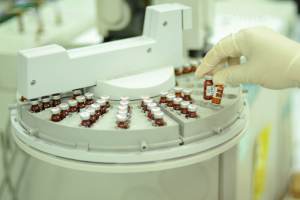
  • Particulate Matter Testing (PMT) is an important aspect of industrial safety and environmental protection. It provides accurate and reliable quantitative data on the composition of the air, enabling industries to monitor their emissions and identify any potential risks to human health and the environment. 
  • Industrial uses of Particulate Matter Testing are numerous and include monitoring pollutants in the workplace, assessing the quality of industrial processes, and controlling emissions from industrial activities.
  • This test is also used to inform decisions about the design of industrial facilities. For instance, it can be used to determine the most appropriate location for an industrial facility and to determine the best methods for controlling emissions. Additionally, PMT can be used to evaluate the performance of filters and other control technologies, enabling industries to reduce their emissions and improve the quality of their products.

Case Studies

In-depth examination of genuine material testing solutions

Dopant and ultra-low concentration elemental analysis using Scanning…

banner

Dopant and ultra-low concentration elemental analysis using Scanning…

EELS analysis of gate and channel is performed on fin field-effect transistors (finFETs). Scanning transmission electron...

Read Case Study

Analysis of degradation of PVC pipe using Fourier…

Fourier Transform Infrared Spectroscopy (FTIR)

Analysis of degradation of PVC pipe using Fourier…

Introduction PVC is the polymer primarily used to make pipes for plumbing, drainage, and electrical conduits....

Read Case Study

Nano-scale roughness measurement of Si-wafers by Atomic Force…

banner

Nano-scale roughness measurement of Si-wafers by Atomic Force…

Nano-scale surface roughness is a critical parameter in fabricated thin-films that are used in optics, solar...

Read Case Study

Talk to Our Experts Today!

Submit your contact info and we’ll get back to you within 24 hours

    Discover more from Infinita Lab

    Subscribe now to keep reading and get access to the full archive.

    Continue reading

    ×

    Talk to an Expert

      Connect Instantly

      (888) 878-3090
      Ensure Quality with the Widest Network of Accredited Labs
      • ddd
        Quick Turnaround and Hasslefree process
      • ddd
        Confidentiality Guarantee
      • ddd
        Free, No-obligation Consultation
      • ddd
        100% Customer Satisfaction

        ddd

        Start Material Testing