A Highly Accelerated Stress Test (HAST), which combines high temperature, high humidity, pressure, and time to assess a component's dependability in challenging conditions, is an essential component of environmental testing. The pressure cooker test (PCT) or unsaturated pressure cooker test (USPCT) are other names for HAST. For customers in the USA and other countries, Infinita Lab offers the best HAST.



A highly accelerated stress test (HAST) is an essential part of environmental testing that combines high temperature, high humidity, pressure, and time to test a component’s reliability under harsh environments. HAST is an efficient and faster alternative to traditional temperature-humidity testing for testing moisture penetration in semiconductors, thin-film resistors, solar panels, and pharmaceutical products to reveal corrosion failures due to packaging, materials, seals, and joints. A higher amount of stress and pressure better simulates the effects of humidity and temperature in the laboratory and helps predict component failures within days. HAST testing is also employed in transportation, packaging, and shelf-life studies of products. HAST tests under the same temperature, humidity, and pressure variables are performed in testing labs with voltage bias (BHAST) to accelerate moisture penetration and related induced failures within the device or product.
Empirically, the acceleration factor for high humidity is calculated as:
AFH = econst (RHsղ-RHoղ)
Where,
const – Value that normally ranges from 0.1 to 0.15
RHs – Stressed humidity
RHo – Operating environment humidity
ղ – Empirically derived constant (usually 1 < n < 5)
The acceleration factor for high temperatures is calculated as follows:
AFT = e(Ea/k)(1/To-1/Ts)
Where,
Ea – Activation energy for the temperature induced failure
To – Operating temperature in Kelvin
Ts – Stressed temperature
Consequently, the overall acceleration factor for the unbiased HAST testing is:
AFHAST = AFH * AFT
In HAST, the samples are put inside a HAST board that are able to withstand severe test conditions. Owing to their capability to tolerate the harsh HAST conditions, the HAST boards are quite expensive.
The HAST test, which is a faster version of the standard non-condensing THB (Temperature Humidity Bias) test, has the benefit of utilising greater temperatures (up to 149°C) and higher pressures to hasten temperature and moisture-induced failures in around one-tenth the time of THB. The standard parameters for HAST and BHAST testing are 130°C and 85% RH, but they can change as per each test requirement.
Our testing labs are well equipped to carry out Highly Accelerated Stress Test (HAST) and provide the best results to our clients based in the USA and other parts of the world. We at Infinita Lab perform not only routine tests, but also custom tests designed in our testing labs as per the client’s specific requirements.
Video 01: HAST Accelerated Aging Test Chamber
Testing Parameters in Highly Accelerated Stress Test (HAST)
Highly Accelerated Stress Test (HAST) Common Uses
Industries using Highly Accelerated Stress Test (HAST)
Highly Accelerated Stress Test (HAST) Laboratories
More Details
Liquid Chromatography-Mass Spectroscopy Liquid Chromatography-Mass Spectroscopy (LC-MS) is an analytical technique that allows the separation, identification, and quantification of the...
Read Article ➙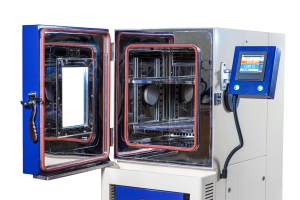
Highly Accelerated Stress Test - HAST Testing Services A highly accelerated stress test (HAST) is an essential part of environmental...
Read Article ➙
Introduction Accelerated aging in product testing is a methodology that simulates the long-term effects of environmental factors on a product...
Read Article ➙In-depth examination of genuine material testing solutions

EELS analysis of gate and channel is performed on fin field-effect transistors (finFETs). Scanning transmission electron...
Read Case Study
Introduction PVC is the polymer primarily used to make pipes for plumbing, drainage, and electrical conduits....
Read Case Study
Nano-scale surface roughness is a critical parameter in fabricated thin-films that are used in optics, solar...
Read Case StudySubmit your contact info and we’ll get back to you within 24 hours


